Giriraj Singh: Cabinet Approves SARTHAK-PDS at ₹25,530 Cr
Synopsis
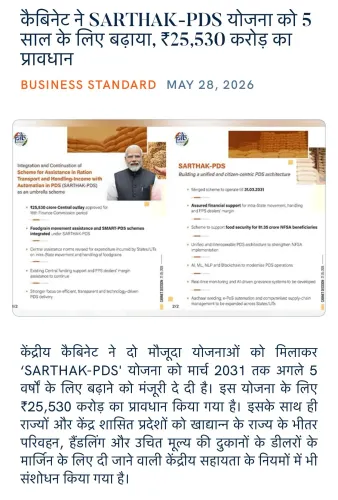
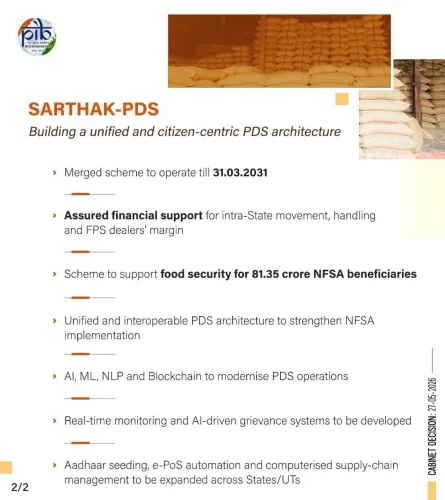
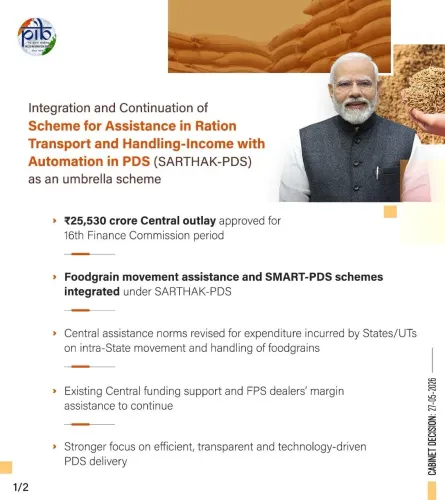
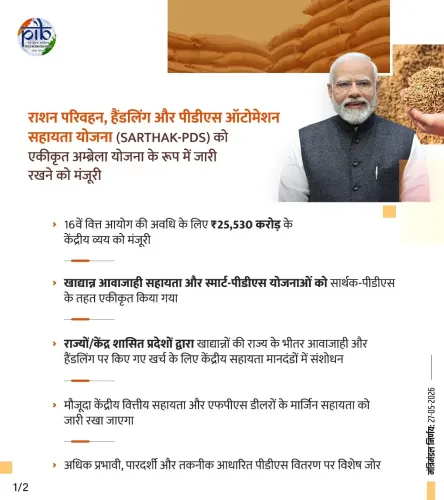
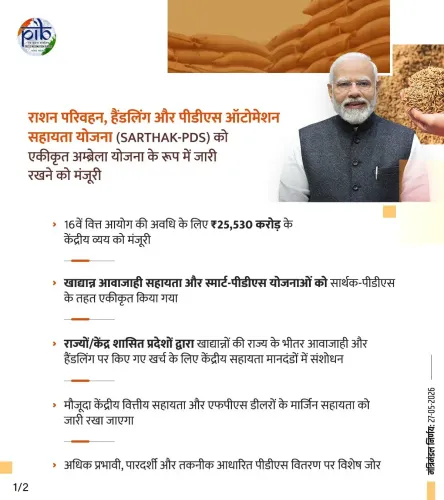
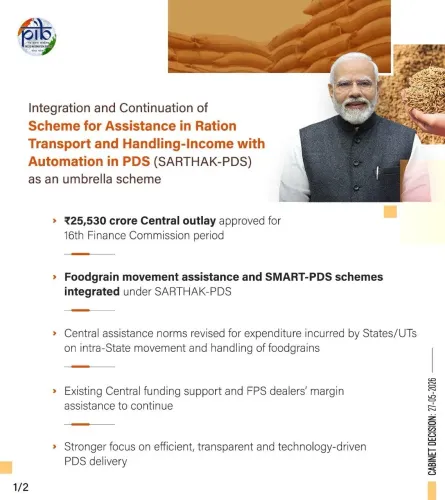
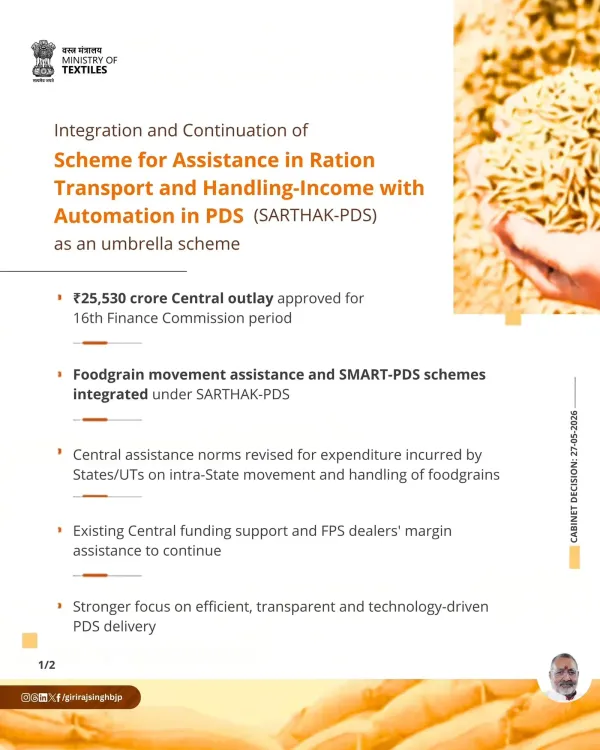
The Union Cabinet has approved the continuation of SARTHAK-PDS with a central share of ₹25,530 crore, Union Minister Giriraj Singh announced on 27 May 2026. The decision aims to strengthen transparency in ration transport and distribution, ensuring uninterrupted and leakage-free delivery of subsidised foodgrains to crores of needy families across India.
Key Takeaways
The Union Cabinet approved the continuation of SARTHAK-PDS with a central share of ₹25,530 crore .
Union Minister Giriraj Singh made the announcement on 27 May 2026 via X.
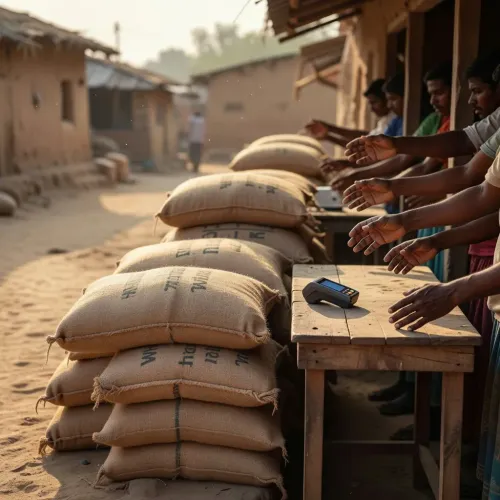
The scheme aims to ensure transparent, uninterrupted ration transport and distribution to crores of needy families.
The decision builds on a decade-long reform lineage including PDS computerisation since 2012–13 and Aadhaar-linked biometric authentication since 2014 .
The National Food Security Act, 2013 provides the legal basis for subsidised foodgrain entitlements covering up to 75% of rural and 50% of urban population.
State civil supplies departments will be the primary implementing agencies for the renewed scheme.
Union Textiles Minister Giriraj Singh announced on Wednesday, 27 May 2026 that the Union Cabinet has approved the continuation of the SARTHAK-PDS scheme with a central share of ₹25,530 crore, marking a significant commitment to strengthening the country's subsidised food distribution network. The minister said the decision would ensure that millions of needy families receive their entitled rations without interruption and with full integrity.
Context
Posting on X, Giriraj Singh wrote: 'केंद्रीय कैबिनेट ने ₹25,530 करोड़ के केंद्रीय अंश के साथ SARTHAK-PDS को जारी रखने की मंजूरी दे दी है' — 'The Union Cabinet has approved the continuation of SARTHAK-PDS with a central share of ₹25,530 crore.' He added that this decision would keep the successful chain of transparency in ration transport and distribution going, ensuring that the rights of crores of needy families reach them directly, without any obstruction and with complete purity.
The announcement carries the hashtags #PDSReforms, #GaribKalyan, #TransformingIndia, and #GoodGovernance, signalling the government's framing of the move as part of its broader welfare and good-governance agenda.
Policy Backdrop
India's Public Distribution System (PDS) is the world's largest food security programme, distributing subsidised wheat, rice, and coarse grains to eligible households through a network of fair price shops. The legal foundation rests on the National Food Security Act, 2013, which entitles up to 75 per cent of the rural population and 50 per cent of the urban population to subsidised foodgrains as a statutory right.
End-to-end computerisation of the PDS was launched in 2012–13 to digitise ration cards, supply chains, and fair price shop operations. Aadhaar linkage with PDS beneficiary records began in 2014, enabling biometric authentication at the point of delivery and substantially reducing the estimated 30–40 per cent diversion of grains that had long plagued the system. The SARTHAK-PDS scheme, as described by the minister, builds on this technology-led reform lineage by embedding transparency and real-time monitoring deeper into the distribution chain.
Stakeholders and Impact
The primary beneficiaries of the Cabinet decision are the crores of ration card holders — predominantly low-income and below-poverty-line households — who depend on the PDS for a significant share of their monthly food requirement. State civil supplies departments, which manage the last-mile delivery infrastructure, will be the key implementing agencies.
The ₹25,530 crore central outlay signals sustained fiscal support for the programme, providing states with the financial assurance needed to plan procurement, logistics, and fair price shop operations over the scheme's continuation period. Improved transparency mechanisms are expected to further reduce leakages and ensure that subsidised grain reaches intended beneficiaries rather than being diverted to the open market.
What's Next
Attention will now shift to state-wise rollout progress reports, which will indicate how quickly the renewed central funding translates into on-ground improvements in ration delivery. Analysts and welfare advocates will also watch food subsidy allocations in the next Union Budget for signals on whether the government plans to scale up or modify the programme's scope. The broader pattern of technology-driven PDS reform — linking Aadhaar authentication, real-time monitoring, and direct transfers — suggests that SARTHAK-PDS will continue to serve as a template for welfare delivery modernisation across multiple schemes.
Point of View
530 crore central share is consistent with the BJP government's sustained emphasis on technology-enabled welfare delivery as a political and governance priority. By framing the decision under #GaribKalyan and #GoodGovernance, the government is reinforcing a narrative of efficient, leakage-free welfare that contrasts with pre-2014 PDS inefficiencies. The move also reflects a pattern of renewing flagship welfare programmes ahead of budget cycles to demonstrate fiscal commitment to the poor. Whether the scheme delivers measurable improvements in last-mile delivery will ultimately depend on state-level implementation capacity and the pace of Aadhaar-linked authentication rollout.
NationPress
15 Oct 2026
Frequently Asked Questions
What is SARTHAK-PDS?
SARTHAK-PDS is a scheme approved by the Union Cabinet aimed at strengthening transparency and efficiency in ration transport and distribution under India's Public Distribution System, with a central outlay of ₹25,530 crore for its continuation.
How much money has the Cabinet approved for SARTHAK-PDS?
The Union Cabinet has approved a central share of ₹25,530 crore for the continuation of SARTHAK-PDS, as announced by Union Minister Giriraj Singh on 27 May 2026.
What is the Public Distribution System (PDS) in India?
The Public Distribution System is India's nationwide programme that distributes subsidised wheat, rice, and coarse grains to eligible households through fair price shops, underpinned by the National Food Security Act, 2013.
How does Aadhaar help in PDS reforms?
Aadhaar integration with PDS enables biometric authentication of beneficiaries at the point of delivery, which has significantly reduced the diversion of subsidised grains estimated at 30–40% before digitisation began in 2014.
Who announced the SARTHAK-PDS Cabinet approval?
Union Textiles Minister Giriraj Singh, a senior BJP leader and Lok Sabha MP from Begusarai, Bihar, announced the Cabinet decision on his official X account on 27 May 2026.