Amit Shah: Cabinet Lauds Modi as Longest-Serving Elected PM
Synopsis
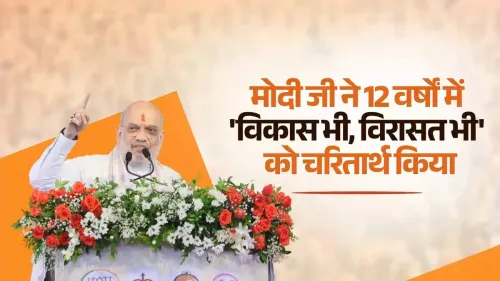
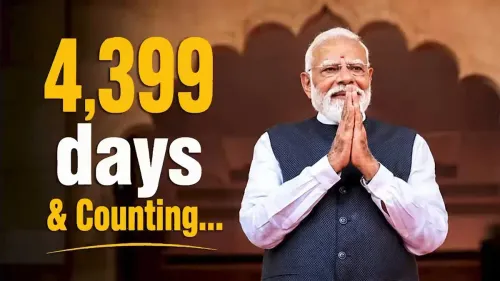
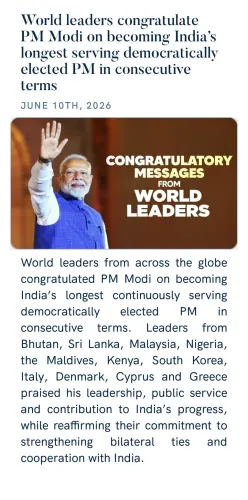
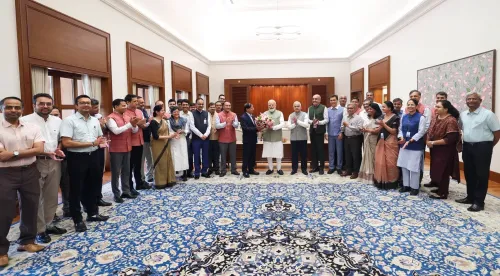
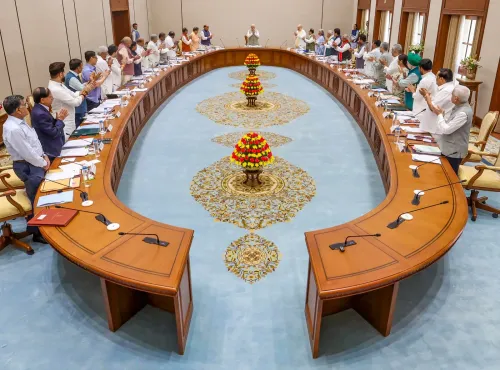
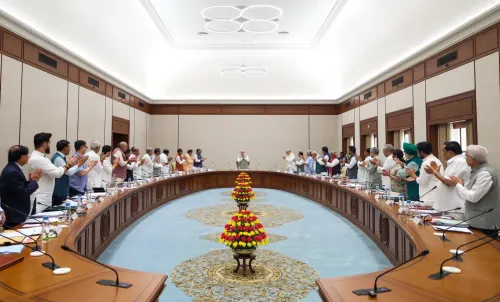
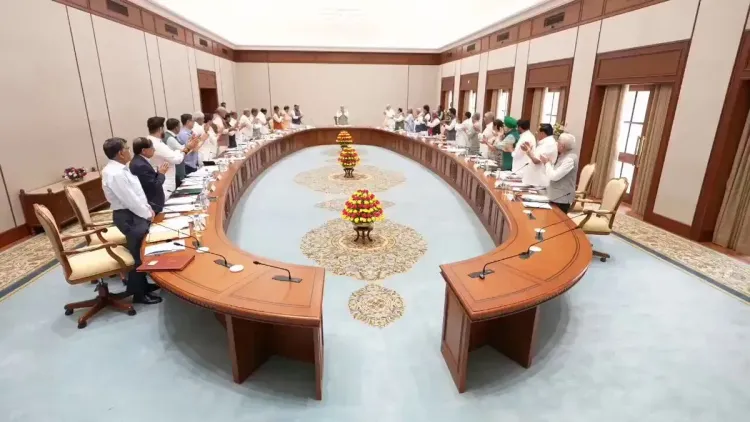
The Union Cabinet on 10 June 2026 passed a formal resolution congratulating Prime Minister Narendra Modi on becoming India's longest-serving elected Prime Minister, with ministers greeting him with a standing ovation. Union Home Minister Amit Shah shared the moment on X.
Key Takeaways
The Union Cabinet passed a formal resolution of congratulation for PM Narendra Modi on 10 June 2026 .
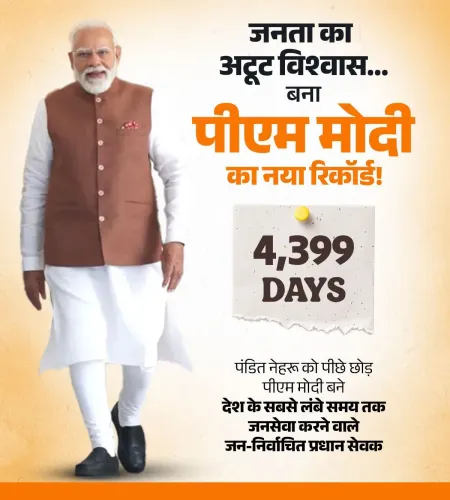
Modi is recognised as India's longest-serving elected Prime Minister , surpassing the tenure benchmark set by Jawaharlal Nehru .
Cabinet members greeted the Prime Minister with a standing ovation to mark the milestone.
Modi has served three consecutive terms beginning 26 May 2014 , 30 May 2019 , and 9 June 2024 .
Union Home Minister Amit Shah announced the cabinet action on X, calling it a 'historic milestone'.
The official resolution text is expected to be released through government channels.
Union Home Minister Amit Shah announced on Wednesday, 10 June 2026 that the Union Cabinet passed a formal resolution of congratulation for Prime Minister Narendra Modi, recognising him as India's longest-serving elected Prime Minister. Cabinet members greeted the Prime Minister with a standing ovation to mark the historic milestone.
Context
Narendra Modi was first sworn in as Prime Minister on 26 May 2014 following the BJP-led NDA's decisive victory in the general election that year. He secured re-election and took oath for a second term on 30 May 2019, and again assumed office for a third consecutive term on 9 June 2024 after the NDA's return to power. The cumulative, unbroken tenure across three successive electoral mandates has now surpassed the record previously associated with India's first Prime Minister.
The milestone places Modi ahead of Jawaharlal Nehru, who served as Prime Minister from 1947 until his death in 1964 and whose continuous tenure as an elected head of government had long stood as the benchmark in post-independence India. The record carries particular significance because it is measured on the basis of elected, democratic mandates rather than appointed or interim service.
Policy Backdrop
Formal cabinet resolutions marking leadership milestones are an established feature of India's parliamentary executive. The Council of Ministers, which takes collective decisions under the Prime Minister's leadership, has historically used such resolutions to place significant anniversaries or records on the official institutional record.
The NDA coalition has governed continuously since May 2014, making this the longest uninterrupted run for any single political formation in recent Indian history. The resolution passed on 10 June 2026 reflects that institutional continuity and the procedural weight the cabinet attaches to the occasion.
Stakeholders and Impact
The immediate stakeholders are the Union Cabinet ministers and the broader BJP leadership, for whom the milestone reinforces the party's electoral narrative of sustained public mandate. The standing ovation within the cabinet room signals a collective, symbolic endorsement that goes beyond routine procedural business.
For the wider political landscape, the recognition carries resonance across Parliament, state governments, and the NDA's coalition partners. Opposition parties are likely to contest the framing of the record, particularly around how 'longest-serving elected Prime Minister' is defined and calculated, keeping the milestone a subject of political debate beyond the cabinet chamber.
What's Next
The official text of the cabinet resolution is expected to be released through government channels, providing the precise language and tenure calculation that underpins the claim. The monsoon session of Parliament is likely to see references to the milestone from the treasury benches, and potentially sharp responses from the opposition. How the government formally documents and communicates the record will shape how it enters India's political and constitutional history.
Point of View
The BJP signals to its base that three consecutive mandates represent a democratic verdict of exceptional scale. The comparison with Nehru is implicitly political, positioning Modi within a founding-era lineage while also transcending it. How the opposition contests the definition and calculation of the record will be as telling as the record itself.
NationPress
26 Oct 2026
Frequently Asked Questions
Why is Narendra Modi called India's longest-serving elected Prime Minister?
Modi has served three consecutive elected terms beginning in May 2014, May 2019, and June 2024, with his cumulative unbroken tenure now exceeding that of Jawaharlal Nehru, who previously held the benchmark for the longest continuous service as Prime Minister in post-independence India.
What did the Union Cabinet do on 10 June 2026?
The Union Cabinet passed a formal resolution of congratulation for Prime Minister Narendra Modi, recognising him as India's longest-serving elected Prime Minister, and members gave him a standing ovation during the cabinet meeting.
Who held the record for longest-serving Prime Minister before Modi?
Jawaharlal Nehru, India's first Prime Minister, who served from 1947 until his death in 1964, had previously been regarded as the longest-serving elected head of government in post-independence India.
Who announced the cabinet resolution on social media?
Union Home Minister Amit Shah posted about the cabinet resolution and the standing ovation on X on 10 June 2026, describing it as a historic milestone.
When did Narendra Modi first become Prime Minister?
Narendra Modi was first sworn in as Prime Minister on 26 May 2014 after the BJP-led NDA won the general election that year.