CM Sawant Backs Cabinet Move to Toughen Exam Anti-Cheat Law
Synopsis
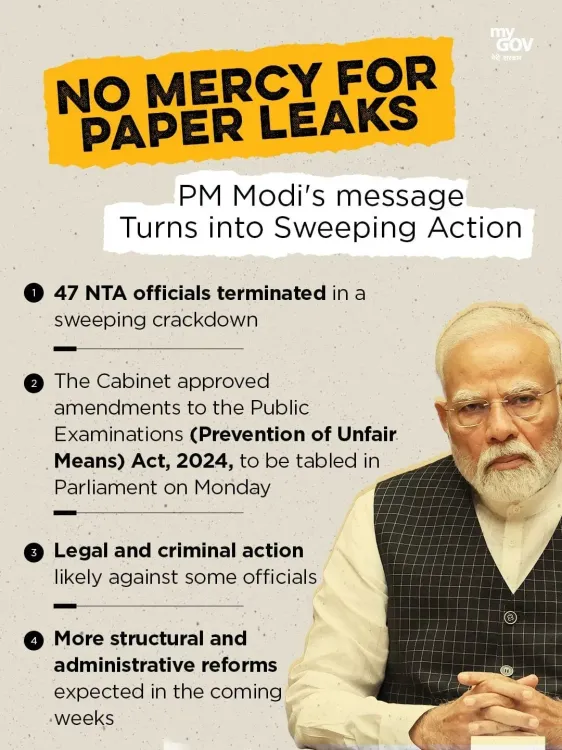
The Union Cabinet, led by PM Narendra Modi, approved amendments to the Public Examinations (Prevention of Unfair Means) Act, 2024, introducing Fast-Track Courts and raising penalties to up to 10 years imprisonment and ₹10 crore in fines. Goa CM Pramod Sawant welcomed the move as a decisive step against paper leaks.
Key Takeaways
The Union Cabinet approved amendments to the Public Examinations (Prevention of Unfair Means) Act, 2024 on or before 25 July 2026 .
Amended provisions introduce Fast-Track Courts to ensure speedy trials in examination malpractice cases.
Maximum imprisonment under the enhanced penalty regime rises to 10 years .
Maximum financial penalty rises to ₹10 crore , sharply raising the cost of organised paper leak operations.
Goa Chief Minister Pramod Sawant publicly endorsed the amendments, signalling state-level alignment with the central framework.
The move continues a central government push since 2022 to restore credibility in competitive examinations through legislative and technological measures.
Goa Chief Minister Pramod Sawant on Saturday, 25 July 2026, welcomed the Union Cabinet's decision to approve amendments to the Public Examinations (Prevention of Unfair Means) Act, 2024, calling the move a strong signal against paper leaks and examination malpractice across India.
Sawant, posting on X, said he welcomed the Cabinet's decision taken 'under the leadership of Hon'ble Prime Minister Shri Narendra Modi' and noted that the proposed amendments provide for Fast-Track Courts for speedy trials, along with significantly enhanced punishments — including imprisonment of up to 10 years and fines of up to ₹10 crore. 'Those who play with the future of our youth will face the strictest consequences,' he stated.
Context
The Public Examinations (Prevention of Unfair Means) Act, 2024 was enacted by Parliament to create a dedicated legal framework targeting paper leaks, impersonation, and other malpractices in national and state-level competitive examinations. The legislation came after a series of high-profile paper leak incidents that shook public confidence in examinations governing access to higher education and government employment.
The latest Cabinet-approved amendments sharpen the Act's teeth by introducing Fast-Track Courts — a mechanism designed to ensure that cases do not languish in an already burdened judicial system — and by raising the ceiling on both custodial and monetary penalties.
Policy Backdrop
The amendments are part of a sustained central government effort since 2022 to restore credibility in competitive examinations. Successive measures have combined legislative tightening with technological interventions such as question paper encryption and mandatory CCTV surveillance at examination centres.
This approach mirrors broader anti-corruption and governance reforms targeting recruitment processes across sectors. The twin levers of deterrence — heavier prison terms and steeper fines — are consistent with the central government's stated philosophy of making white-collar examination fraud economically and socially ruinous for perpetrators.
Stakeholders and Impact
The primary beneficiaries of the amendments are students and job aspirants who compete in examinations conducted by bodies such as the Union Public Service Commission (UPSC) and the National Testing Agency (NTA). For millions of candidates, a single compromised paper can erase years of preparation and delay career timelines by a year or more.
Examination boards and state recruitment commissions will also feel the impact, as the Fast-Track Court mechanism places institutional accountability in sharper relief. Organised syndicates that have historically profited from paper leaks now face a qualitatively different legal risk profile under the enhanced penalty regime.
What's Next
Attention will now turn to state-level implementation — specifically, whether states will designate and resource Fast-Track Courts in time to handle cases arising from examinations scheduled in the second half of 2026. The first prosecutions under the enhanced penalty provisions will be closely watched as a test of the law's deterrent effect.
As a BJP chief minister whose state runs its own recruitment and educational examinations, CM Sawant's endorsement signals that Goa is likely to align its administrative machinery with the amended central framework, potentially making it an early mover in adopting the new trial mechanism at the state level.
Point of View
Syndicate-driven nature of modern paper leaks. By pairing Fast-Track Courts with dramatically higher penalties, the government is addressing two persistent failures: weak deterrence and slow justice. CM Sawant's swift endorsement is politically significant — it demonstrates that BJP-governed states are being mobilised as implementation partners, not just passive recipients of central legislation. The real test, however, will be whether prosecutorial infrastructure and judicial capacity can keep pace with the law's ambitions.
NationPress
23 Oct 2026
Frequently Asked Questions
What are the new punishments under the amended Public Examinations Act 2024?
The amended Act provides for imprisonment of up to 10 years and fines of up to ₹10 crore for those found guilty of examination malpractice, along with Fast-Track Courts for speedy trials.
What is the Public Examinations (Prevention of Unfair Means) Act, 2024?
It is a central law enacted by Parliament to create a dedicated legal framework against paper leaks, impersonation, and other unfair practices in national and state-level public examinations.
Why did Goa CM Pramod Sawant welcome the Cabinet's decision on exam law?
CM Pramod Sawant welcomed the amendments as a strong measure to protect the future of students and job aspirants by ensuring strict consequences for those who engage in examination malpractice.
What are Fast-Track Courts and how do they relate to exam paper leaks?
Fast-Track Courts are dedicated judicial forums designed to dispose of cases more quickly than regular courts. Under the amended Act, they will handle examination malpractice cases to prevent prolonged trials.
Which examination bodies will be affected by the amended Public Examinations Act?
National bodies such as UPSC and NTA , as well as state recruitment commissions, fall within the scope of the Act, meaning candidates and institutions across a wide range of competitive examinations are covered.