Centre funds underwater excavations at Dwarka, Mahabalipuram, Poompuhar
Synopsis
India's submerged past is being systematically unearthed — from a 3,500-year-old protection wall at Bet Dwarka that hints at Roman trade links, to the partly sunken Chola capital of Poompuhar. With Centre funding, ASI active at four sites, and Maharashtra's coastal forts queued for 2030, this is the most coordinated underwater archaeology push India has seen.
Key Takeaways
The Centre has sanctioned funds for underwater excavations at Dwarka , Bet Dwarka (Gujarat), Mahabalipuram (Tamil Nadu), and Karaikal (Puducherry).
Previous digs at Bet Dwarka uncovered a 580-metre protection wall dated to 1,500 BCE , a Late Harappan seal , and evidence of Roman trade links .
Underwater exploration at Vijay Durga and Janjira in Maharashtra is planned by 2030 .
The Tamil Nadu State Department of Archaeology has been licensed to excavate Poompuhar and has earmarked ₹7 crore for the work.
The National Institute of Oceanography has a budgetary allocation of ₹20 lakh for research at Gujarat sites.
The ASI's Underwater Archaeology Wing has launched a dedicated training programme for underwater survey specialists.
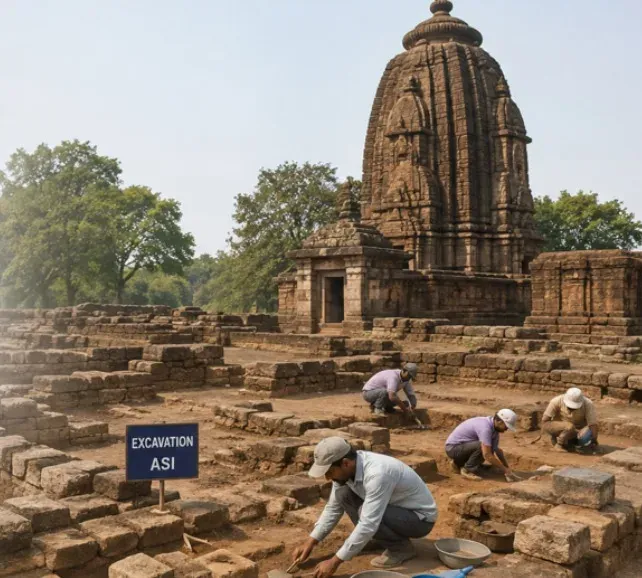
The Centre has sanctioned funds for underwater research and excavation at several of India's most historically significant submerged sites, including Dwarka and Bet Dwarka in Gujarat, Mahabalipuram in Tamil Nadu, and Karaikal in Puducherry, the government informed Parliament. The Underwater Archaeology Wing of the Archaeological Survey of India (ASI) is currently conducting active exploration at all four locations.
Sites Under Active Exploration
Excavations at Bet Dwarka have already yielded significant finds: remains of earthen pots and artefacts from the Late Harappan period, and a 580-metre-long protection wall dated to approximately 1,500 BCE, believed to have been submerged following a sea storm. A Late Harappan seal and associated items were also recovered. Notably, shipwrecks and stone anchors unearthed at the site point to ancient trade relations with the Romans — a finding that broadens the known reach of India's early maritime commerce.
Underwater excavation and exploration at Vijay Durga and Janjira in Maharashtra is additionally planned and is expected to be undertaken by 2030.
Poompuhar: The Submerged Chola Capital
The government has separately granted a licence for underwater excavation at Poompuhar in Tamil Nadu to the Tamil Nadu State Department of Archaeology. Poompuhar, the ancient Sangam-era capital and port city of the early Chola dynasty, is believed to lie partly submerged as a result of tsunamis that may have struck hundreds of years ago. The Tamil Nadu department has earmarked ₹7 crore for both land-based and underwater archaeological excavations.
Research Institutions and Budget Allocations
The Marine Archaeology Centre of the National Institute of Oceanography (NIO) will continue its research at Bet Dwarka, Chhari, and Gangata Bet in Gujarat, with a budgetary allocation of ₹20 lakh. The NIO's sustained presence at these sites signals a long-term institutional commitment to maritime heritage documentation.
This comes amid a broader push by the Centre to systematically map India's submerged cultural landscape — a field that has historically received far less attention than land-based archaeology despite the country's extensive coastline and ancient maritime traditions.
Capacity Building and Training
The Underwater Archaeology Wing of the ASI has also launched a focused programme to train archaeologists in underwater survey techniques and to conduct systematic assessments of submerged sites across the country. The initiative is expected to expand the pool of specialists capable of working in India's coastal and riverine archaeological zones.
With multiple sites now under simultaneous study, researchers expect fresh discoveries that could reshape the understanding of India's ancient trade networks, urban planning, and maritime history in the years ahead.
Point of View
And the Centre's funding push is overdue. Yet the budget figures — ₹20 lakh for NIO and ₹7 crore for Tamil Nadu — are modest against the scale of sites involved. The more consequential question is whether the ASI's training programme can build a sustainable cadre of underwater archaeologists, since equipment and funding alone cannot substitute for specialist expertise. The Roman trade evidence at Bet Dwarka, if corroborated by further excavation, would materially alter mainstream narratives about India's ancient global commercial reach — a story that deserves more than incremental allocation cycles.
NationPress
14 Sept 2026
Frequently Asked Questions
Which sites are currently under underwater excavation by the ASI?
The Underwater Archaeology Wing of the ASI is currently conducting active exploration at Dwarka and Bet Dwarka in Gujarat, Mahabalipuram in Tamil Nadu, and Karaikal in Puducherry, following Centre funding approval informed to Parliament.
What has been found at Bet Dwarka so far?
Excavations at Bet Dwarka have uncovered earthen pots and artefacts from the Late Harappan period, a 580-metre-long protection wall dated to around 1,500 BCE, a Late Harappan seal, and shipwrecks with stone anchors suggesting ancient trade links with the Romans.
What is the significance of Poompuhar and why is it being excavated?
Poompuhar was the Sangam-era capital and port city of the early Chola dynasty, now partly submerged due to tsunamis believed to have occurred centuries ago. The Tamil Nadu State Department of Archaeology has received a government licence to excavate the site and has allocated ₹7 crore for the work.
When will excavations at Maharashtra's coastal sites begin?
Underwater excavation and exploration at Vijay Durga and Janjira in Maharashtra is planned to be undertaken by 2030, according to the government's statement to Parliament.
How much funding has been allocated for underwater archaeology research?
The National Institute of Oceanography has a budgetary allocation of ₹20 lakh for research at Bet Dwarka, Chhari, and Gangata Bet in Gujarat. The Tamil Nadu State Department of Archaeology has separately earmarked ₹7 crore for land and underwater excavations, including at Poompuhar.