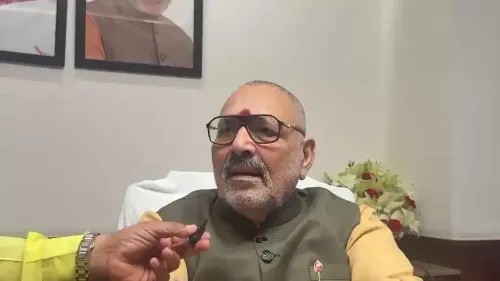
Giriraj Singh flags ₹25,000 cr cyber fraud blocked, e-Zero FIR expanded
Synopsis
Union Textiles Minister Giriraj Singh on Sunday cited government data showing ₹25,000 crore in cyber fraud prevented and ₹323 crore returned to victims, while the Centre expands the e-Zero FIR mechanism — a key tool enabling jurisdiction-free electronic registration of cyber crime complaints.
Key Takeaways
Cyber fraud worth ₹25,000 crore has been prevented under central government initiatives, according to data shared by Minister Giriraj Singh . ₹323 crore has been returned to cyber crime victims, reflecting a victim-centric recovery approach.
The Centre has expanded the scope of e-Zero FIR , enabling electronic FIR registration for cyber crimes without jurisdictional constraints.
The Indian Cyber Crime Coordination Centre (I4C) , operational since 2020 , serves as the nodal body coordinating response across states, banks, and digital intermediaries.
The National Cyber Crime Reporting Portal , launched in August 2019 , underpins the citizen-facing complaint infrastructure.
These measures are part of a broader technology-enabled policing push under the Digital India framework.
Union Textiles Minister Giriraj Singh on Sunday, 13 July 2026, shared data highlighting that cyber fraud worth ₹25,000 crore has been prevented and ₹323 crore returned to victims, while the Centre has expanded the scope of the e-Zero FIR mechanism for cyber crimes. The senior BJP leader and Lok Sabha MP from Begusarai, Bihar, shared the development via the NaMo App.
Context
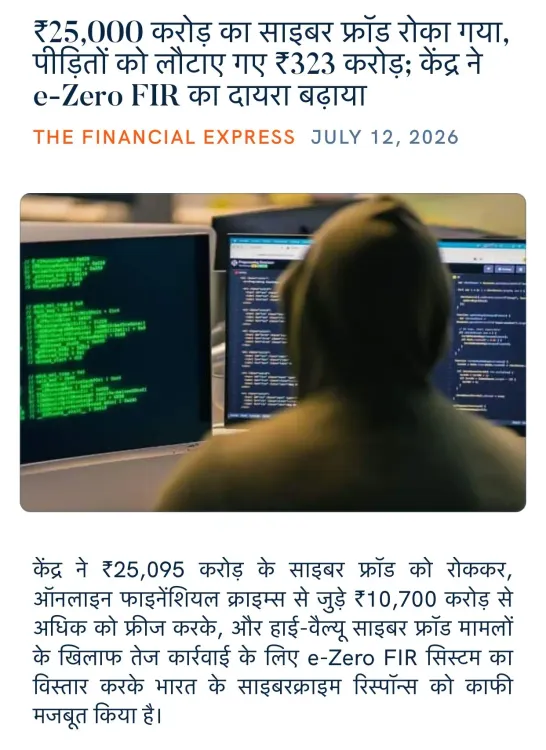
The post, shared in Hindi, reads: '₹25,000 करोड़ का साइबर फ्रॉड रोका गया, पीड़ितों को लौटाए गए ₹323 करोड़; केंद्र ने e-Zero FIR का दायरा बढ़ाया' — translating to: 'Cyber fraud worth ₹25,000 crore prevented, ₹323 crore returned to victims; Centre expands scope of e-Zero FIR.' The figures and the expansion of e-Zero FIR are attributed to central government action on cyber crime mitigation.
The e-Zero FIR initiative, operated under the Ministry of Home Affairs (MHA), enables immediate electronic registration of First Information Reports for cyber crimes regardless of the jurisdiction in which the offence occurred. This removes a long-standing barrier that required victims to approach the police station with territorial jurisdiction over the crime — a near-impossible task in borderless digital fraud.
Policy Backdrop
India's institutional response to cyber crime has been built in layers over the past several years. The National Cyber Crime Reporting Portal was launched in August 2019 to allow citizens to file complaints online. The Indian Cyber Crime Coordination Centre (I4C) was operationalised in 2020 as the apex nodal body to coordinate investigations across state police forces, banks, and digital intermediaries.
The Zero FIR concept for cyber crimes was introduced in 2020–21 specifically to dismantle jurisdictional barriers. Its electronic avatar, e-Zero FIR, builds on this by integrating the complaint process with digital infrastructure, allowing faster freezing of fraudulent accounts and swifter victim relief. The expansion of its scope, as cited in the post, signals a deepening of this architecture.
These measures sit within the broader Digital India framework, where rapid growth in digital payments and internet penetration has been accompanied by a parallel rise in reported cyber fraud cases. The government's response has increasingly focused on real-time inter-agency coordination and technology-enabled policing.
Stakeholders and Impact
The primary beneficiaries of these measures are cyber crime victims — individuals who have lost money to online fraud, phishing, investment scams, and digital payment deception. The figure of ₹323 crore returned to victims represents a victim-centric shift in law enforcement, where recovery, not just prosecution, is a measurable outcome.
Digital payment users — a constituency that now spans hundreds of millions of Indians — stand to gain from a more robust deterrence and response framework. Banks and payment intermediaries are also key nodes in this ecosystem, as account freezing and fund recovery depend on rapid coordination between police and financial institutions, a function I4C is designed to facilitate.
What's Next
The expansion of e-Zero FIR's scope raises the question of integration depth — specifically, how seamlessly state police portals connect with the national cyber coordination infrastructure. MHA annual reports on cyber crime statistics will be a key measure of whether these figures scale further. Greater integration could also reduce the average time between a complaint and an account freeze, which is currently the critical window in which fraud proceeds are moved or laundered.
As India's digital economy continues to expand, the institutional architecture around cyber crime — from portal-based reporting to electronic FIRs and inter-bank coordination — will face increasing stress-testing. The numbers cited by Minister Giriraj Singh suggest the framework is yielding results, but the scale of digital fraud in India means the challenge will only grow alongside the opportunity.
Point of View
000 crore prevention figure, if substantiated, would represent one of the most significant quantified outcomes of India's cyber crime architecture, lending credibility to years of institutional investment in I4C and the National Cyber Crime Reporting Portal. The expansion of e-Zero FIR is also a meaningful procedural reform, as jurisdictional confusion has historically been the single biggest barrier to timely victim relief in digital fraud cases. Taken together, the data points reflect a government narrative that is shifting from infrastructure-building to outcome-reporting — a more politically potent frame as digital fraud anxiety grows among India's expanding internet user base.
NationPress
11 Oct 2026
Frequently Asked Questions
What is e-Zero FIR for cyber crimes in India?
e-Zero FIR is an initiative under the Ministry of Home Affairs that allows victims to electronically register a First Information Report for cyber crimes at any police station, regardless of where the crime occurred, removing jurisdictional barriers that previously delayed action.
How much cyber fraud has been prevented in India?
According to data shared by Union Minister Giriraj Singh on 13 July 2026, cyber fraud worth ₹25,000 crore has been prevented through central government mechanisms, though this figure is sourced from a report cited in his post.
How much money has been returned to cyber fraud victims in India?
₹323 crore has been returned to cyber crime victims, according to the data cited by Minister Giriraj Singh, reflecting the government's victim-centric recovery efforts through inter-agency coordination.
What is the Indian Cyber Crime Coordination Centre (I4C)?
I4C is the apex nodal agency established in 2020 under the Ministry of Home Affairs to coordinate cyber crime investigations across state police forces, banks, and digital intermediaries, enabling faster response and fund recovery.
How can I report a cyber crime in India?
Citizens can report cyber crimes through the National Cyber Crime Reporting Portal, launched in August 2019, or by filing an e-Zero FIR at any police station, which will be transferred to the appropriate jurisdiction.