Kishan Reddy: Centre ensures fertiliser supply for Telangana Kharif 2026
Synopsis
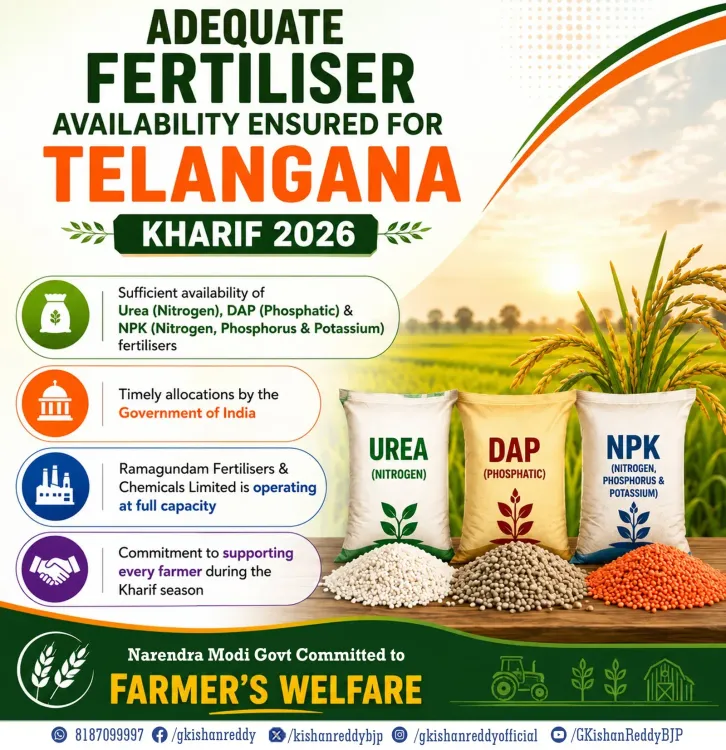
Union Minister G. Kishan Reddy announced on June 26, 2026 that the Centre has secured adequate Urea, DAP and NPK fertiliser supplies for Telangana's Kharif 2026 season through timely allocations, domestic production and strategic imports, with Ramagundam Fertilisers operating at full capacity.
Key Takeaways
The Centre has assured adequate availability of Urea, DAP and NPK fertilisers for Telangana farmers for the Kharif 2026 season.
Ramagundam Fertilisers and Chemicals Limited (RFCL) in Telangana is operating at full capacity , stabilising regional supply.
The Centre's strategy includes timely allocations, higher domestic urea production, strategic imports and continuous monitoring.
Kishan Reddy credited the supply measures to the leadership of Prime Minister Narendra Modi .
The minister placed responsibility for last-mile distribution squarely on the Telangana state government .
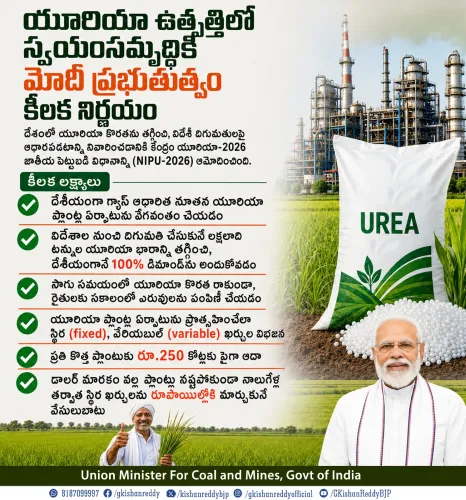
The supply push aligns with the New Urea Policy of 2015 , which aimed to expand domestic fertiliser production and cut import dependence.
Union Coal and Mines Minister G. Kishan Reddy on Friday, June 26, 2026, stated that the Central government has ensured adequate availability of Urea, DAP (Di-Ammonium Phosphate), and NPK (Nitrogen, Phosphorus and Potassium) fertilisers for farmers across Telangana ahead of the Kharif 2026 cropping season. The minister, who also serves as BJP Telangana state president, credited the measures to the leadership of Prime Minister Narendra Modi.
Context
Reddy's post asserts that the Centre has deployed a multi-pronged approach — 'timely allocations, higher domestic urea production, strategic imports and continuous monitoring' — to guarantee uninterrupted fertiliser access for Telangana's farming community. The statement comes as the southwest monsoon advances and farmers prepare land for the primary Kharif sowing window, when demand for soil nutrients peaks sharply.
Critically, the minister highlighted that Ramagundam Fertilisers and Chemicals Limited (RFCL), a urea production unit located in Telangana, is 'operating at full capacity,' contributing to supply stability in the state.
Policy Backdrop
The Central government's emphasis on domestic urea production traces back to the New Urea Policy of 2015, which revised pricing and investment frameworks with the explicit goal of expanding indigenous capacity and reducing dependence on imports. RFCL — a joint venture backed by Central support — is among the units that emerged from that policy push, making its full-capacity operation a direct outcome of that long-term investment.
Fertiliser subsidies remain one of the largest line items in India's Union Budget, and pre-season supply assurances to states are a recurring feature of Centre-state agricultural coordination. Global fertiliser price volatility — driven by energy costs and geopolitical supply disruptions — has made strategic import planning an increasingly significant component of the Centre's annual preparedness exercise.
Stakeholders and Impact
Telangana is a major producer of paddy, cotton, and pulses — all Kharif crops that are heavily dependent on timely fertiliser application, particularly nitrogen-rich urea and phosphatic fertilisers like DAP. Any shortfall during the sowing window can directly reduce yields and farm incomes, making pre-season supply assurances politically and economically consequential for the state's roughly 60 lakh farming households.
Reddy's post notably places responsibility for 'effective last-mile distribution' on the Telangana state government, drawing a clear federal line: the Centre handles allocation and supply, while the state must ensure fertilisers 'reach every genuine farmer on time.' This framing implicitly signals that any distribution failures at the ground level would be attributed to the Congress-led state administration.
What's Next
Attention will now shift to whether the Telangana state government activates its distribution network efficiently through licensed dealers and cooperative societies before peak sowing demand arrives. Parliamentary questions on Kharif fertiliser supply status are expected during the upcoming monsoon session of Parliament. Reports from district-level agriculture offices on actual stock positions and retailer availability will be the key metrics to watch in the weeks ahead.
Point of View
But it carries substantive policy weight given RFCL's operational status and the Centre's sustained investment in domestic urea capacity since 2015. By explicitly calling out the state government's responsibility for last-mile delivery, Reddy is laying political groundwork: if supply reaches godowns but not fields, the Congress-led Telangana government absorbs the blame. The framing reflects a broader BJP pattern of using federal agricultural coordination as a platform to contrast Central delivery with state-level governance, particularly in opposition-ruled states.
NationPress
25 Sept 2026
Frequently Asked Questions
Is there enough fertiliser for Telangana farmers in Kharif 2026?
The Central government has stated that adequate quantities of Urea, DAP and NPK fertilisers have been allocated for Telangana's Kharif 2026 season through timely planning, domestic production and strategic imports.
What is Ramagundam Fertilisers and Chemicals Limited?
Ramagundam Fertilisers and Chemicals Limited (RFCL) is a urea manufacturing plant located in Telangana, backed by Central government support. It is currently reported to be operating at full capacity, contributing to fertiliser supply stability in the state.
What fertilisers are covered under the Centre's Kharif 2026 allocation for Telangana?
The Central government's allocation covers three key fertilisers: Urea (a nitrogen fertiliser), DAP (Di-Ammonium Phosphate), and NPK (Nitrogen, Phosphorus and Potassium) compounds — all critical for Kharif crops like paddy and cotton.
Who is responsible for fertiliser distribution in Telangana?
While the Central government handles national allocation and supply, Union Minister G. Kishan Reddy has stated that effective last-mile distribution to individual farmers is the responsibility of the Telangana state government.
What is the New Urea Policy of 2015?
The New Urea Policy of 2015 was a Central government initiative that revised pricing and investment norms for urea production to boost domestic manufacturing capacity and reduce India's dependence on fertiliser imports.