Aarogya Setu 2.0 launch on June 29: India's biggest digital health push yet

Synopsis
Aarogya Setu is no longer just a pandemic relic — it is being relaunched on 29 June as India's central digital health identity, bundling AI health insights, PM-JAY wallet access, real-time blood bank data, and a WhatsApp chatbot for last-mile delivery. This is the most ambitious single-day rollout of India's national health stack.
Key Takeaways
Union Health Minister JP Nadda will launch Aarogya Setu 2.0 and multiple digital health initiatives on 29 June in New Delhi .
Aarogya Setu 2.0 evolves into a comprehensive Personal Health Record (PHR) platform with AI-powered insights , wearable integration, and ABHA management.
Ayushman Sarathi , a WhatsApp chatbot , will extend PM-JAY services to last-mile beneficiaries through a conversational interface.
The National Health Claims Exchange (NHCX) will standardise health claims processing across public and private insurers.
A Drug Registry and Common LOINC Codes for India (CLCI) will be launched to enforce data standards and interoperability across the healthcare ecosystem.
Union Health Minister JP Nadda is set to launch Aarogya Setu 2.0 and a suite of digital health initiatives on 29 June in New Delhi, marking a significant step in India's push toward a connected, interoperable healthcare ecosystem. The revamped application transforms the pandemic-era contact-tracing tool into a comprehensive Personal Health Record (PHR) platform for citizens.
What Aarogya Setu 2.0 Offers
Building on the trust established during the COVID-19 pandemic, the upgraded application consolidates a wide range of digital health services under a single platform. Citizens can create and manage their ABHA (Ayushman Bharat Health Account), access and share digital health records, and use consent-based health information exchange.
The app also integrates AI-powered health insights, smart health reports, and wearable device connectivity. Practical features include OPD registration via Scan & Register, hospital payments through Scan & Pay, medication reminders, and family health management. Users can discover nearby healthcare facilities, doctors, ambulance services, blood banks with real-time blood unit availability, and Jan Aushadhi Kendras, according to the Ministry of Health.
Access to PM-JAY (Pradhan Mantri Jan Arogya Yojana) services — including empanelled hospital search, the AB PM-JAY wallet, and Ayushman CAPF policy details — is also built into the platform.
Key Initiatives Being Launched
Alongside Aarogya Setu 2.0, the launch event will introduce several other digital health infrastructure components. The enhanced Ayushman App will serve as a dedicated one-stop platform for AB PM-JAY beneficiaries, while Ayushman Sarathi — a WhatsApp chatbot — will deliver scheme-related services through a simple conversational interface, specifically aimed at improving last-mile accessibility.
The National Health Claims Exchange (NHCX), a digital public infrastructure for health claims processing, will standardise the exchange of claims data between providers and payers across both public and private insurance programmes, reducing administrative burden and enabling faster settlements.
Standards and Interoperability Frameworks
The government will also launch a Drug Registry to standardise medicine-related information across the healthcare ecosystem. In a notable step toward global alignment, the Common LOINC Codes for India (CLCI) — a nationally curated subset of international laboratory standards tailored for Indian healthcare, developed by NRCeS — will be released to underpin interoperability across diagnostic systems.
Who Will Be at the Launch
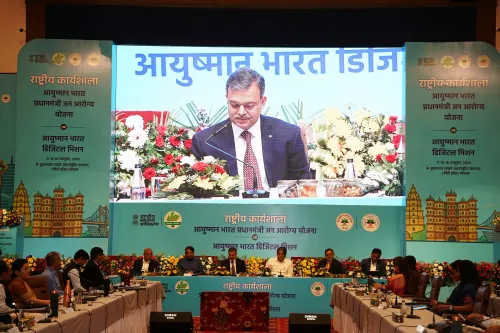
The 29 June event in the national capital will bring together state representatives, senior government officials, healthcare leaders, technology partners, and industry stakeholders from across the healthcare ecosystem. The gathering signals the Centre's intent to align federal and state digital health infrastructure under a unified framework.
With these launches, India moves closer to a fully interoperable national health stack — the next milestone will be adoption at scale across states and private providers.
Point of View
But the history of India's digital health stack — from e-Sanjeevani to ABHA rollout — is littered with strong launches and weak adoption curves. The real test is not the feature list announced on 29 June, but whether state governments integrate NHCX into their claims workflows and whether private hospitals plug into the interoperability framework. The CLCI and Drug Registry are unglamorous but genuinely foundational — if enforced, they could solve the fragmentation that has stalled health data exchange for years. Watch adoption numbers at the six-month mark, not the launch-day downloads.
NationPress
27 Jun 2026
Frequently Asked Questions
What is Aarogya Setu 2.0 and how is it different from the original?
Aarogya Setu 2.0 is a revamped Personal Health Record (PHR) platform that goes far beyond the original app's COVID-19 contact-tracing function. It now offers ABHA account management, AI-powered health insights, wearable device integration, PM-JAY wallet access, and real-time discovery of blood banks and Jan Aushadhi Kendras — all within a single application.
When and where will Aarogya Setu 2.0 be launched?
Union Health Minister JP Nadda is scheduled to launch Aarogya Setu 2.0 and the accompanying digital health initiatives on 29 June in New Delhi. The event will include state representatives, healthcare leaders, and technology and industry stakeholders.
What is Ayushman Sarathi?
Ayushman Sarathi is a WhatsApp chatbot designed to deliver PM-JAY (Pradhan Mantri Jan Arogya Yojana) services through a simple conversational interface. It is aimed at improving accessibility for scheme beneficiaries, particularly those in areas with limited digital literacy or smartphone access.
What is the National Health Claims Exchange (NHCX)?
The NHCX is a digital public infrastructure that standardises the exchange of health claims information between healthcare providers and insurers — across both public and private programmes. It is intended to reduce administrative delays and enable faster, more efficient claims settlements.
What are Common LOINC Codes for India (CLCI)?
CLCI is a nationally curated subset of international laboratory data standards, tailored for Indian healthcare needs and developed by NRCeS. It is designed to ensure that diagnostic data can be shared and understood consistently across different healthcare systems and providers in India.