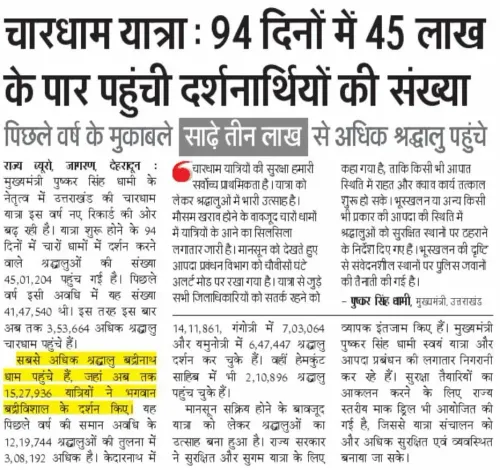
Uttarakhand CM Office: Char Dham crosses 47 lakh pilgrims in 114 days

Synopsis
The Chief Minister's Office of Uttarakhand announced on 12 August 2026 that the Char Dham Yatra has surpassed 47 lakh pilgrims in 114 days, putting the 2026 season on course for a new all-time record as the circuit's improved infrastructure draws growing crowds.
Key Takeaways
The Char Dham Yatra 2026 crossed 47 lakh pilgrims in 114 days , as announced by the Uttarakhand CMO on 12 August 2026 .
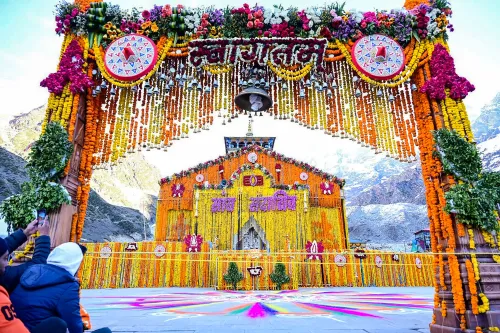
The circuit covers four Himalayan shrines: Yamunotri, Gangotri, Kedarnath and Badrinath .
The Char Dham all-weather road project , approved in 2016 , has progressively improved access to all four shrines.
Uttarakhand's economy depends heavily on religious tourism, making pilgrim footfall a key economic indicator for the state.
The yatra season has roughly two months remaining, leaving scope for the final tally to set a new seasonal record.
Forty-seven lakh pilgrims. 114 days. The Char Dham Yatra 2026 is racing toward a record season, and the Chief Minister's Office of Uttarakhand made that momentum official on Wednesday, 12 August 2026 — declaring the annual pilgrimage circuit on course for a new all-time high.
The post, shared in Hindi, announced: 'नए कीर्तिमान की ओर अग्रसर उत्तराखण्ड चारधाम यात्रा: 114 दिनों में दर्शनार्थियों की संख्या 47 लाख पार' — ('Uttarakhand Char Dham Yatra marching toward a new record: pilgrim count crosses 47 lakh in 114 days.')
Four shrines, one surging season
The Char Dham circuit links four high-altitude shrines — Yamunotri, Gangotri, Kedarnath and Badrinath — strung across the Garhwal Himalayas of Uttarakhand. The yatra typically opens in April or May, aligned with auspicious Hindu calendar dates, and closes before the onset of winter snowfall, usually in October or November. Pilgrims travel the circuit for spiritual merit, and for many it is a once-in-a-lifetime journey.
Averaging roughly 4.1 lakh pilgrims per fortnight at the current pace, the 2026 season is outpacing non-disaster years that preceded it. Uttarakhand's state government has repeatedly pointed to rising footfall as a marker of improved tourism management — a narrative the CMO's announcement reinforces directly.
Infrastructure push behind the numbers
The surge does not happen in a vacuum. The Char Dham all-weather road project, approved in 2016, has been progressively upgrading connectivity to all four shrines — widening mountain roads, cutting travel times and reducing the risk of weather-related blockades that historically stranded pilgrims. Alongside road access, authorities have expanded helicopter services, medical posts and crowd-regulation checkpoints along the routes to manage the growing volume safely.
For Uttarakhand, a Himalayan state whose economy is deeply intertwined with religious tourism, each pilgrim represents direct spending on lodging, transport, local eateries and temple offerings. A record season translates into a measurable economic lift for communities from Rishikesh and Haridwar at the plains to the high-altitude dhams themselves.
What the end-of-season tally could mean
The yatra still has roughly two months left before the shrines close for winter. If the current pace holds, the final tally could comfortably exceed previous seasonal records. State authorities are expected to announce new crowd-management measures and road-project milestones as the season closes — the real test of whether infrastructure investment is keeping pace with demand.
Forty-seven lakh in, and the Himalayas are still open for business.
Point of View
Record footfall also creates pressure on the state to demonstrate that crowd-management and safety systems are scaling at the same rate as demand. For Uttarakhand, where religious tourism is both an economic lifeline and a reputational asset, a record 2026 season would strengthen the ruling establishment's narrative — but the end-of-season safety record will be the real verdict.
NationPress
26 Sept 2026
Frequently Asked Questions
How many pilgrims have visited Char Dham in 2026?
According to the Uttarakhand Chief Minister's Office, more than 47 lakh pilgrims visited the Char Dham circuit in the first 114 days of the 2026 yatra season.
Which shrines are part of the Char Dham Yatra?
The Char Dham Yatra covers four high-altitude shrines in Uttarakhand: Yamunotri, Gangotri, Kedarnath and Badrinath.
When does the Char Dham Yatra season open and close?
The yatra typically opens in April or May on auspicious Hindu calendar dates and closes before winter snowfall, usually in October or November.
What is the Char Dham all-weather road project?
The Char Dham all-weather road project, approved in 2016, is a central government initiative to widen and upgrade mountain roads connecting the four Char Dham shrines, reducing travel times and weather-related disruptions for pilgrims.
Is Char Dham Yatra 2026 on track for a record season?
The Uttarakhand CMO indicated the 2026 season is heading toward a new record, with 47 lakh pilgrims recorded in 114 days and roughly two months of the yatra season still remaining.