Char Dham Yatra Sets New Record 45 Days Early Under CM Dhami

Synopsis
The Char Dham Yatra 2026 has set a new pilgrim footfall record one-and-a-half months ahead of the season's close, the Uttarakhand CMO announced, crediting CM Pushkar Singh Dhami's emphasis on organised, safe pilgrimage management and sustained infrastructure investment.
Key Takeaways
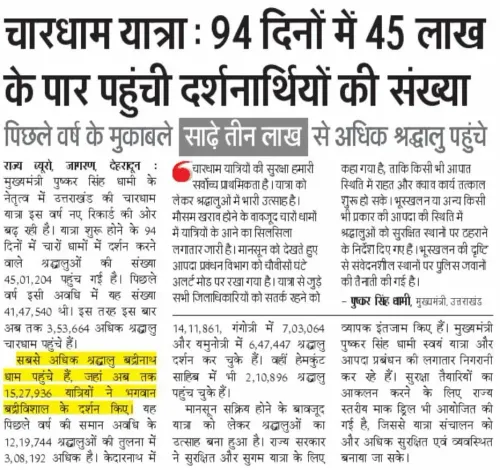
The Char Dham Yatra 2026 broke its previous all-time pilgrim footfall record with approximately 45 days still remaining in the season.
The achievement was announced by the Chief Minister's Office of Uttarakhand on 26 September 2026 .
The CMO specifically credited organised and safe conduct of the yatra under CM Pushkar Singh Dhami as the key factor.
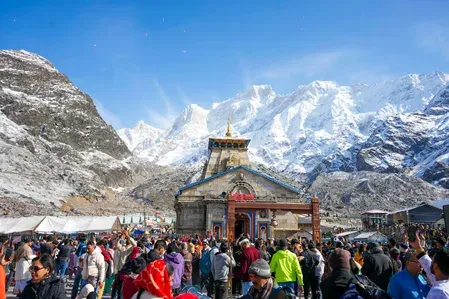
The pilgrimage covers four high-altitude Himalayan shrines: Yamunotri, Gangotri, Kedarnath , and Badrinath .
The Char Dham all-weather highway project (approved 2016 ) has been a foundational infrastructure driver behind rising annual footfall.
Final year-end figures will be available only after the shrine portals close, likely in October–November 2026 .
A pilgrimage that threads through some of the highest Himalayan shrines on earth has shattered its own record — and the season is not even over yet. The Chief Minister's Office of Uttarakhand announced on Saturday, 26 September 2026, that the Char Dham Yatra — conducted in an organised and safe manner under the leadership of Chief Minister Pushkar Singh Dhami — has set a new pilgrim-footfall record a full one-and-a-half months ahead of the yatra's scheduled close.
Four Shrines, One Milestone
The Char Dham circuit — Yamunotri, Gangotri, Kedarnath, and Badrinath — winds through the high-altitude Garhwal Himalayas and draws millions of Hindu pilgrims every year between April and November. Breaking a season record with six weeks still remaining is significant: it means actual footfall at closure will exceed this peak by an unknown but likely substantial margin. The CMO's framing — emphasising that the yatra was conducted 'vyavasthit aur surakshit roop se' (in an organised and safe manner) — points directly to the state's investment in crowd management and infrastructure as the engine behind this surge.
How Uttarakhand Built the Pilgrimage Machine
The record did not arrive overnight. Uttarakhand governments have, over successive years, layered registration systems, online permit mechanisms, health checkpoints, and helicopter evacuation protocols onto the yatra infrastructure. The Char Dham all-weather highway project, approved in 2016, has steadily improved road connectivity to all four shrines, reducing the journey time that once deterred older or less-fit pilgrims.
CM Dhami, who has led the state since 2021, has positioned orderly pilgrimage management as a flagship governance deliverable — framing safety not as a constraint on footfall but as the very condition that enables it. That bet appears to be paying off this season in record numbers.
What the Record Means for the Season's Final Leg
With the shrine portals typically closing in October or early November for the winter, pilgrimage operators and local tourism stakeholders now face an unusual challenge: managing the tail end of a record-breaking season without compromising the safety standards the CMO is publicly crediting for the surge. Official year-end figures — expected after the portals shut — will give the definitive number. For now, the milestone stands as the sharpest indicator yet of how organised religious tourism, when backed by infrastructure and logistics, can scale without sacrificing safety.
The mountain gods may have been generous this season — but Uttarakhand's administration is taking the credit it has arguably earned.
Point of View
' the CMO is making a direct argument that state capacity, not just religious sentiment, drives pilgrimage scale. This fits a broader national pattern where BJP-governed states have sought to brand Hindu pilgrimage circuits as proof of administrative competence. With the 2027 Uttarakhand assembly cycle approaching, a record Char Dham season becomes potent political capital. The real test, however, will be whether the final footfall number after portal closure is accompanied by comparable safety data — because a record tarnished by preventable incidents would invert the narrative entirely.
NationPress
26 Sept 2026
Frequently Asked Questions
What is the Char Dham Yatra and when does it take place?
The Char Dham Yatra is an annual Hindu pilgrimage to four sacred shrines — Yamunotri, Gangotri, Kedarnath, and Badrinath — located in the Garhwal Himalayas of Uttarakhand. The yatra season typically runs from April or May through October or November each year.
What record did Char Dham Yatra 2026 break?
According to the Uttarakhand CMO, the Char Dham Yatra 2026 set a new all-time pilgrim footfall record with roughly one-and-a-half months still left before the season closes, meaning the final tally will be even higher.
What role did CM Pushkar Singh Dhami play in the Char Dham Yatra 2026?
CM Pushkar Singh Dhami, who has led Uttarakhand since 2021, oversaw the organised and safe management of the yatra. The CMO credited his leadership — including registration systems, safety protocols, and infrastructure investment — as central to the record-breaking season.
What is the Char Dham all-weather highway project?
Approved in 2016, the Char Dham all-weather highway project aims to build and upgrade roads connecting all four Char Dham shrines to make them accessible year-round, reducing travel time and enabling more pilgrims to complete the circuit safely.
When will the final Char Dham Yatra 2026 pilgrim numbers be released?
The definitive year-end pilgrim figures will be available after the shrine portals officially close for winter, which typically happens in October or early November. The current record was achieved with the season still ongoing.