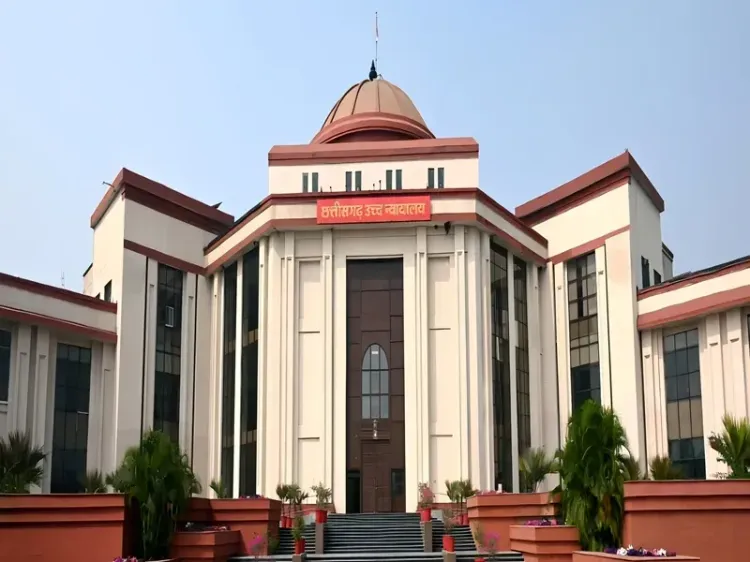
Chhattisgarh HC dismisses plea against mantras in govt schools
Synopsis
The Chhattisgarh High Court has refused to strike down a state directive requiring Hindu mantras in government school assemblies, ruling the challenge premature and finding no proven coercion. The door remains open for a fresh petition — but for now, the policy stands, raising unresolved questions about the constitutional line between moral instruction and religious practice in state-funded schools.
Key Takeaways
The Chhattisgarh High Court dismissed a writ petition against the state's directive on 8 July 2026 , calling it premature.
Justice Amitendra Kishore Prasad found no coercive element in the 12 June 2026 school education order mandating the Saraswati Vandana , Gayatri Mantra , and other invocations.
Petitioners — including former Chhattisgarh Waqf Board chairman Abdul Salam Rizvi — alleged violations of Articles 14, 21, 25, 28(1), 29, and 30 of the Constitution.
The state government argued the invocations promote discipline and moral values in line with NEP 2020 , and had drawn no complaints since implementation.
The court reserved liberty for petitioners to file a fresh petition if concrete evidence of rights violations emerges.
The Chhattisgarh High Court on 8 July 2026 dismissed as premature a writ petition challenging the state government's directive mandating the recitation of the Saraswati Vandana, Gayatri Mantra, Guru Mantra, Shanti Mantra, and other invocations during school assemblies in government schools from the 2026-27 academic session. A single-judge bench of Justice Amitendra Kishore Prasad found no coercive element in the order and held that petitioners had failed to demonstrate any actual violation of fundamental rights.
What the Court Ruled
Justice Prasad held that a careful reading of the impugned order dated 12 June 2026 revealed 'no mandatory or coercive direction compelling students to act in a manner contrary to their respective religious beliefs, conscience or faith.' The bench further observed that the government order, read as a whole, disclosed no 'express requirement obligating students to participate in any activity that would interfere with their constitutionally protected freedom of religion or freedom of conscience.'
Critically, the court noted that the petitioners had placed no material on record to establish violation of any fundamental right, and that 'no individual or direct injury has been shown.' The petition was accordingly dismissed as premature, though the court reserved liberty for petitioners to return with fresh proceedings supported by cogent material if a concrete grievance arises.
Who Filed the Petition and What They Sought
The petition was filed by Abdul Salam Rizvi, former chairman of the Chhattisgarh Waqf Board; Mahendra Chhabda, former chairman of the Minority Department; and Bilaspur-based social activist Shafique Ahmed. They sought quashing of the June 12 order and a declaration that compulsory recitation of the Saraswati Vandana, Guru Mantra, Gayatri Mantra, Shanti Mantra, Bhojan Mantra, and similar prayers in state-funded schools was unconstitutional.
The petitioners contended that the directive violated Articles 14, 21, 25, 28(1), 29, and 30 of the Constitution by compelling students from minority communities to participate in religious practices associated with a particular faith.
The State Government's Defence
The Chhattisgarh state government opposed the plea, arguing it rested on speculative apprehensions and that the policy neither amounted to religious instruction nor to conversion. The state submitted that the circular had already been implemented across government schools without any complaint from students, parents, or teachers. Officials further contended that the prescribed invocations were intended to promote discipline, moral values, environmental awareness, and national heritage in alignment with the National Education Policy (NEP), 2020.
The Constitutional Question on Article 28
Agreeing with the state's submissions, Justice Prasad examined the scope of Article 28(1) of the Constitution, which prohibits religious instruction in institutions wholly maintained out of state funds. The court held that the expression 'religious instruction' under Article 28(1) carries a restricted meaning — it bans the teaching of religious customs, rituals, and modes of worship, but does not prohibit 'moral instruction, disassociated from any denominational doctrines, which remains an essential part of training in citizenship, maintenance of law and order in the State and growth of social cohesion.'
This distinction between religious instruction and moral instruction is likely to be a focal point if the matter returns to court with fresh evidence. The ruling does not foreclose a future challenge; it simply holds that the current petition was premature for want of demonstrated injury.
What Happens Next
The dismissal is not a final verdict on the constitutionality of the directive. The court has explicitly left the door open for a fresh petition backed by concrete evidence of harm. Legal observers note that the outcome could differ significantly if petitioners document specific instances of students being compelled to participate against their will. The matter is being closely watched by minority rights groups and education policy advocates across the country.
Point of View
Not a clean constitutional clearance — yet it hands the Chhattisgarh government a significant political win. The court's distinction between 'religious instruction' and 'moral instruction' is doing a lot of heavy lifting here, and that line has historically been contested in Indian jurisprudence. What the judgment does not resolve is whether the invocations, in practice, are being presented as optional or de facto mandatory — a fact question that only documented classroom evidence can answer. If petitioners return with that evidence, the constitutional debate around Article 28(1) and minority rights in state-funded schools will be far harder to sidestep.
NationPress
7 Oct 2026
Frequently Asked Questions
What did the Chhattisgarh High Court rule on mantras in government schools?
The Chhattisgarh High Court dismissed a petition challenging the state's directive to recite the Saraswati Vandana, Gayatri Mantra, and other invocations in government school assemblies, ruling the challenge premature. Justice Amitendra Kishore Prasad found no coercive element in the order and said petitioners had not demonstrated any actual violation of fundamental rights.
Which mantras are covered under the Chhattisgarh school directive?
The state government's order dated 12 June 2026 introduced the recitation of the Saraswati Vandana, Gayatri Mantra, Guru Mantra, Shanti Mantra, and Bhojan Mantra during school assemblies in government schools, effective from the 2026-27 academic session.
Who challenged the Chhattisgarh government's school mantra directive?
The petition was filed by Abdul Salam Rizvi, former chairman of the Chhattisgarh Waqf Board; Mahendra Chhabda, former chairman of the Minority Department; and Bilaspur-based social activist Shafique Ahmed. They argued the directive violated multiple constitutional articles protecting minority religious rights.
Does the High Court's dismissal mean the directive is constitutionally valid?
Not definitively. The court dismissed the petition as premature for want of concrete evidence of harm, not on full constitutional merits. The bench explicitly reserved liberty for petitioners to file a fresh challenge if specific instances of rights violations are documented in the future.
What is the government's justification for introducing mantras in schools?
The Chhattisgarh state government argued that the invocations are intended to promote discipline, moral values, environmental awareness, and national heritage, consistent with the National Education Policy (NEP) 2020. It also submitted that the directive had been implemented without any complaint from students, parents, or teachers.