Chirag Paswan hails Cabinet nod for ₹7,145 cr Kanpur–Kabrai corridor
Synopsis
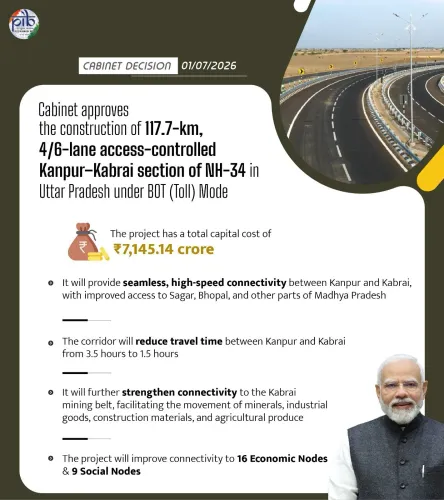
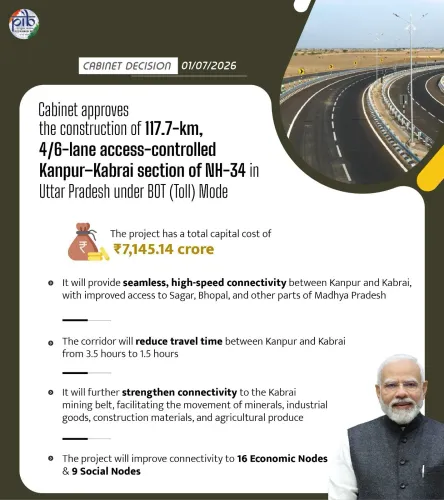
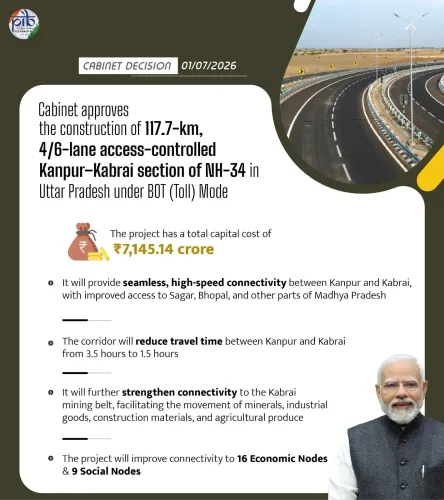
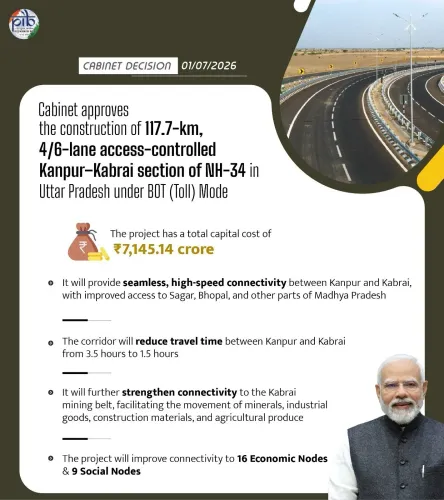
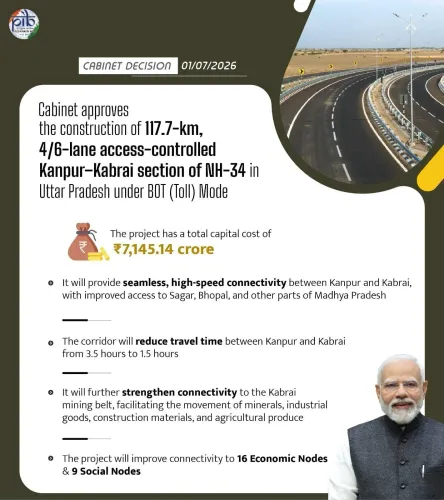
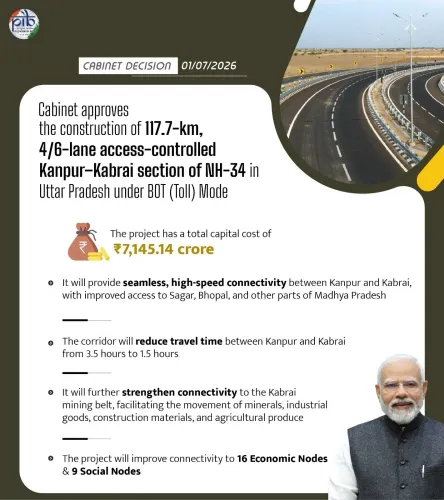
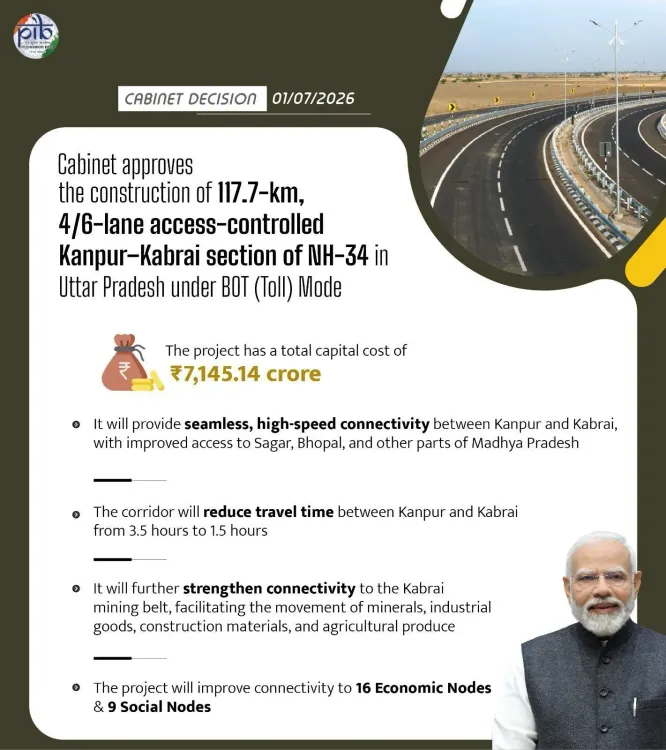
The Union Cabinet chaired by PM Narendra Modi has approved a ₹7,145.14 crore, 117.7-km access-controlled corridor on NH-34 between Kanpur and Kabrai. Union Minister Chirag Paswan announced the decision on X, saying it will boost connectivity to Sagar, Bhopal, and other parts of Madhya Pradesh through 16 economic and 9 social nodes.
Key Takeaways
The Union Cabinet approved the Kanpur–Kabrai NH-34 corridor at a cost of ₹7,145.14 crore .
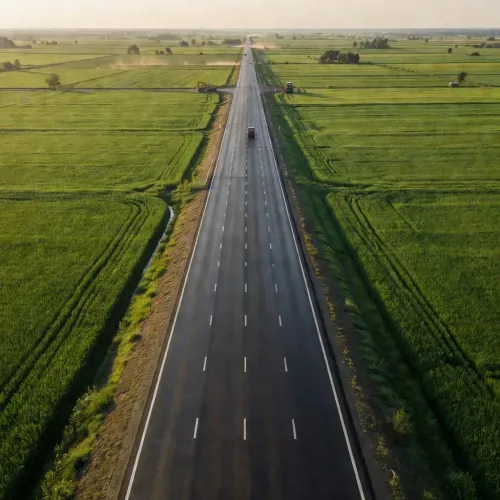
The corridor spans 117.7 kilometres and will be developed as a 4/6-lane access-controlled highway .
The project will improve connectivity to Sagar , Bhopal , and other regions of Madhya Pradesh .
It will link 16 economic nodes and 9 social nodes , targeting regional development and job creation.
The project aligns with the Bharatmala Pariyojana and the PM Gati Shakti National Master Plan .
NHAI is expected to begin tendering following the cabinet sanction.
Union Food Processing Minister Chirag Paswan on Wednesday, 1 July 2026, took to X to welcome the Union Cabinet's approval of a ₹7,145.14 crore project to develop a 117.7-kilometre access-controlled corridor on NH-34 between Kanpur and Kabrai, describing it as a boost for trade, agriculture, and investment across Madhya Pradesh.
Context
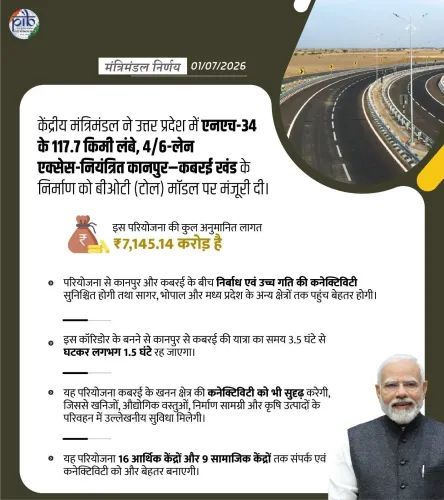
The cabinet chaired by Prime Minister Narendra Modi approved the four- and six-lane access-controlled corridor, which Paswan said would ensure 'uninterrupted and fast connectivity' (निर्बाध तथा तेज़ कनेक्टिविटी) to Sagar, Bhopal, and other parts of Madhya Pradesh. Writing in Hindi, the minister stated that the project would give 'new energy' to trade, industry, agriculture, and investment in the region. The approval was tagged under #CabinetDecisions, part of the government's practice of amplifying cabinet outcomes across ministerial social-media accounts.
Policy backdrop
The project sits within the broader framework of the Bharatmala Pariyojana, launched in 2015 to develop economic corridors and upgrade national highways across India. It also aligns with the PM Gati Shakti National Master Plan, introduced in 2021, which seeks to integrate multimodal infrastructure planning and reduce logistics costs by linking industrial clusters with agricultural hinterlands. Since 2014, successive cabinet approvals have targeted access-controlled corridors as a means of cutting freight times and stimulating regional economies, particularly in central India.
The Kanpur–Kabrai stretch is significant because it bridges a northern industrial hub in Uttar Pradesh with the Bundelkhand and central Madhya Pradesh belt — an area historically underserved by high-capacity road infrastructure.
Stakeholders and impact
Paswan's post highlighted that the corridor would connect 16 economic nodes and 9 social nodes, framing the project as a driver of both regional development and employment generation. Farmers, traders, and industrial investors in Madhya Pradesh — particularly in the districts around Sagar and Bhopal — stand to benefit from reduced transit times and lower logistics costs. The access-controlled design is intended to limit entry and exit points, improving traffic flow and road safety over the full 117.7 km stretch.
For the food-processing sector specifically, faster highway connectivity between agricultural production zones in central India and consumption centres in the north can shorten supply chains, reduce post-harvest losses, and make the region more attractive for cold-chain and processing investments — areas that fall directly within Paswan's ministerial mandate.
What's next
The National Highways Authority of India (NHAI) is expected to initiate tendering and finalise construction timelines following the cabinet sanction. Analysts tracking infrastructure spending will also watch whether related allocations appear in the next Union Budget. The project's node-based development model — linking roads to economic and social infrastructure — will be a test case for the government's stated goal of making highway investment a catalyst for broader regional growth rather than a standalone connectivity measure.
Point of View
The government is signalling that this is not merely a road project but a structured attempt to anchor investment and employment along the corridor. For Chirag Paswan, amplifying a highways decision from his food-processing portfolio underscores how ministers are being deployed as broad-spectrum communicators of cabinet outcomes, blurring the line between sectoral mandates and general governance messaging. The real test will be NHAI's execution speed and whether the node-based model translates into measurable economic activity on the ground.
NationPress
1 Jul 2026
Frequently Asked Questions
What is the Kanpur–Kabrai NH-34 corridor project?
It is a cabinet-approved infrastructure project to build a 117.7-km, four- and six-lane access-controlled highway on NH-34 between Kanpur in Uttar Pradesh and Kabrai, at a total cost of ₹7,145.14 crore.
How much will the Kanpur–Kabrai highway corridor cost?
The Union Cabinet approved the project at a cost of ₹7,145.14 crore.
Which states will benefit from the NH-34 Kanpur–Kabrai corridor?
The corridor is expected to benefit Uttar Pradesh, where Kanpur is located, and Madhya Pradesh, with improved connectivity to cities such as Sagar and Bhopal.
What are the economic and social nodes in the NH-34 project?
The project will connect 16 economic nodes — points of industrial or commercial activity — and 9 social nodes such as towns or service centres along the corridor, aimed at boosting regional development and employment.
What is Bharatmala Pariyojana and how does this project relate to it?
Bharatmala Pariyojana is a central government programme launched in 2015 to develop economic corridors and upgrade national highways across India; the Kanpur–Kabrai NH-34 corridor aligns with its goals of reducing logistics costs and linking industrial and agricultural regions.