CM Bhajan Lal Backs Cabinet Nod on Mudra Credit Guarantee Fund

Synopsis
The Union Cabinet approved continuation of the Credit Guarantee Fund for PM Mudra Yojana with a ₹5,000 crore corpus, aiming to unlock ₹12.6 lakh crore in collateral-free loans for micro-entrepreneurs, youth, and self-employed individuals. Rajasthan CM Bhajan Lal Sharma praised the move.
Key Takeaways
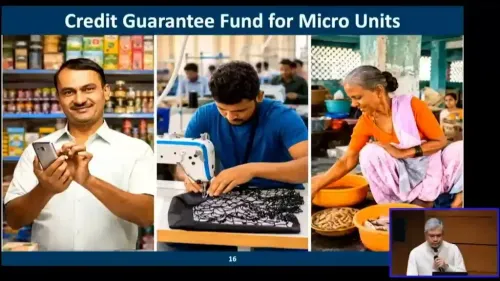
The Union Cabinet approved continuation of the Credit Guarantee Fund for Pradhan Mantri Mudra Yojana with a ₹5,000 crore corpus .
The fund is projected to facilitate ₹12.6 lakh crore in Mudra loans to micro-enterprises.
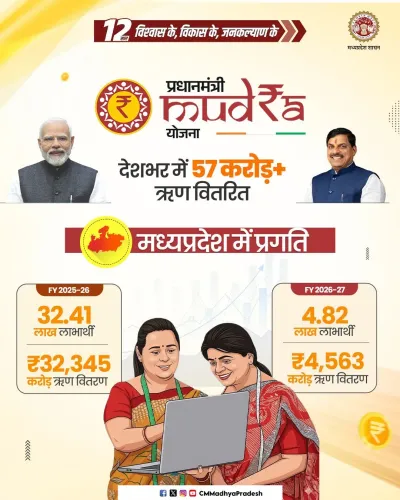
PMMY , launched in April 2015 , offers collateral-free loans up to ₹10 lakh to non-farm micro and small businesses.
Primary beneficiaries include small entrepreneurs, youth, and self-employment aspirants — segments historically underserved by formal credit.
Rajasthan CM Bhajan Lal Sharma welcomed the decision, attributing it to PM Narendra Modi's leadership and the cabinet.
Ministry of Finance operationalisation guidelines and state-level disbursement targets are the key next steps to watch.
A ₹5,000 crore corpus, a guarantee backstop for the country's smallest entrepreneurs, and a projected pipeline of ₹12.6 lakh crore in fresh credit — the Union Cabinet's decision to continue the Credit Guarantee Fund for Pradhan Mantri Mudra Yojana is one of those quietly consequential moves that reshapes the financial floor beneath millions of micro-businesses. Rajasthan Chief Minister Bhajan Lal Sharma welcomed the decision on Wednesday, November 11, 2026, crediting Prime Minister Narendra Modi and the central cabinet for what he called a vital step toward entrepreneurship and self-employment.
What the Cabinet Actually Approved
The decision extends the Credit Guarantee Fund that underpins Pradhan Mantri Mudra Yojana (PMMY) — a scheme launched in April 2015 to provide collateral-free loans of up to ₹10 lakh to micro and small non-farm enterprises. By anchoring the fund at a ₹5,000 crore corpus, the government provides lenders a guarantee cover, removing the single biggest psychological barrier for banks and NBFCs extending credit to first-time or asset-light borrowers. The cabinet's move is designed to unlock ₹12.6 lakh crore in Mudra loans — a figure that underscores just how much leverage a well-structured guarantee fund generates.
Who Stands to Gain — and Why It Matters
CM Sharma's post, written in Hindi, spells out the target constituencies with precision: 'छोटे उद्यमियों, युवाओं और स्वरोजगार की आकांक्षा रखने वाले लोगों' — small entrepreneurs, youth, and those aspiring toward self-employment. These are exactly the segments that formal credit markets have historically underserved, either because they lack collateral or because the ticket sizes are too small to justify a bank's due-diligence costs. The guarantee fund solves both problems at once: it absorbs default risk for lenders and validates loan applications that would otherwise never reach a disbursement desk.
Since its 2015 launch, PMMY has operated across three loan categories — Shishu (up to ₹50,000), Kishore (₹50,001 to ₹5 lakh), and Tarun (₹5 lakh to ₹10 lakh) — channelling credit to street vendors, artisans, small traders, and service providers. The credit guarantee mechanism has been periodically refreshed to keep pace with rising disbursement ambitions, and this latest corpus enhancement continues that trajectory.
Rajasthan's Stake in Scaling Mudra
For a state like Rajasthan — where micro and small enterprise activity spans handicrafts, textiles, tourism services, and agri-processing — an expanded guarantee-backed Mudra pipeline carries direct economic weight. CM Sharma's endorsement signals that state-level implementation machinery will be aligned to channel the enhanced credit flow to eligible beneficiaries. The next critical juncture will be Ministry of Finance guidelines on fund operationalisation and state-level disbursement targets, likely to feature in the next Union Budget cycle.
Credit guarantee schemes work best when last-mile delivery — the branch-level banker who actually sanctions a Mudra loan — is confident the backstop is real and accessible. That is precisely what a funded, government-backed corpus provides. With ₹12.6 lakh crore in potential lending on the table, the pipeline is set; the execution is what determines whether that number becomes reality for India's smallest businesses.
Point of View
Keeping the lending market-driven while absorbing the last-mile risk that banks won't. CM Sharma's enthusiastic endorsement is politically significant: it ties Rajasthan's governance narrative to the Centre's MSME growth story ahead of budget season. The ₹12.6 lakh crore lending projection is an ambition marker, not a guarantee — the real test is whether disbursement infrastructure at the state and branch level scales commensurately. If it does, the Credit Guarantee Fund's leverage ratio makes it one of the most cost-efficient public-finance instruments in India's development toolkit.
NationPress
11 Nov 2026
Frequently Asked Questions
What is the Credit Guarantee Fund for Mudra Yojana?
It is a dedicated government-backed fund that provides guarantee cover for loans disbursed under Pradhan Mantri Mudra Yojana, allowing banks and NBFCs to lend to micro-enterprises without requiring collateral from borrowers. The Cabinet has now approved its continuation with a ₹5,000 crore corpus.
What is Pradhan Mantri Mudra Yojana and who can avail it?
Pradhan Mantri Mudra Yojana (PMMY) was launched in April 2015 to provide collateral-free loans of up to ₹10 lakh to micro and small non-farm enterprises, including street vendors, artisans, small traders, and service providers. It operates through three categories: Shishu, Kishore, and Tarun.
How much credit is expected to flow under the renewed Mudra guarantee fund?
The Cabinet decision is projected to enable approximately ₹12.6 lakh crore in Mudra loans, backed by the ₹5,000 crore Credit Guarantee Fund corpus.
Why did Rajasthan CM Bhajan Lal Sharma comment on this central cabinet decision?
CM Sharma welcomed the decision as it directly benefits micro-entrepreneurs, youth, and self-employment aspirants in states like Rajasthan. His statement signals Rajasthan's intent to align state-level delivery machinery with the enhanced credit guarantee framework.
What comes next after the Cabinet approves the Mudra Credit Guarantee Fund?
Ministry of Finance guidelines on fund operationalisation and state-level Mudra disbursement targets are the key next steps, with details expected to feature prominently in the forthcoming Union Budget cycle.