CM Bhajan Lal Directs Time-Bound Disposal of Registration Cases
Synopsis
The Rajasthan CMO on 10 July 2026 directed time-bound resolution of all registration-related cases, tagging CM Bhajan Lal Sharma under the state's 'Aapno Agrani Rajasthan' initiative. The move invokes the Rajasthan Public Service Guarantee Act and targets chronic pendency at sub-registrar offices affecting lakhs of property owners.
Key Takeaways
The Rajasthan CMO on 10 July 2026 issued a directive for time-bound disposal of all registration-related cases.
The post was addressed to Chief Minister Bhajan Lal Sharma under the #AapnoAgraniRajasthan governance banner.
The Rajasthan Public Service Guarantee Act, 2011 already mandates statutory deadlines for registration and mutation services.
The Rajasthan Revenue Department oversees property registration, stamp duty, and land records across 33 districts .
Faster registration disposal directly benefits property owners, home buyers, and businesses awaiting legal document clearance.
Follow-up circulars and digital monitoring dashboards from the Revenue Department will indicate on-ground implementation.
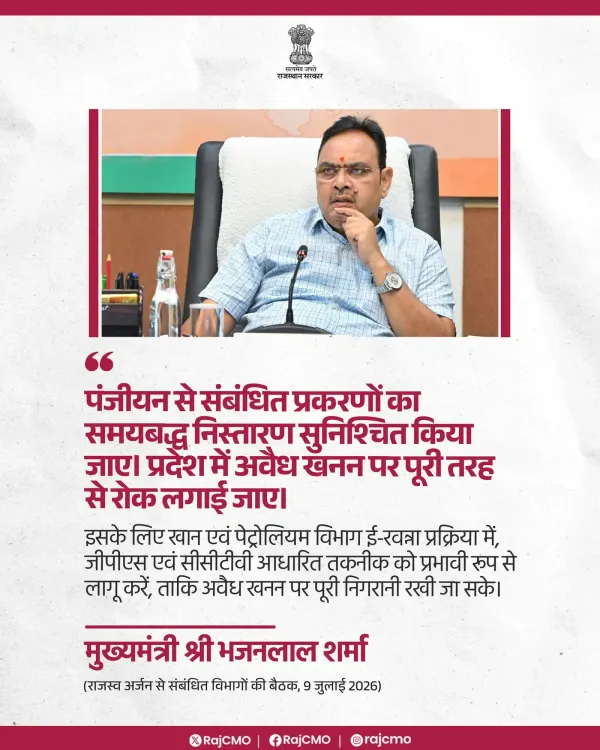
The Chief Minister's Office of Rajasthan on Friday, 10 July 2026 directed that all pending registration-related cases be resolved within fixed timelines, tagging Chief Minister Bhajan Lal Sharma in the official communication under the state's 'Aapno Agrani Rajasthan' (Our Leading Rajasthan) governance initiative.
The post, shared from the official @RajCMO handle, stated: 'Panjeeyan se sambandhit prakaranon ka samayabaddh nistaaran sunishchit kiya jae' — 'Time-bound disposal of registration-related cases must be ensured.' The directive was addressed directly to Chief Minister Bhajan Lal Sharma, signalling a top-level push for administrative accountability in the state's revenue and registration machinery.
Context
Registration-related cases in Rajasthan span property transfers, stamp duty matters, and document authentication — services that directly affect lakhs of citizens and businesses each year. Delays in these processes have historically been a source of public grievance, often linked to pendency at field-level revenue offices across the state's 33 districts.
The directive comes under the banner of #AapnoAgraniRajasthan, the Bhajan Lal government's overarching governance theme signalling Rajasthan's ambition to lead among Indian states in administrative efficiency and service delivery.
Policy Backdrop
Rajasthan has a statutory foundation for such directives: the Rajasthan Public Service Guarantee Act, 2011 mandates time-bound delivery of notified public services, including registrations and mutations. The Act has been amended periodically to expand the list of covered services and tighten deadlines.
Across India, state governments have increasingly paired such legislative frameworks with digital tools — online dashboards, e-stamping portals, and digitised land records — to monitor and reduce case pendency. Rajasthan's Revenue Department, which oversees land records, property registration, and stamp duty, has been a key focus of these e-governance reforms since the early 2010s.
The broader national pattern reflects a concerted push under ease-of-doing-business rankings, where property registration efficiency is a weighted parameter assessed by the Department for Promotion of Industry and Internal Trade.
Stakeholders and Impact
The most immediate beneficiaries of faster registration disposal are property owners, home buyers, and small businesses who depend on timely document registration for legal certainty over assets. Delays in registration can stall home loans, inheritance transfers, and commercial transactions.
Revenue officials at sub-registrar offices across Rajasthan will face renewed pressure to clear backlogs. Civil society groups tracking land governance have long flagged that pendency at registration offices creates rent-seeking opportunities — a problem that digital monitoring is designed to curb.
What's Next
Observers will watch for follow-up circulars from the Rajasthan Revenue Department specifying exact timelines, digital monitoring mechanisms, and accountability measures for field officers. Quarterly pendency reports and any new grievance redressal dashboards for registration offices will be key indicators of whether this directive translates into measurable improvement on the ground.
If implemented rigorously, the push could strengthen Rajasthan's standing in national ease-of-doing-business assessments and reduce the volume of public complaints reaching the Chief Minister's grievance portal.
Point of View
Timestamped record of governance intent. This fits a pattern seen across BJP-governed states where social media is used not just for communication but as a soft audit trail, placing named officials on notice. The 'Aapno Agrani Rajasthan' framing elevates a routine administrative instruction into a brand-building exercise ahead of potential performance assessments. Whether the directive produces measurable pendency reduction will depend on whether it is backed by enforceable timelines and digital monitoring at the sub-registrar level.
NationPress
10 Jul 2026
Frequently Asked Questions
What did the Rajasthan CMO direct on 10 July 2026?
The Rajasthan CMO directed that all registration-related cases be disposed of in a time-bound manner, tagging Chief Minister Bhajan Lal Sharma in the official post on X.
What are registration-related cases in Rajasthan?
Registration-related cases include property transfers, stamp duty assessments, document authentication, and mutation filings handled by sub-registrar offices under the Rajasthan Revenue Department.
What law governs time-bound services in Rajasthan?
The Rajasthan Public Service Guarantee Act, 2011 mandates statutory deadlines for notified public services, including registrations and mutations, and has been amended periodically to cover more services.
Who benefits from faster disposal of registration cases?
Property owners, home buyers, and businesses are the primary beneficiaries, as timely registration is essential for securing home loans, completing inheritance transfers, and finalising commercial transactions.
What is 'Aapno Agrani Rajasthan'?
'Aapno Agrani Rajasthan' — meaning 'Our Leading Rajasthan' — is the Bhajan Lal government's governance theme aimed at positioning Rajasthan as a leader among Indian states in administrative efficiency and service delivery.