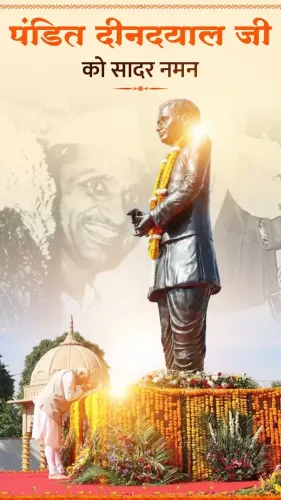
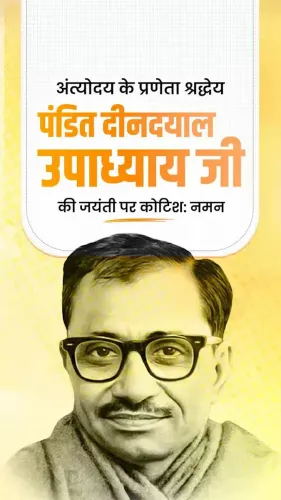
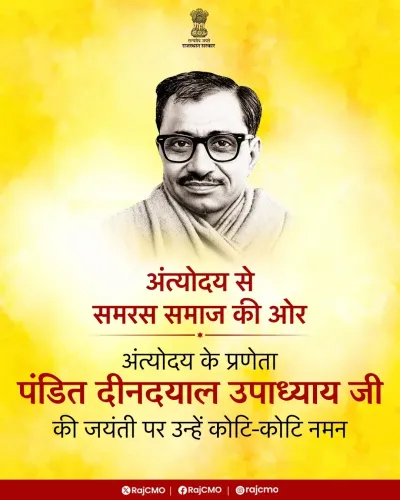
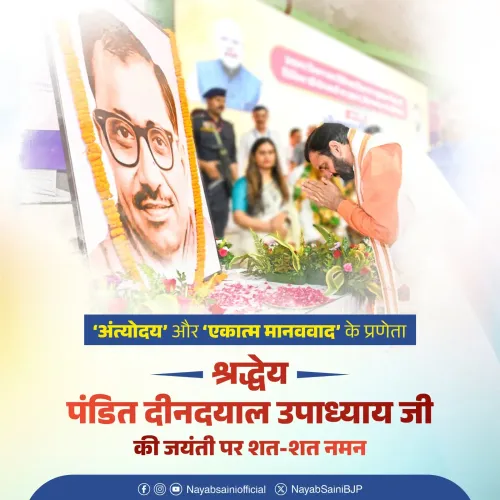
CM Bhajan Lal Honours Deendayal Upadhyay on Birth Anniversary
Synopsis
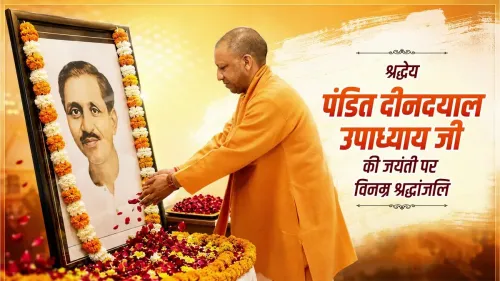
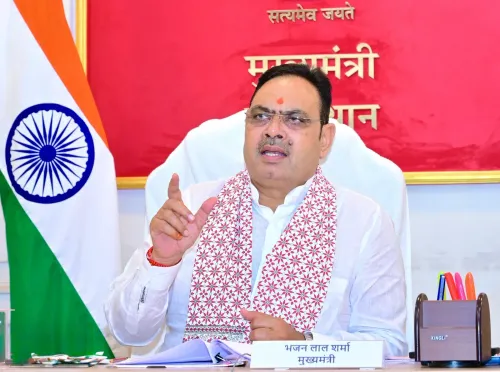
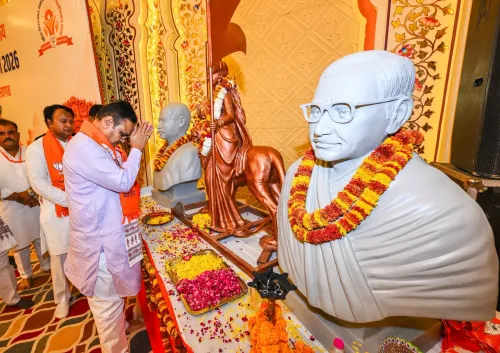
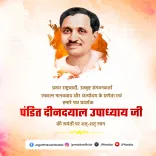
Rajasthan CM Bhajan Lal Sharma marked Pandit Deendayal Upadhyay's birth anniversary on September 25, 2026, calling his Antyodaya philosophy the foundation of the state government's welfare approach and pledging continued work for the most marginalised.
Key Takeaways
Rajasthan Chief Minister Bhajan Lal Sharma paid tribute to Pandit Deendayal Upadhyay on his birth anniversary, September 25, 2026 .
CM Sharma described Upadhyay as a 'sharp nationalist thinker, skilled organiser, and visionary' and reaffirmed Antyodaya as the bedrock of his government's welfare philosophy.
Pandit Deendayal Upadhyay was the ideologue of Integral Humanism and the Bharatiya Jana Sangh , articulating the Antyodaya concept in the 1960s .
Antyodaya prioritises upliftment of the weakest section of society — the 'last person in the queue' — as the true measure of development.
BJP governments at state and central level routinely invoke Upadhyay's anniversary to reaffirm inclusive growth commitments and welfare delivery pledges.
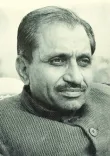
On the birth anniversary of Pandit Deendayal Upadhyay, Rajasthan Chief Minister Bhajan Lal Sharma paid tribute on Friday, September 25, 2026, reaffirming his government's commitment to reaching the last person in the development queue — the very principle Upadhyay spent his life championing.
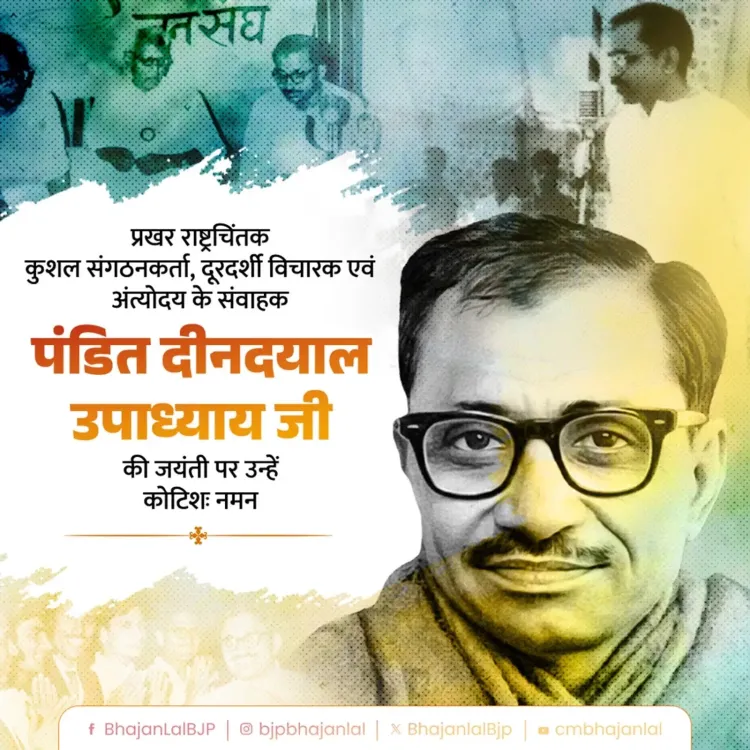
In his post, CM Sharma described Upadhyay as a 'प्रखर राष्ट्रचिंतक, कुशल संगठनकर्ता, दूरदर्शी विचारक' — a 'sharp nationalist thinker, skilled organiser, and visionary' — and a 'bearer of Antyodaya.' He offered kotishaha naman (countless salutations) to the ideologue, before connecting that reverence directly to present-day governance: 'Pandit Deendayal Ji's Antyodaya vision remains the foundation of our thinking on public welfare.'
Who Was Pandit Deendayal Upadhyay and What Did Antyodaya Mean?
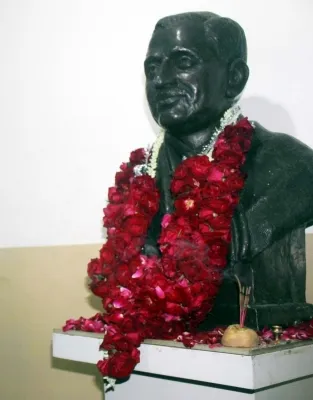
Pandit Deendayal Upadhyay was a towering figure in the Bharatiya Jana Sangh — the BJP's ideological predecessor — and the architect of Integral Humanism, which he articulated in the 1960s. At its core sat the concept of Antyodaya: literally, 'rise of the last.' The idea held that true national progress could only be measured by whether the most marginalised person — not the median citizen — had been uplifted.
That philosophy did not remain a pamphlet-era abstraction. It has since woven itself into the BJP's welfare vocabulary, shaping how the party frames everything from rural housing schemes to direct benefit transfers. For Rajasthan's current government, invoking Upadhyay is both a statement of ideological lineage and a political framing device for social spending.
Rajasthan Government's Antyodaya Commitment in Practice
CM Sharma stated that his government is 'continuously and committedly working to deliver the benefits of development to the person standing in the last row of society, make him self-reliant, and bring positive change in his life.' The language mirrors the antim vyakti (last person) framing that BJP governments at the state and central level have used to position welfare delivery as ideologically grounded rather than purely transactional.
Rajasthan's BJP administration has consistently anchored state welfare narratives around this bottom-up model since coming to power. The birth anniversary of Upadhyay — observed each September 25 — has become a recurring moment for such reaffirmations, often timed to coincide with welfare announcements or programme reviews.
The tribute underscores a broader BJP pattern: marking the anniversaries of party ideologues as occasions to publicly renew governance pledges, keeping the philosophical thread between foundational thinkers and contemporary policy visible to voters and cadre alike.
As Rajasthan heads further into its governance cycle, watch for whether Antyodaya-framed welfare rollouts translate into concrete programme launches — because a philosophy only earns its anniversary if the last person in the queue actually moves forward.
Point of View
Which must demonstrate welfare delivery credentials to a predominantly rural electorate. By anchoring social spending to a philosophical tradition rather than mere electoral arithmetic, the party attempts to give its welfare agenda a moral register that outlasts any single scheme. The key test, as always, is whether 'the last person in the queue' sees tangible movement — not just in anniversary posts, but in programme outcomes.
NationPress
25 Sept 2026
Frequently Asked Questions
Who was Pandit Deendayal Upadhyay?
Pandit Deendayal Upadhyay was a key leader of the Bharatiya Jana Sangh and the thinker behind Integral Humanism, a doctrine that placed the upliftment of the most marginalised — Antyodaya — at the centre of national development. His birth anniversary is observed on September 25.
What is the Antyodaya philosophy?
Antyodaya, meaning 'rise of the last,' is a concept articulated by Pandit Deendayal Upadhyay in the 1960s. It holds that genuine development must be measured by whether the weakest and most vulnerable person in society has been lifted up, not just the average or majority.
What did Rajasthan CM Bhajan Lal Sharma say on Deendayal Upadhyay's birth anniversary?
CM Bhajan Lal Sharma said that Upadhyay's Antyodaya vision remains the foundation of the Rajasthan government's welfare thinking, and pledged continued work to deliver development benefits to the last person in society, make them self-reliant, and bring positive change to their lives.
Why do BJP leaders mark Deendayal Upadhyay's birth anniversary every year?
BJP leaders observe Upadhyay's birth anniversary to reaffirm ideological continuity with the party's foundational philosophy of Integral Humanism and Antyodaya, using the occasion to link current governance and welfare programmes to the party's historical roots.
When is Deendayal Upadhyay's birth anniversary?
Pandit Deendayal Upadhyay's birth anniversary falls on September 25 every year.