CM Bhajan Lal pays tribute to Maharaja Ganga Singh on birth anniversary
Synopsis
Rajasthan CM Bhajan Lal Sharma paid tribute to Maharaja Ganga Singh of Bikaner on his birth anniversary, calling him the 'architect of modern Bikaner' and 'Bhagiratha of the Desert' for his transformative Gang Canal and governance legacy.
Key Takeaways
Rajasthan Chief Minister Bhajan Lal Sharma paid tribute to Maharaja Ganga Singh on his birth anniversary on October 13, 2026 .
Ganga Singh ruled the princely state of Bikaner from 1880 to 1943 and is credited with transforming the Thar Desert through the Gang Canal irrigation project.
He is celebrated with the epithet 'Marubhumi ke Bhagiratha' — the Bhagiratha of the desert — for bringing water to arid Rajasthan.
Ganga Singh also represented India at the Paris Peace Conference of 1919 and the League of Nations .
The tribute follows a consistent Rajasthan political tradition of honouring pre-independence regional rulers on their birth anniversaries.
A ruler who turned desert into farmland and a princely state into a modern institution — Maharaja Ganga Singh of Bikaner is remembered on his birth anniversary with the reverence that history rarely forgets. Rajasthan Chief Minister Bhajan Lal Sharma offered his tribute on Tuesday, October 13, honouring the man widely celebrated as the 'Bhagiratha of the Desert.'
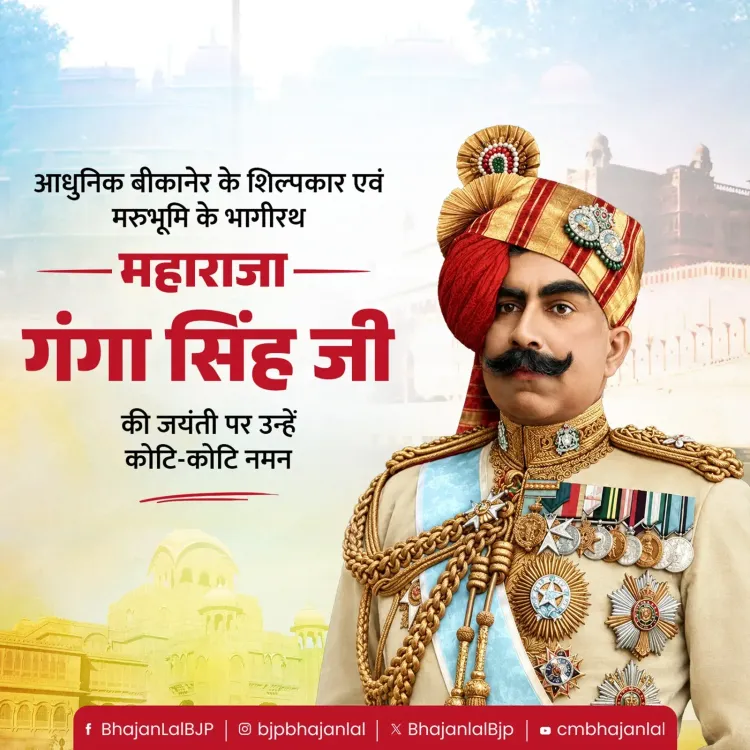
Posting in Hindi, CM Sharma wrote: 'Aadhunik Bikaner ke shilpkar evam Marubhumi ke Bhagiratha naam se vikhyaat Maharaja Ganga Singh ji ki jayanti par unhe koti-koti naman!' — 'Crores of salutations to Maharaja Ganga Singh, renowned as the architect of modern Bikaner and the Bhagiratha of the desert, on his birth anniversary.' He added that the Maharaja's inspiring life, dedication to public welfare, and far-sightedness 'will always guide future generations.'
The man who brought water to the Thar
Maharaja Ganga Singh ruled the princely state of Bikaner from 1880 to 1943, presiding over one of the most ambitious transformation projects in pre-independence Rajasthan. His most enduring legacy is the Gang Canal, an irrigation lifeline drawn from the Sutlej River that brought cultivable water to the arid Thar Desert — earning him the epithet 'Marubhumi ke Bhagiratha,' a reference to the mythological sage who brought the Ganga to earth.
Beyond irrigation, Ganga Singh was a noted statesman who represented India at the Paris Peace Conference of 1919 and the League of Nations, giving the subcontinent a rare international voice during the colonial era. His administrative reforms modernised Bikaner's civil infrastructure at a time when most princely states remained feudally static.
A tribute rooted in Rajasthan's political tradition
Tributes to pre-independence rulers on their birth anniversaries are a consistent feature of Rajasthan's political calendar. For a BJP government in Jaipur, invoking Ganga Singh's legacy of regional development and public welfare carries a clear symbolic register — connecting the party's governance narrative to the state's historic builders.
CM Sharma's tribute, brief and dignified, does not announce new schemes or specific policy measures. It is a moment of institutional memory — a state's chief executive reminding citizens that the infrastructure they inherit was built on visionary sacrifice.
Centuries after the Gang Canal first flowed, the deserts of Bikaner still bear the watermark of one ruler's refusal to accept scarcity as fate.
Point of View
Which frames modern governance as a continuation of India's civilisational builders. For CM Sharma, invoking Ganga Singh's water-management legacy in a state that still battles agrarian water scarcity is not merely ceremonial — it subtly links the current government's development narrative to a validated historical precedent. Such tributes also reinforce Rajasthan's distinct regional identity within the national BJP tent, signalling attention to local pride. Whether the anniversary prompts any concrete infrastructure announcement linked to Bikaner's legacy will be the real indicator of policy intent.
NationPress
13 Oct 2026
Frequently Asked Questions
Who was Maharaja Ganga Singh of Bikaner?
Maharaja Ganga Singh was the ruler of the princely state of Bikaner from 1880 to 1943. He is best known for the Gang Canal irrigation project that brought water from the Sutlej River to the Thar Desert, and for representing India at the Paris Peace Conference of 1919 and the League of Nations.
Why is Maharaja Ganga Singh called 'Marubhumi ke Bhagiratha'?
He is called 'Marubhumi ke Bhagiratha' — the Bhagiratha of the desert — because, like the mythological sage who brought the Ganga to earth, Ganga Singh channelled river water through the Gang Canal into the arid Thar Desert, transforming its agriculture and livelihoods.
What is the Gang Canal and why is it significant?
The Gang Canal is an irrigation channel constructed under Maharaja Ganga Singh's initiative that draws water from the Sutlej River into the Bikaner region of Rajasthan. It remains one of the most significant pre-independence irrigation projects in northwestern India, enabling farming in an otherwise desert landscape.
Why did CM Bhajan Lal Sharma pay tribute to Maharaja Ganga Singh?
October 13 marks the birth anniversary of Maharaja Ganga Singh. Rajasthan Chief Minister Bhajan Lal Sharma posted on X to honour his legacy of public welfare, irrigation, and modernisation of Bikaner, in keeping with the tradition of state leaders paying tribute to historic regional figures.
When was Maharaja Ganga Singh born?
Maharaja Ganga Singh was born on October 13, and his birth anniversary is observed annually in Rajasthan. He ruled Bikaner from 1880 until his death in 1943.