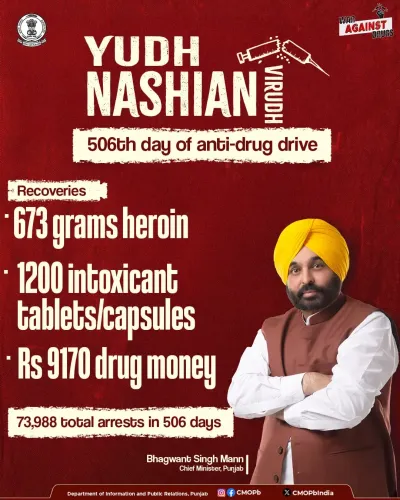
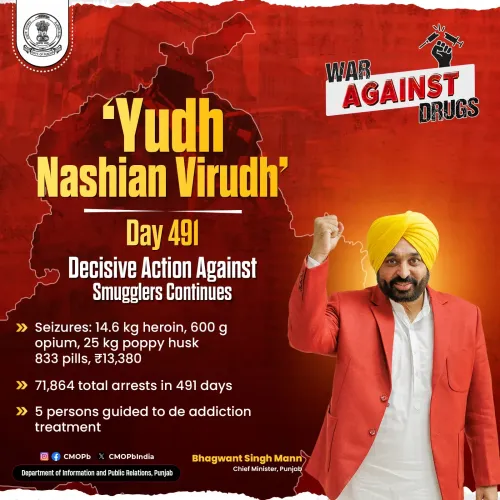
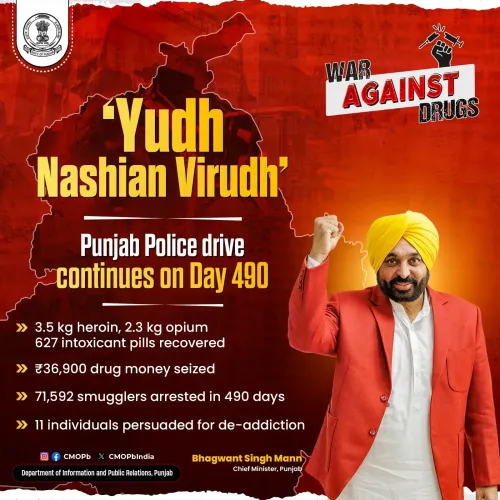
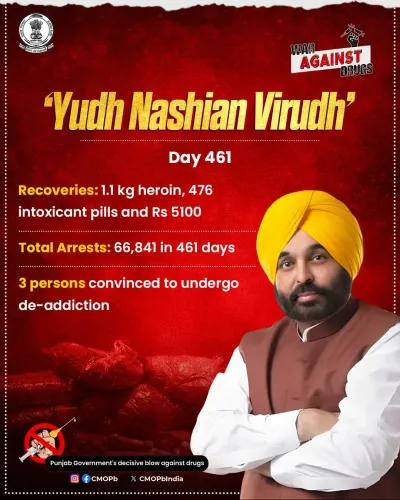
Punjab Police Hits Day 590 of 'Yudh Nashian Virudh', Total Arrests at 84,613
Synopsis
On day 590 of the 'Yudh Nashian Virudh' drive, Punjab Police arrested fresh drug smugglers, seized 923g heroin, 700g opium, and 1,001 pills, pushing total arrests to 84,613 while convincing 24 more persons to seek de-addiction treatment.
Key Takeaways
Day 590 of the uninterrupted 'Yudh Nashian Virudh' anti-drug campaign reported on 13 October 2026 .
Fresh seizures: 923 grams heroin , 700 grams opium , 1,001 intoxicant pills , and ₹7,900 drug money .
Cumulative drug smuggler arrests have reached 84,613 since the campaign began in 2022.
24 persons were convinced on day 590 alone to voluntarily enter de-addiction and rehabilitation treatment.
The campaign combines daily enforcement arrests with a parallel de-addiction outreach mandate.
Launched by Chief Minister Bhagwant Mann 's AAP government, the drive has maintained daily public reporting as a governance accountability tool.
Nearly 600 days without a single pause — and on Tuesday, 13 October 2026, the Chief Minister's Office of Punjab reported that the state's relentless anti-drug drive 'Yudh Nashian Virudh' (War Against Drugs) has crossed its 590th consecutive day, with fresh seizures and arrests adding to a staggering cumulative toll.
Day 590: What Punjab Police recovered
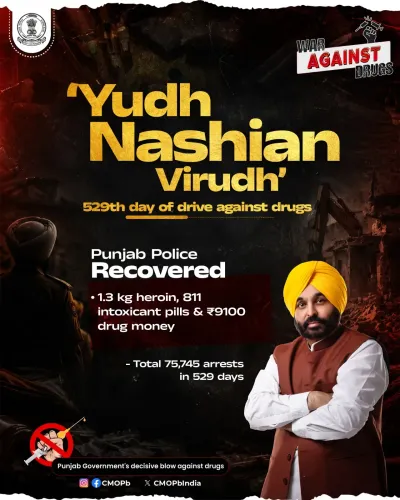
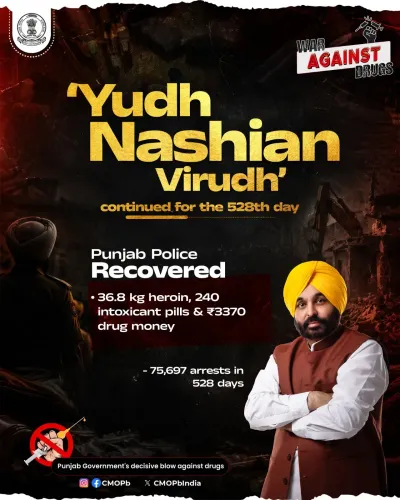
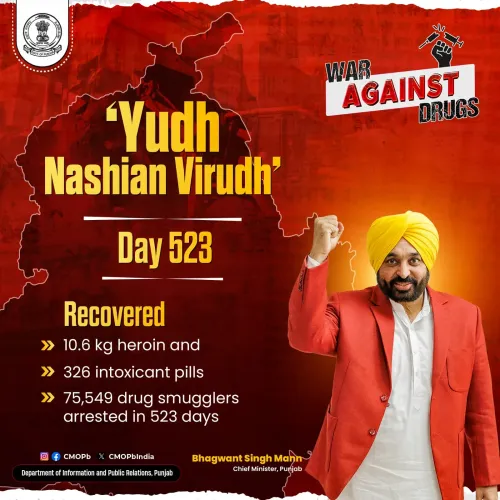
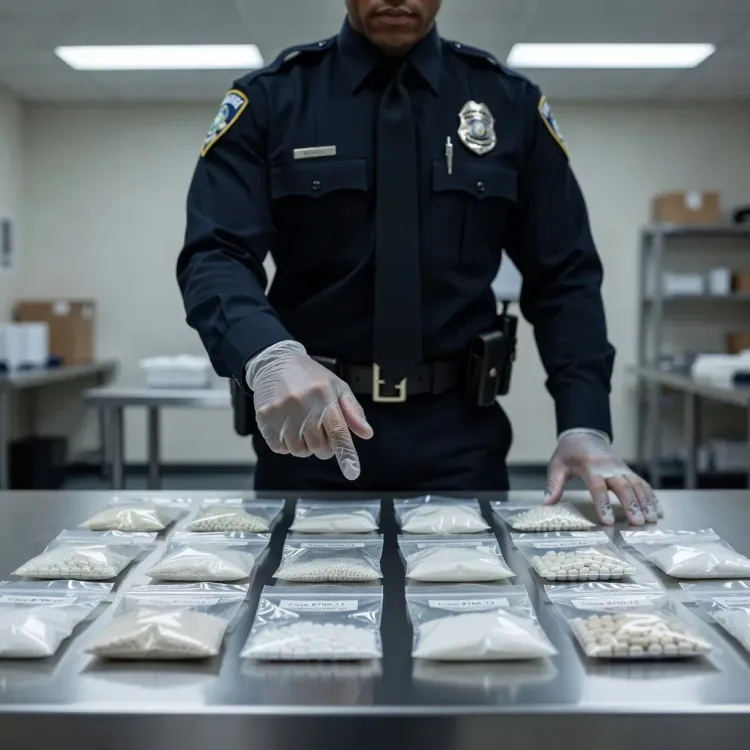
In the latest 24-hour enforcement cycle, Punjab Police arrested multiple drug smugglers and seized 923 grams of heroin, 700 grams of opium, and 1,001 intoxicant pills. Officers also recovered ₹7,900 in drug money — modest in rupee terms, but each such seizure chips away at the supply chain that has fed addiction across the state for decades.
The milestone figure now stands at 84,613 drug smugglers arrested since the campaign's launch — a number that rivals the population of a mid-sized Indian town.
Beyond arrests: 24 more persons steered toward rehabilitation
What separates Yudh Nashian Virudh from a conventional police crackdown is its dual mandate. Alongside enforcement, the drive runs a parallel de-addiction track: on day 590 alone, Punjab Police convinced 24 persons to voluntarily undergo de-addiction and rehabilitation treatment.
That human-centred component reflects the broader design of the campaign, which Chief Minister Bhagwant Mann's Aam Aadmi Party government embedded into the drive from its launch in 2022. The logic is straightforward — arresting suppliers while simultaneously reducing demand is the only formula that can break the cycle, not just displace it.
Punjab's long war with narcotics — and why the daily drumbeat matters
Punjab's drug crisis predates any single government. Decades of entrenched trafficking routes, geographic proximity to the 'Golden Crescent', and a generation scarred by addiction have made the issue a defining fault-line of state politics. Previous administrations cycled through enforcement blitzes that faded without sustained follow-through.
The Mann government's answer has been relentless public accountability: a daily report, publicly posted, every single day. The approach converts governance into a live scoreboard — and makes it politically costly to go quiet. Sixteen months in, the cumulative arrests counter ticking past 84,000 signals that the operational tempo has not slipped.
What the numbers still can't tell us
Raw arrest figures are a necessary but incomplete measure. The deeper question — whether addiction rates, drug availability, and trafficking networks in Punjab are genuinely contracting — demands longer-term public-health data that daily police bulletins cannot supply. As the drive approaches the 600-day mark, a comprehensive state-level review of outcomes, not just operations, is the logical next step.
For now, the scoreboard reads: 84,613 arrested, 590 days, no days off. Punjab is watching to see if the numbers eventually show up in healthier communities.
Point of View
000 arrests in 590 days demonstrates operational consistency that earlier Punjab governments failed to maintain, but the campaign is approaching a credibility inflection point: without corroborating public-health data showing falling addiction prevalence, the arrest counter risks becoming a metric that measures activity rather than impact. The integrated de-addiction component is the campaign's most structurally sound element, yet it remains dwarfed in scale by enforcement numbers, suggesting the rehabilitation pipeline needs significant expansion to match the ambition of the enforcement side.
NationPress
13 Oct 2026
Frequently Asked Questions
What is the 'Yudh Nashian Virudh' campaign in Punjab?
'Yudh Nashian Virudh' — meaning 'War Against Drugs' in Punjabi — is an ongoing anti-narcotics drive launched by the Bhagwant Mann government in 2022. It combines daily police enforcement targeting drug smugglers with a de-addiction and rehabilitation outreach programme for users.
How many drug smugglers have been arrested in Punjab's anti-drug drive?
As of day 590 of the campaign, the total number of drug smugglers arrested under 'Yudh Nashian Virudh' has reached 84,613 , according to the Chief Minister's Office of Punjab.
What drugs were seized by Punjab Police on day 590?
On day 590 (13 October 2026), Punjab Police recovered 923 grams of heroin , 700 grams of opium , 1,001 intoxicant pills , and ₹7,900 in drug money .
Does the Punjab anti-drug drive include rehabilitation, or only arrests?
Yes, the campaign has a dual mandate. Alongside arresting smugglers, Punjab Police actively works to convince drug users to seek treatment. On day 590 alone, 24 persons were steered toward de-addiction and rehabilitation.
When did the Yudh Nashian Virudh campaign start?
The campaign was launched in 2022 after the Aam Aadmi Party, led by Chief Minister Bhagwant Mann, formed the government in Punjab. The drive has maintained daily enforcement reporting since its inception.