CM Bhajan Lal Pledges Better Public Transport for Rajasthan
Synopsis
Rajasthan CM Bhajan Lal Sharma has pledged full government commitment to expanding safe, accessible public transport across urban and rural areas of the state, framing connectivity as a core resolve of his administration.
Key Takeaways
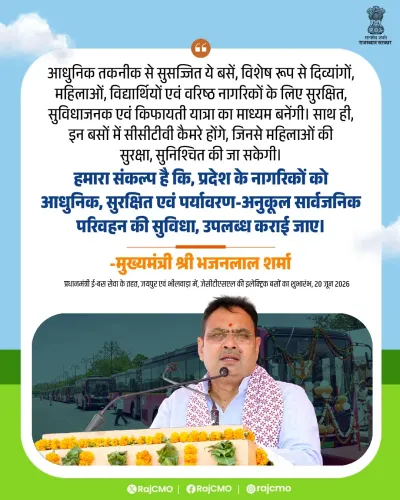
Rajasthan CM Bhajan Lal Sharma posted a public commitment on 16 November 2026 to provide accessible, safe, and convenient public transport to every citizen.
The pledge specifically targets both urban and rural areas , acknowledging the connectivity divide in India's largest state by area.
Sharma used the word 'sankalp' (solemn resolve), signalling this as a headline governance priority rather than a routine departmental update.
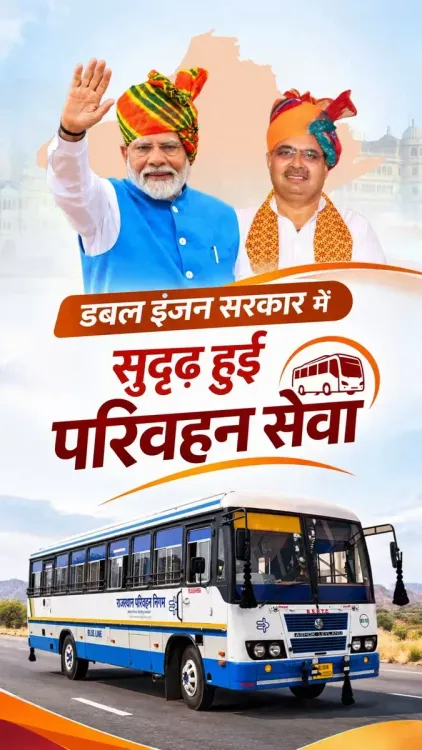
The post was accompanied by a video , suggesting a campaign or scheme context behind the statement.
Concrete follow-ups to watch include new bus routes, fleet additions, and budget provisions for Rajasthan's transport sector.
Every village, every city lane — Rajasthan Chief Minister Bhajan Lal Sharma has publicly committed his government to delivering smooth, safe, and convenient public transport to each of the state's citizens, with a particular push to bridge the connectivity gap between urban centres and rural communities.
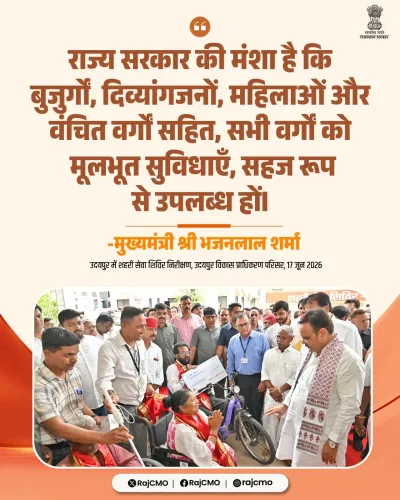
Posting on 16 November 2026, the Chief Minister wrote: 'प्रदेश के हर नागरिक को सुगम, सुरक्षित एवं सुविधाजनक सार्वजनिक परिवहन सेवाएं उपलब्ध कराना हमारा संकल्प है' — 'It is our resolve to provide accessible, safe, and convenient public transport services to every citizen of the state.' He added that the state government is working 'with full commitment' to expand transport facilities in both urban and rural areas, making daily commutes easier for ordinary people.
The Rural-Urban Gap Rajasthan Must Close
Rajasthan's sheer geography makes this pledge meaningful. The state is India's largest by area, stretching across desert plains, tribal belts, and semi-arid hinterlands where the last bus to the nearest town can determine whether a child reaches school or a patient reaches a hospital. Connecting this spread is not a routine administrative task — it is a governance challenge that successive state governments have grappled with for decades.
Indian state governments have long tied public transport expansion to broader goals: cutting road accidents, reducing private vehicle congestion in cities, and giving rural households access to economic opportunity without owning a vehicle. Sharma's framing of transport access as a 'sankalp' — a solemn resolve — signals this is intended as a headline commitment, not a one-line budget footnote.
What the Commitment Needs to Become Policy
A pledge becomes a programme when it comes with numbers: new bus routes, fleet additions, driver recruitment, and budget lines. The post accompanies a video, suggesting a campaign or scheme context, though specifics of any linked announcement remain to be detailed in formal government communications. Watchers of Rajasthan's transport sector will look for follow-up on route expansions — particularly in districts where connectivity is weakest — and any budgetary provision that backs the rhetoric.
Until then, CM Sharma has drawn a clear public line: the measure of his government's transport policy will be whether a villager in a remote corner of Rajasthan can board a state bus without uncertainty. That is a standard his administration has now set for itself.
Point of View
Reminding rural constituencies that the government sees them. The real test is whether this translates into measurable fleet expansion and new routes in underserved districts. For the BJP in Rajasthan, keeping rural voters satisfied between election cycles requires visible delivery on exactly this kind of bread-and-butter infrastructure promise. The framing of transport access as a 'sankalp' rather than a mere policy goal raises the stakes: it invites accountability the moment follow-through lags.
NationPress
16 Nov 2026
Frequently Asked Questions
What did CM Bhajan Lal Sharma say about public transport in Rajasthan?
CM Bhajan Lal Sharma pledged that his government is fully committed to providing accessible, safe, and convenient public transport to every citizen of Rajasthan, with a focus on expanding services in both urban and rural areas.
Which areas does Rajasthan's transport expansion plan target?
The commitment targets both urban centres and rural areas of Rajasthan, aiming to make daily commutes easier for ordinary residents across the state.
Why is public transport connectivity a challenge in Rajasthan?
Rajasthan is India's largest state by area, with vast desert plains, tribal belts, and remote hinterlands where reliable bus services are critical for access to education, healthcare, and economic opportunity.
What specific transport schemes has the Rajasthan government announced?
No specific new scheme details have been formally announced alongside this statement. Watchers expect follow-up on new bus routes, fleet additions, and budget provisions in coming government communications.
Who is Bhajan Lal Sharma?
Bhajan Lal Sharma is the Chief Minister of Rajasthan and a BJP leader, serving as the head of the state government.