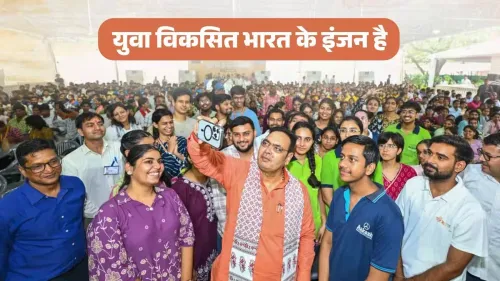
CM Bhajan Lal Sharma credits Modi for Viksit Bharat 2047 vision
Synopsis
Rajasthan CM Bhajan Lal Sharma invoked Chandrayaan-3, mobile manufacturing, the India Semiconductor Mission, Startup India and UPI on 12 November 2026 to argue that PM Modi's Viksit Bharat 2047 vision is not just achievable — it is already under way.
Key Takeaways
Rajasthan CM Bhajan Lal Sharma posted on 12 November 2026 crediting PM Modi for India's technology and innovation milestones.
Chandrayaan-3 achieved the world's first soft landing near the lunar south pole in August 2023 .
The India Semiconductor Mission carries a Rs 76,000 crore outlay to build indigenous chip-fabrication capacity.
Startup India , launched in January 2016 , has helped create one of the world's largest startup ecosystems.
UPI , born from the 2015 Digital India initiative, processes billions of transactions monthly and is being adopted globally.
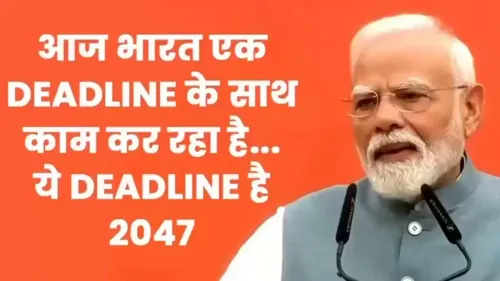
All achievements are framed by Sharma as evidence that Viksit Bharat 2047 — developed India by the Independence centenary — is on course.
From the Moon's south pole to a semiconductor foundry, India has been racking up milestones that once looked impossible — and Rajasthan Chief Minister Bhajan Lal Sharma wants every citizen to feel the momentum. On Thursday, 12 November 2026, Sharma posted a pointed reminder that the country's run of breakthroughs is proof enough that the Viksit Bharat 2047 pledge will not remain a slogan.
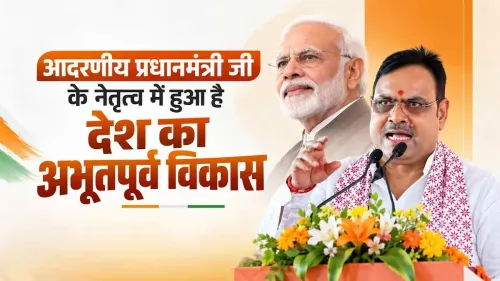
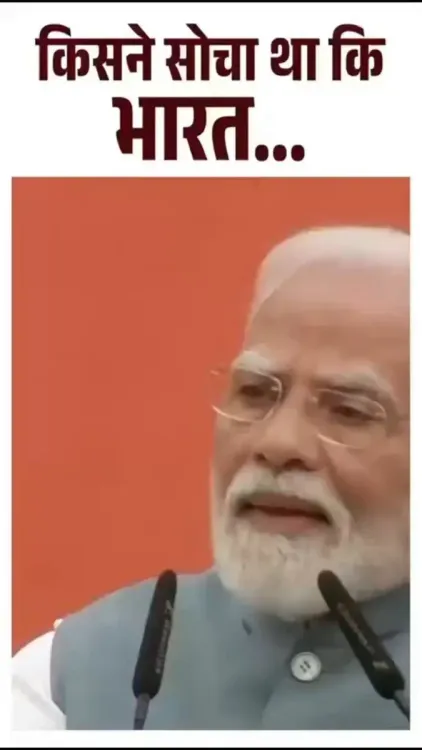
Quoting the post in translation: 'Chandrayaan ki aitihasik safalta se lekar mobile nirman, semiconductor, startup aur digital bhugtan ke kshetra mein Bharat ki uplabdhiyan...' — 'From the historic success of Chandrayaan to mobile manufacturing, semiconductors, startups and digital payments, India's achievements are proof of the country's capability and collective effort. When the country has made seemingly impossible targets possible, the resolve of Viksit Bharat 2047 will certainly be realised.' The tribute was directed squarely at Prime Minister Narendra Modi, whom Sharma addressed as 'Honourable Prime Minister.'
Chandrayaan-3 to chip fabs: the evidence Sharma cites
The achievements Sharma invokes are not rhetorical. In August 2023, ISRO's Chandrayaan-3 became the first mission in history to soft-land near the lunar south pole — a feat that placed India in an exclusive club alongside the United States, Russia and China. The mission's success catalysed fresh public pride and international credibility for India's space programme.
On the manufacturing front, India has emerged as the world's second-largest mobile phone producer, a transformation driven by production-linked incentive schemes. The India Semiconductor Mission, approved with a Rs 76,000 crore outlay, is designed to build an indigenous chip-fabrication ecosystem and reduce the crippling import dependence that exposed supply-chain vulnerabilities during the global semiconductor shortage. Meanwhile, Startup India, launched in January 2016, has seeded one of the world's largest startup ecosystems, now home to over a hundred unicorns.
Digital payments may be the most visible proof point of all. India's Unified Payments Interface (UPI), born out of the Digital India initiative launched in 2015, now processes billions of transactions monthly and has been exported as a model to countries across Asia, Africa and beyond.
Viksit Bharat 2047 — the target anchoring it all
Sharma's post is consciously pegged to Viksit Bharat 2047, the central government's overarching vision to transition India into a fully developed economy by the centenary of Independence. The goal fuses incremental sectoral wins — space, semiconductors, digital infrastructure, clean energy — into a single narrative arc stretching to 2047. Each milestone Sharma cites is meant to serve as a data point on that longer journey, not merely a trophy moment.
The logic Sharma deploys is deliberate: if Chandrayaan succeeded against the odds, and if a country of 1.4 billion people leapfrogged to become a global digital-payments leader, then a developed-economy target two decades away is not a fantasy — it is a trajectory. The post functions as both political endorsement and motivational argument, attributing the arc of achievement to Modi's leadership.
Semiconductor fabs moving to operational status and ISRO's crewed Gaganyaan mission will be the next concrete stress-tests of that trajectory — the moments that will tell us whether the momentum is structural or merely symbolic.
Point of View
Verifiable wins — a lunar landing, a payments revolution, a chip-manufacturing push — into a single forward-looking promise branded Viksit Bharat 2047. It serves a dual purpose: reinforcing Modi's developmental credentials among the party's base while positioning Rajasthan's leadership as firmly aligned with New Delhi's agenda. The timing, well ahead of any immediate electoral trigger, suggests this is part of a sustained long-arc communication strategy rather than an opportunistic burst. As semiconductor fabs move toward production and Gaganyaan edges closer to launch, the BJP will likely lean harder on this 'impossible made possible' frame to defend its governance record heading into the centenary decade.
NationPress
12 Nov 2026
Frequently Asked Questions
What is Viksit Bharat 2047?
Viksit Bharat 2047 is the Indian government's long-term vision to transform India into a fully developed economy by 2047, the centenary of Independence, by building capabilities across technology, manufacturing, infrastructure and social indicators.
What was Chandrayaan-3's achievement?
Chandrayaan-3 achieved India's first successful soft landing on the Moon, touching down near the lunar south pole in August 2023 — a historic first for any nation in that region of the Moon.
What is the India Semiconductor Mission?
The India Semiconductor Mission is a government programme approved in 2021 with a Rs 76,000 crore outlay to establish semiconductor chip fabrication and design infrastructure in India and reduce import dependence.
Why is Bhajan Lal Sharma posting about PM Modi's achievements?
As Rajasthan Chief Minister and BJP leader, Sharma regularly amplifies the central government's developmental agenda; this post cites India's tech milestones to reinforce confidence in the Viksit Bharat 2047 goal under PM Modi's leadership.
How has India's digital payments sector grown under Digital India?
India's UPI, launched under the Digital India initiative in 2015, has grown into one of the world's largest real-time payments platforms, processing billions of transactions every month and being adopted as a model by several other countries.