CM Bhajan Lal Sharma hails India's poverty exit milestone
Synopsis
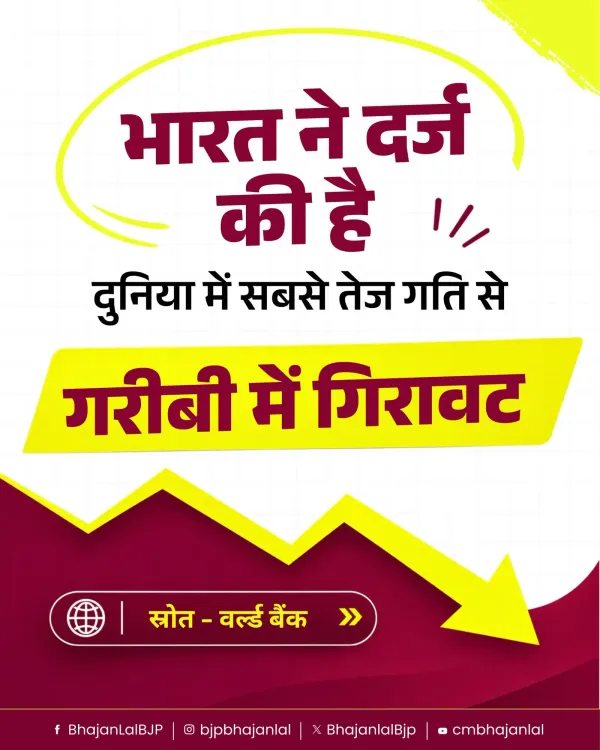
Rajasthan Chief Minister Bhajan Lal Sharma praised India's poverty-reduction record on 2 November 2026, citing 49.6 crore people exiting poverty and a 90% drop in extreme deprivation, linking the achievement to PM Modi's leadership and the Viksit Bharat 2047 vision.
Key Takeaways
49.6 crore Indians have reportedly exited poverty, according to figures cited by CM Sharma.
Extreme poverty has declined by 90 per cent , per the same claim.
Sharma frames the milestone within the Viksit Bharat @ 2047 framework — India's goal of becoming a developed nation by its independence centenary.
NITI Aayog's National MPI is the government's standard tool for tracking multidimensional poverty across health, education, and living standards.
The Aspirational Districts Programme (2018) forms part of the policy lineage Sharma's remarks implicitly invoke.
The precise source and methodology behind the cited figures await confirmation from NITI Aayog's next official MPI update.
Nearly 49.6 crore Indians have moved out of poverty and extreme deprivation has fallen by 90 per cent — numbers that Rajasthan Chief Minister Bhajan Lal Sharma placed at the centre of a sweeping welfare tribute on Monday, 2 November 2026, crediting the trajectory to the vision of Prime Minister Narendra Modi.
What Sharma said — and why the numbers carry weight
Writing in Hindi, the Chief Minister declared that India has achieved a 'remarkable milestone in the direction of poverty eradication' under Modi's leadership. 'समाज के अंतिम पायदान पर खड़े व्यक्ति तक विकास का लाभ पहुँचाना' — 'reaching the last person standing at the bottom rung of society with the fruits of development' — he wrote, framing the statistics not as a bureaucratic data point but as a moral obligation fulfilled.
The figures Sharma cites echo the logic of the National Multidimensional Poverty Index (MPI), the benchmark published by NITI Aayog that measures poverty across health, education, and living standards rather than income alone. The government think tank's baseline work, which tracked trends from 2005–06 to 2015–16, established the methodology that subsequent administrations have used to chart welfare gains.
The Viksit Bharat 2047 scaffolding behind the claim
Sharma explicitly anchors the poverty data to Viksit Bharat @ 2047, the flagship national vision to make India a fully developed economy by the centenary of independence. The framework links measurable welfare outcomes — housing, nutrition, direct benefit transfers — to a long-run growth ambition, giving state-level leaders a narrative spine for communicating central schemes to local audiences.
The Aspirational Districts Programme, launched in 2018, sits in the same lineage: a Centre-driven push to lift the most backward districts by accelerating progress on social indicators. Sharma's post signals that Rajasthan's ruling dispensation is firmly synchronised with that federal welfare story, positioning the state as an active participant rather than a passive beneficiary.
The data caveat India's policymakers will be watching
The precision of the figures — exactly 49.6 crore people and a 90 per cent drop in extreme poverty — raises a legitimate methodological question: which report, which year, and by which measure? NITI Aayog's next MPI update, when it arrives, will either substantiate or qualify the headline. Until then, the numbers function primarily as a political-communication benchmark, situating India's welfare narrative on the world stage at a moment when the government is also defining its 2047 development roadmap.
What is not in dispute is the direction of travel. Successive MPI releases have shown consistent, material reductions in multidimensional poverty — a trend that spans both the UPA and NDA eras, and one that has attracted international attention for its scale and speed.
Point of View
Making it harder to contest on purely technical grounds. The unresolved question of source methodology, however, means the figures remain politically potent but empirically provisional — a gap that opposition parties and independent researchers will exploit if NITI Aayog's next MPI release does not corroborate the headline numbers. Watch for the next Union Budget to see whether fresh welfare outlays are pegged to this poverty-exit narrative.
NationPress
2 Nov 2026
Frequently Asked Questions
How many people have come out of poverty in India according to CM Bhajan Lal Sharma?
CM Bhajan Lal Sharma cited a figure of 49.6 crore (496 million) people exiting poverty in India. The precise source and methodology behind this number are pending official confirmation from NITI Aayog.
What is Viksit Bharat 2047?
Viksit Bharat @ 2047 is India's official long-term vision to become a fully developed nation by 2047 , the centenary of independence, with a focus on last-mile welfare delivery, economic growth, and improved quality of life for every citizen.
What is India's National Multidimensional Poverty Index?
The National Multidimensional Poverty Index (MPI) is published by NITI Aayog and measures poverty across three dimensions — health, education, and living standards — rather than income alone. Its baseline covered trends from 2005–06 to 2015–16 .
What did Rajasthan CM Bhajan Lal Sharma post about poverty on 2 November 2026?
CM Sharma posted on X on 2 November 2026 praising PM Modi's leadership for India's poverty-reduction gains, citing 49.6 crore people exiting poverty and a 90 per cent decline in extreme poverty , and linking the achievement to the Viksit Bharat 2047 vision.
What is the Aspirational Districts Programme?
The Aspirational Districts Programme was launched in 2018 to fast-track development indicators in India's most backward districts, forming part of the central government's framework for last-mile welfare delivery.