CM Bhajanlal Directs Collectors to Clear Land Cases via Seva Shivirs
Synopsis
CM Bhajanlal Sharma's office has directed all District Collectors in Rajasthan to use seva shivirs — public service camps — to resolve encroachment and revenue cases, offering citizens relief from disputes pending for years.
Key Takeaways
The Chief Minister's Office of Rajasthan issued the directive on 20 June 2026 via its official X account.
District Collectors have been asked to use seva shivirs (service camps) to resolve encroachment and revenue cases.
The directive targets relief for citizens suffering from disputes that have remained unresolved for years .
The initiative aligns with the BJP government's post-2023 push for administrative efficiency and pendency reduction in revenue courts.
Rajasthan's camp-based service delivery model has precedent under the Rajasthan Public Service Guarantee Act framework.
The post was tagged with #AapnoAgraniRajasthan , the current government's flagship development-outreach branding.
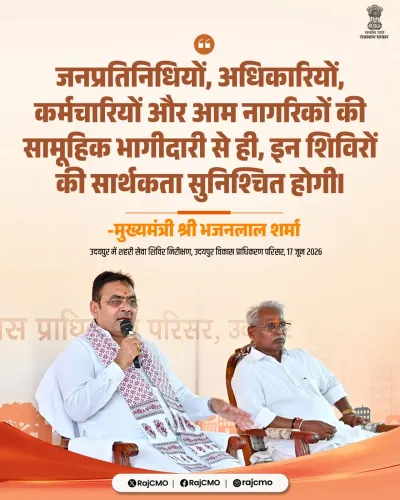
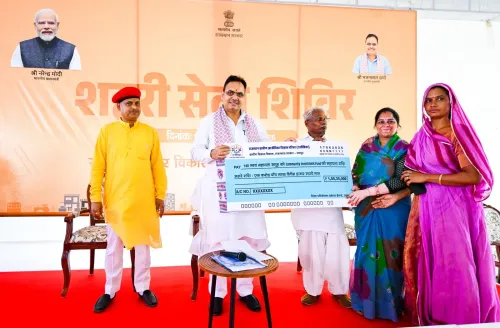
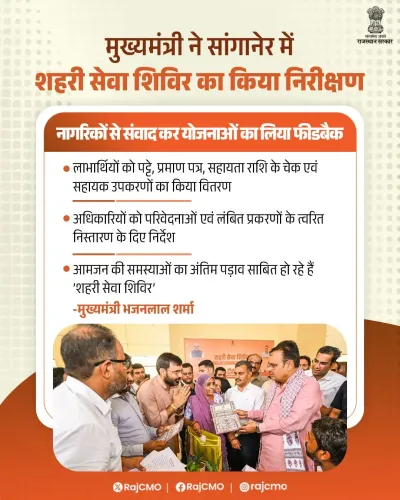
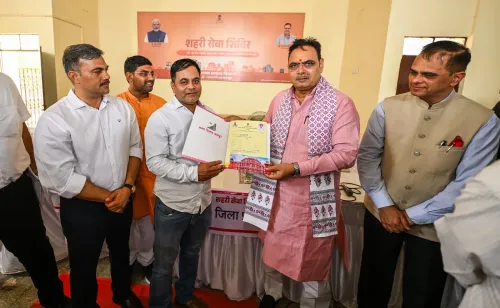
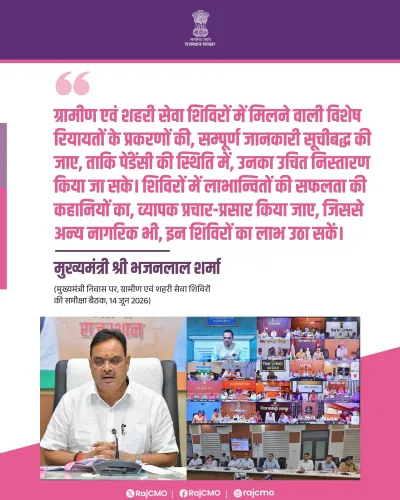
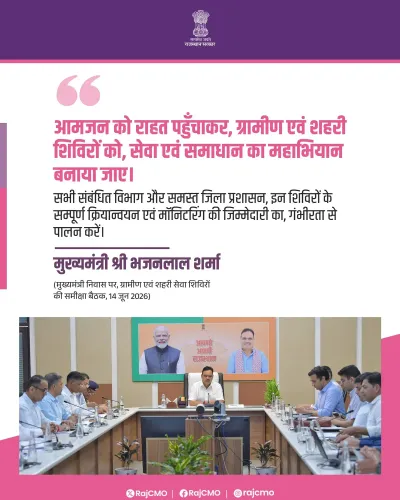
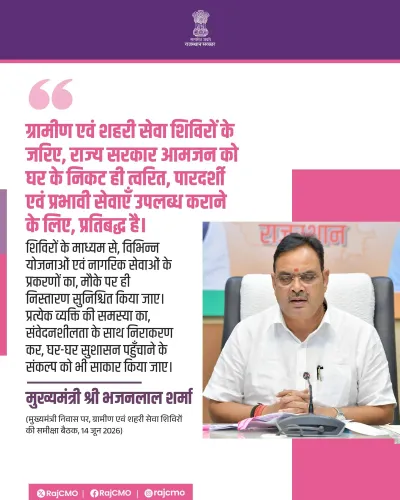
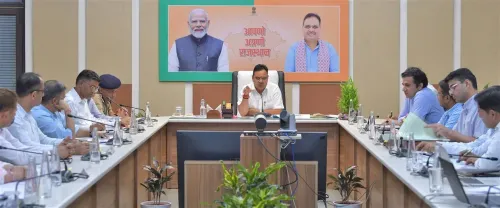
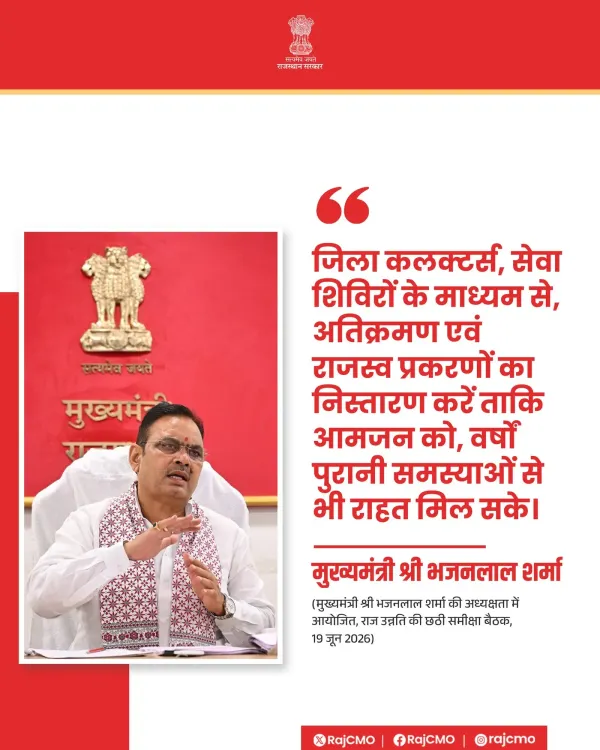
The Chief Minister's Office of Rajasthan, on behalf of Chief Minister Bhajanlal Sharma, on Saturday, 20 June 2026, directed all District Collectors across the state to resolve encroachment and revenue cases through dedicated service camps, aiming to provide relief to citizens burdened by long-pending disputes.
The directive, posted on the official CMO account, states: 'Jila Kalktars, seva shiviron ke madhyam se, atikraman evam rajasva prakaranon ka nistaraan karen taaki aamjan ko, varshon purani samasyaon se bhi rahat mil sake' — 'District Collectors should, through service camps, resolve encroachment and revenue cases so that the common people can also get relief from problems that have persisted for years.'
Context
The instruction is directed at District Collectors, who serve as the principal revenue and administrative authority at the district level in Rajasthan. Land encroachment and revenue disputes — involving boundaries, title records, and unauthorised occupation of government or private land — represent one of the most persistent categories of unresolved cases in the state's administrative machinery. Citizens in rural and semi-urban areas have historically faced years-long waits for resolution, often requiring repeated visits to government offices. The post carries the hashtag #AapnoAgraniRajasthan (Aapno Agrani Rajasthan — 'Our Leading Rajasthan'), a branding phrase associated with the current BJP government's outreach and development messaging.Policy Backdrop
Following the BJP's victory in the December 2023 Rajasthan assembly elections, Chief Minister Bhajanlal Sharma prioritised administrative efficiency and the reduction of pendency in revenue courts. Rajasthan has a documented history of organising district-level public service camps — often called seva shivirs — under the framework of the Rajasthan Public Service Guarantee Act, which has been in operation since the early 2010s. These camps bring government officials directly to citizens, reducing the burden of travel and bureaucratic navigation. The current directive fits a broader pattern visible across BJP-governed states, where existing district machinery is activated for targeted grievance-clearance drives rather than creating new legislative frameworks. The emphasis is on measurable disposal of cases within defined camp timelines.Stakeholders and Impact
The primary beneficiaries of this directive are common citizens, farmers, and landowners in Rajasthan, particularly those with disputes that have remained unresolved for years or decades. Encroachment cases frequently involve agricultural land boundaries and government land, while revenue cases span inheritance records, mutation entries, and title corrections — issues that directly affect livelihoods and property rights. District Collectors will bear the operational responsibility of organising, scheduling, and reporting on these camps. The directive signals a top-down push from the Chief Minister's Office to ensure that camp-based resolution is not discretionary but expected as a standard administrative function.What's Next
Attention will now turn to whether the Rajasthan Revenue Department issues a formal circular setting timelines, targets, and reporting formats for the camps. District-wise data on case disposals — particularly the number of encroachment and revenue matters settled per camp — will be the key metric by which the initiative's effectiveness is judged. A follow-up review by the Chief Minister's Office or the state revenue department is the logical next step, and any such review could determine whether the camp model is scaled up or made mandatory on a fixed periodic schedule across all 33 districts of Rajasthan.Point of View
Not merely a bureaucratic matter. It fits a pattern in BJP-governed states of using camp-based outreach as a visible, citizen-facing governance tool that doubles as political messaging. The choice to invoke 'years-old problems' is deliberate, implicitly drawing a contrast with prior governments' handling of revenue backlogs. Whether the directive translates into measurable outcomes will depend entirely on whether formal targets and accountability mechanisms follow.
NationPress
20 Jun 2026
Frequently Asked Questions
What are seva shivirs in Rajasthan?
Seva shivirs are public service camps organised at the district level in Rajasthan where government officials, including revenue staff, meet citizens directly to resolve pending cases and deliver services without requiring people to visit offices repeatedly.
What types of cases will District Collectors resolve through these camps?
District Collectors have been directed to focus on encroachment cases — involving unauthorised occupation of land — and revenue cases such as mutation entries, title corrections, and inheritance records that have remained pending for years.
Who is CM Bhajanlal Sharma?
Bhajanlal Sharma is the Chief Minister of Rajasthan, in office since December 2023 following the BJP's victory in the state assembly elections. His government has emphasised administrative efficiency and grievance redressal.
How many districts does Rajasthan have?
Rajasthan has 33 districts , each headed by a District Collector who is responsible for revenue administration, law and order, and public service delivery.
What is the Rajasthan Public Service Guarantee Act?
The Rajasthan Public Service Guarantee Act is a state law that mandates time-bound delivery of specified government services to citizens. It has provided the framework for camp-based service delivery initiatives in Rajasthan since the early 2010s.