CM Bhajanlal Directs Pre-Monsoon Drain, Road Work Completion
Synopsis
The Chief Minister's Office of Rajasthan on 20 June 2026 directed civic bodies to complete drain desilting and road patchwork before the monsoon, with CM Bhajan Lal Sharma's office underlining the urgency of seasonal infrastructure preparedness across the state.
Key Takeaways
The Chief Minister's Office of Rajasthan issued a pre-monsoon infrastructure directive on 20 June 2026 .
The order calls for completion of drain cleaning and road patchwork before rains arrive.
The directive is attributed to Chief Minister Bhajan Lal Sharma of the BJP, sworn in December 2023.
Rajasthan cities such as Jaipur and Jodhpur face annual risks of waterlogging and road damage during the June–September monsoon.
Municipal corporations and local bodies are the implementing agencies responsible for on-ground execution.
Compliance and flood outcomes during the 2026 monsoon season will be the real measure of the directive's effectiveness.
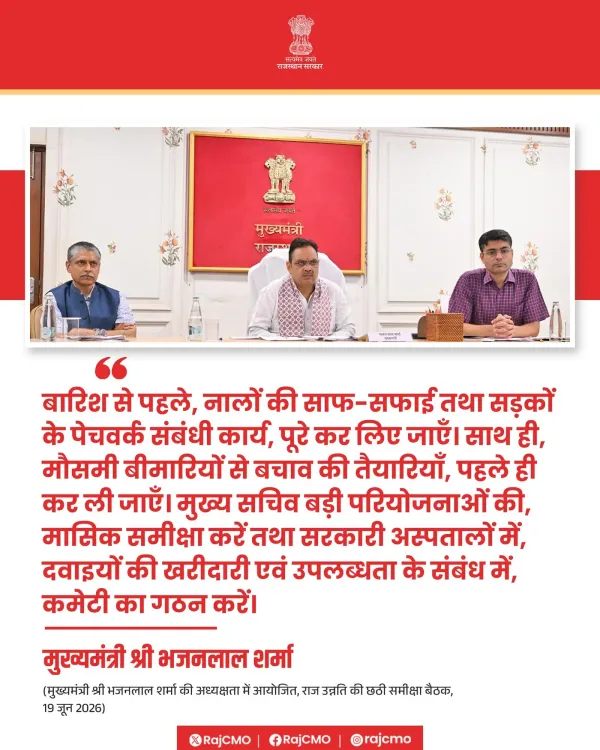
The Chief Minister's Office of Rajasthan on Saturday, 20 June 2026, issued a directive in the name of Chief Minister Bhajan Lal Sharma, calling on civic authorities to complete drain cleaning and road patchwork across the state before the onset of the monsoon season.
Context
The post, shared under the hashtag #आपणो_अग्रणी_राजस्थान ('Our Leading Rajasthan'), states plainly: 'बारिश से पहले, नालों की साफ-सफाई तथा सड़कों के पेचवर्क संबंधी कार्य, पूरे कर लिए जाएँ' — 'Before the rains, work related to drain cleaning and road patchwork must be completed.' The directive is tagged to @BhajanlalBjp, the official handle of Chief Minister Sharma, signalling that the instruction carries the weight of the top executive office.
Rajasthan receives the bulk of its annual rainfall between June and September. Major urban centres including Jaipur and Jodhpur regularly face waterlogging and pothole-related road accidents when monsoon rains arrive before civic preparedness work is finished.
Policy Backdrop
Pre-monsoon drain desilting and road repair are a recurring feature of urban administration across Indian states. Rajasthan's civic bodies — including municipal corporations in its larger cities — have carried out such seasonal drives in previous years as part of standard maintenance cycles.
The directive follows a well-established administrative pattern: state governments issue top-down instructions to municipal bodies ahead of the monsoon to reduce the risk of flooding, waterlogging, and traffic fatalities caused by deteriorated roads. The Chief Minister's direct intervention signals that the government is treating timely completion as a priority rather than leaving it to routine municipal scheduling.
Stakeholders and Impact
Urban residents across Rajasthan's towns and cities are the primary beneficiaries of timely pre-monsoon infrastructure work. Blocked or silted drains are a leading cause of localised flooding that damages property, disrupts livelihoods, and poses public health risks during the rainy season.
Municipal corporations and local bodies are the implementing agencies that will need to mobilise workers and machinery to meet the deadline implied by the directive. Compliance with such orders — and the speed of execution — typically varies across urban local bodies depending on available resources and administrative capacity.
What's Next
The practical test of this directive will come when the 2026 monsoon arrives in Rajasthan, expected in the coming weeks. Compliance reports from municipal corporations and any incidents of urban flooding or road accidents will indicate how effectively the instruction was translated into ground-level action.
Sustained follow-through — including inspection mechanisms and accountability for local officials — will determine whether this pre-monsoon push results in measurably better outcomes for residents compared to previous years.
Point of View
The post personalises accountability, a deliberate framing choice. The 'Aapno Agraṇi Rajasthan' hashtag situates even routine maintenance within a broader brand narrative of proactive leadership. Whether the directive translates into measurable improvement depends on the state's ability to enforce timelines across dozens of urban local bodies — a challenge that has tripped up previous administrations in the state.
NationPress
20 Jun 2026
Frequently Asked Questions
What did the Rajasthan CMO direct on 20 June 2026?
The Chief Minister's Office of Rajasthan directed civic bodies to complete drain cleaning and road patchwork across the state before the monsoon season begins.
Why is pre-monsoon drain cleaning important in Rajasthan?
Clogged or silted drains cause waterlogging and localised flooding during the June–September monsoon in cities like Jaipur and Jodhpur, damaging property and posing public health risks.
Who is the Chief Minister of Rajasthan in 2026?
Bhajan Lal Sharma of the Bharatiya Janata Party is the Chief Minister of Rajasthan, having been sworn in during December 2023.
Which agencies are responsible for carrying out the pre-monsoon work in Rajasthan?
Municipal corporations and urban local bodies across Rajasthan are the implementing agencies responsible for drain desilting and road repair work.
What is the hashtag used by the Rajasthan CMO in this post?
The CMO used the hashtag #आपणो_अग्रणी_राजस्थान, which translates to 'Our Leading Rajasthan', a branding phrase used by the state government.