CM Bhajanlal Pledges Dense Plantation at Neendad Van for Eco-Tourism
Synopsis
The Rajasthan Chief Minister's Office announced CM Bhajanlal Sharma will develop Neendad Van through intensive plantation to promote nature tourism, aligning with the state's Harit Rajasthan afforestation programme and a broader strategy of linking green cover expansion with eco-tourism revenue in arid zones.
Key Takeaways
The Chief Minister's Office of Rajasthan announced on 30 May 2026 that Neendad Van will be developed through dense plantation.
The stated twin objective is expanding forest cover and promoting nature tourism in the area.
CM Bhajanlal Sharma described Neendad Van as 'extremely beautiful and full of possibilities.' The move aligns with the state's Harit Rajasthan afforestation programme launched in 2023 .
The Rajasthan Forest Department is the implementing agency for plantation and eco-tourism infrastructure.
Budget allocations and plantation targets are yet to be officially disclosed; the 2026-27 state budget is the next milestone to watch.
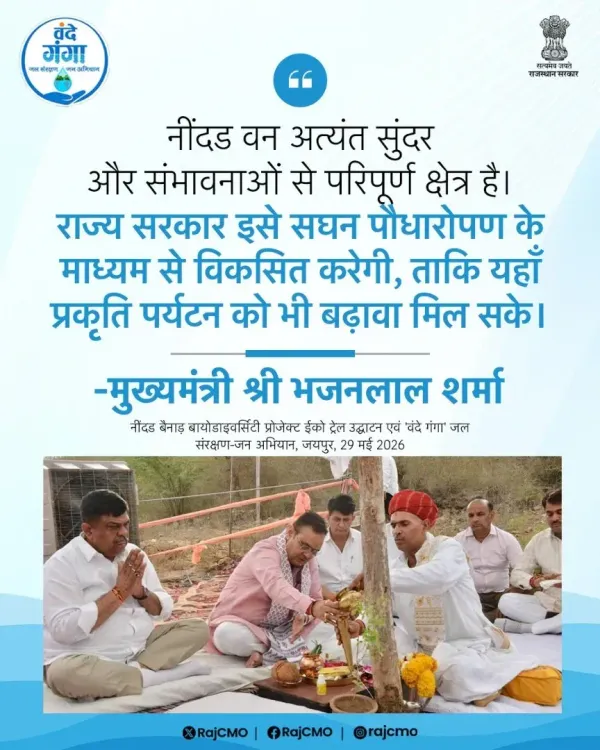
The Chief Minister's Office of Rajasthan announced on Saturday, 30 May 2026 that the state government will develop Neendad Van through intensive plantation drives, with the explicit goal of promoting nature tourism in the forest area. Chief Minister Bhajanlal Sharma described the region as 'extremely beautiful and full of possibilities,' signalling a policy push that links afforestation with eco-tourism revenue generation.
Context
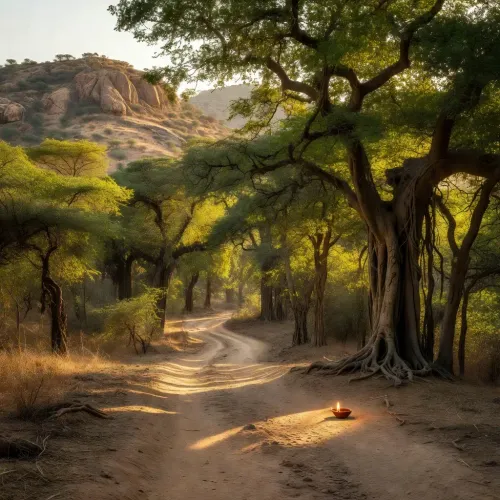
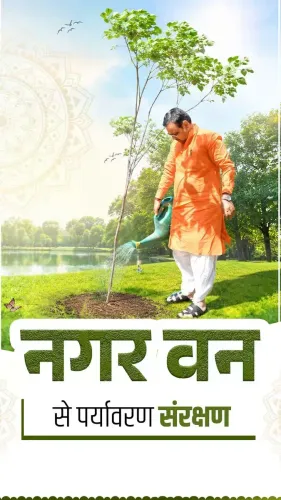
The post, shared from the official Rajasthan Chief Minister's Office handle and tagged to @BhajanlalBjp, states in Hindi: 'Neendad Van atyanth sundar aur sambhavnaon se paripurn kshetra hai' ('Neendad Van is an extremely beautiful and possibility-filled region'). The government, it adds, will develop it through 'dense plantation' so that nature tourism can also be promoted there. The message was accompanied by an image and carried the hashtag #AapnoAgrani_Rajasthan ('Our Pioneering Rajasthan'), the BJP state government's signature campaign branding.
Policy Backdrop
The announcement fits squarely within Rajasthan's Harit Rajasthan (Green Rajasthan) programme launched in 2023, which targets large-scale afforestation and expanded green cover across the state. The Rajasthan Forest Department is the nodal agency responsible for implementing plantation drives and building eco-tourism infrastructure. Rajasthan governments across party lines have long linked afforestation with eco-tourism as a dual strategy — meeting national forest-cover targets while generating income in ecologically fragile arid and semi-arid zones.
The current BJP administration, in power since December 2023, has continued and expanded on earlier schemes that promoted nature tourism in districts with existing forest patches. The approach mirrors similar state-level models in Gujarat and Madhya Pradesh, where regulated visitor access to plantation zones has been combined with community-based tourism to create sustainable livelihoods.
Stakeholders and Impact
Local communities living near Neendad Van stand to benefit most directly — both from the ecological improvements that dense plantation brings and from potential employment in nature-tourism operations such as guided trails, homestays, and forest camps. Tourism operators in the region could see new business opportunities if the state follows through with supporting infrastructure such as access roads, visitor centres, and regulated entry systems.
Environmental groups and forest-rights activists will likely watch whether the plantation drive prioritises native species suited to Rajasthan's arid ecology, a concern that has accompanied earlier afforestation pushes in the state. The balance between tourism footfall and forest conservation will be a key pressure point as plans take shape.
What's Next
Concrete details — including the scale of plantation targets, the timeline, and the budget — have not yet been disclosed. Observers should track the 2026-27 Rajasthan state budget and the Forest Department's annual plan for dedicated allocations or tender notices related to Neendad Van. Any formal eco-tourism policy notification or a district-level project report from the Forest Department would be the next administrative milestone confirming the government's commitment. If Neendad Van follows the trajectory of other Rajasthan forest-tourism sites, a phased development plan with community involvement could emerge as the model.
Point of View
The announcement remains aspirational until budget lines and project timelines are published, and the choice of tree species will determine whether the plantation genuinely strengthens the ecosystem or merely adds to canopy-count statistics. Local community inclusion will be the real test of whether this initiative departs meaningfully from earlier, top-down plantation drives.
NationPress
13 Oct 2026
Frequently Asked Questions
What is Neendad Van in Rajasthan?
Neendad Van is a forest area in Rajasthan identified by the state government as a region of natural beauty and ecological potential, now earmarked for dense plantation and nature-tourism development.
What did CM Bhajanlal Sharma say about Neendad Van?
CM Bhajanlal Sharma, through the official CMO handle, described Neendad Van as 'extremely beautiful and full of possibilities' and said the state government will develop it through intensive plantation to promote nature tourism.
What is the Harit Rajasthan programme?
Harit Rajasthan is a large-scale afforestation programme launched by the Rajasthan government in 2023, aiming to increase green cover across the state through systematic plantation drives.
How will Neendad Van plantation benefit local communities?
Dense plantation at Neendad Van is expected to create employment and business opportunities for local communities through nature-tourism activities such as guided trails, homestays, and forest camps, while also improving the local ecology.
When will the Neendad Van development project begin?
Specific timelines and budget allocations have not yet been announced. The 2026-27 Rajasthan state budget and the Forest Department's annual plan are expected to carry the first concrete details of the project.