CM Bhupendra Patel Drives Revenue Service Modernisation in Gujarat

Synopsis
The Chief Minister's Office of Gujarat on 3 July 2026 spotlighted ongoing efforts under CM Bhupendra Patel to make revenue services ultra-modern and effective for citizens, continuing the state's long-standing e-governance and paperless administration agenda.
Key Takeaways
The Chief Minister's Office of Gujarat posted on 3 July 2026 highlighting revenue service modernisation under CM Bhupendra Patel .
The initiative aims to make revenue services 'ultra-modern and effective' for ordinary Gujarat citizens.
Gujarat has been digitising land and revenue records since the National Land Records Modernisation Programme of 2008 .
Key services being upgraded include land mutation, certified document copies, and grievance redressal.
The reforms align with the national Digital India programme and aim to reduce citizens' physical visits to revenue offices.
Upcoming announcements on new portals or mobile applications and transaction-volume data will be key indicators of progress.
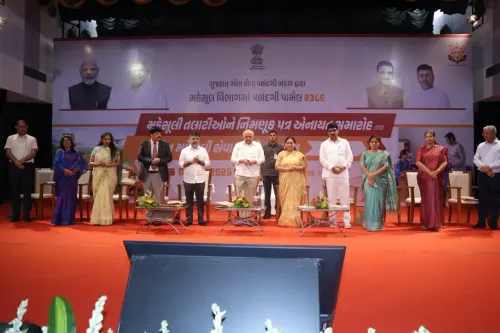
The Chief Minister's Office of Gujarat on Friday, 3 July 2026, highlighted the state government's ongoing commitment to upgrading revenue services for ordinary citizens under the leadership of Chief Minister Bhupendra Patel, sharing what it described as news of Gujarat forging ahead in making revenue administration modern and effective.
The post, published under the hashtag #અગ્રેસર_ગુજરાત ('Gujarat Always Ahead'), invited citizens to learn about steps being taken to make revenue services 'ultra-modern and effective for the common people' under CM Patel's leadership.
Context
Gujarat has long positioned itself as a frontrunner in digitising land and revenue administration. The state's push to reduce physical visits to revenue offices and shorten service timelines has been a defining feature of its governance model across successive administrations. The current communication from the Chief Minister's Office frames ongoing upgrades as a continuation of this established agenda.
Revenue services — covering land records, mutation, certified copies of documents, and related grievance redressal — directly affect millions of landowners and ordinary citizens who must interact with the state's administrative machinery for property transactions, inheritance, and agricultural matters.
Policy Backdrop
The modernisation of land and revenue records in Gujarat traces its formal lineage to the National Land Records Modernisation Programme, launched in 2008, which encouraged states to computerise land records and introduce online services. Gujarat was among the early adopters, rolling out platforms for online mutation requests and digitally certified document copies.
These state-level efforts have continued alongside and in alignment with the national Digital India programme, which seeks to deliver government services electronically at scale. Chief Minister Bhupendra Patel, who has helmed the state since 2021, has maintained this trajectory, with the administration periodically announcing enhancements to citizen-facing revenue portals and mobile-based service delivery.
Stakeholders and Impact
The primary beneficiaries of improved revenue services are Gujarat's landowners, farmers, and urban property holders — citizens who previously had to make multiple visits to taluka or district revenue offices to complete routine transactions. Digital and paperless processes reduce both time and opportunity costs for this group.
Broader administrative gains include reduced scope for delays and intermediaries in document processing, more transparent record-keeping, and faster grievance resolution. For the state government, higher transaction volumes processed digitally also serve as measurable indicators of governance efficiency.
What's Next
Observers will watch for the roll-out of any new revenue portals or mobile applications that the Chief Minister's Office may announce in the coming weeks, as well as official reports on transaction volumes and grievance redressal metrics. Such data would provide concrete evidence of the modernisation gains the government is signalling.
As Gujarat continues to position its administrative reforms as a model for other states, the pace and depth of revenue-service digitisation under CM Bhupendra Patel will remain a closely watched benchmark in India's broader e-governance landscape.
Point of View
Reinforcing the ruling administration's 'always ahead' brand ahead of what is likely a formal announcement of a new digital revenue tool or portal. Gujarat's consistent messaging around e-governance serves a dual purpose: it signals administrative competence to citizens and benchmarks the state against national Digital India targets. Under CM Bhupendra Patel, these communications have become a steady drumbeat, keeping the administration's reform credentials visible between larger policy announcements. The real test will be whether the signalled upgrades translate into measurable reductions in citizen grievances and processing times.
NationPress
3 Jul 2026
Frequently Asked Questions
What revenue services is Gujarat modernising in 2026?
The Gujarat government, under CM Bhupendra Patel, is working to make revenue services such as land mutation, certified document copies, and grievance redressal ultra-modern and digitally accessible, reducing the need for citizens to visit revenue offices in person.
Who is the Chief Minister of Gujarat in 2026?
Bhupendra Patel is the Chief Minister of Gujarat. He has held the position since 2021 and has continued the state's focus on e-governance and administrative modernisation.
What is the National Land Records Modernisation Programme?
The National Land Records Modernisation Programme, launched in 2008, encouraged Indian states including Gujarat to computerise land records and introduce online services for citizens, forming the policy foundation for current revenue digitisation efforts.
How does Gujarat's revenue modernisation connect to Digital India?
Gujarat's state-level revenue digitisation efforts run alongside and complement the national Digital India programme, which aims to deliver government services electronically at scale and reduce paperwork across all departments.
What should citizens watch for next regarding Gujarat revenue services?
Citizens and observers should watch for announcements of new revenue portals or mobile applications from the Gujarat government, as well as official data on digital transaction volumes and grievance redressal timelines as measures of progress.