CM Bhupendra Patel Flags CG Semi Chip Output Goals at Sanand

Synopsis
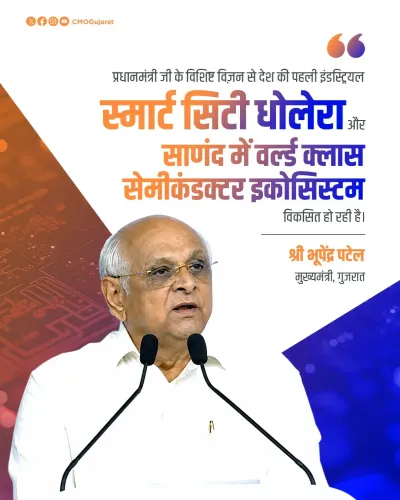
Gujarat Chief Minister Bhupendra Patel announced that CG Semi's Sanand plant will produce 20 crore chips annually, with a long-term target of 500 crore chips per year, as Prime Minister Modi visited the site under the SemiconHubBharat initiative.
Key Takeaways
CG Semi 's plant in Sanand, Gujarat is set to produce 20 crore chips per year at the outset.
The long-term production target for the facility is 500 crore chips annually .
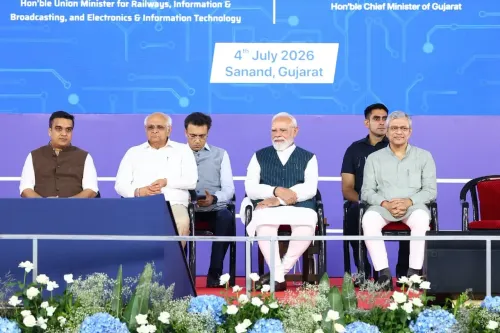
Prime Minister Narendra Modi visited the Sanand site, as indicated by the #PMinSanand hashtag on CM Patel's post.
The announcement aligns with India's Semicon India Programme , which carries a Rs 76,000 crore central outlay approved in December 2021 .
Sanand has emerged as Gujarat's key node for semiconductor and electronics investment under the national mission.
Scaling chip output domestically is central to India's strategy of reducing semiconductor import dependence.
Gujarat Chief Minister Bhupendra Patel on Saturday, 4 July 2026, highlighted the semiconductor production ambitions of CG Semi's plant in Sanand, Gujarat, stating that the facility is set to produce 20 crore chips annually at the outset, with a long-term target of 500 crore chips per year — remarks made in the context of Prime Minister Narendra Modi's visit to the site under the #SemiconHubBharat initiative.
Context
Patel posted on X, writing in Hindi: 'CG Semi ke plant se har saal 20 crore chips niklegi.. aur aage chalkar saal ki 500 crore chips ka lakshya rakha gaya hai' — ('The CG Semi plant will produce 20 crore chips every year.. and going forward, a target of 500 crore chips per year has been set'). The post tagged Prime Minister Narendra Modi and carried the hashtags #SemiconHubBharat and #PMinSanand, indicating the remarks were made during or around a high-profile visit to the Sanand industrial zone.
Sanand, located near Ahmedabad, has emerged as one of Gujarat's flagship industrial corridors, attracting investments in electronics, electric vehicles, and now semiconductors. CG Semi is among the companies developing semiconductor manufacturing capacity in the state.
Policy Backdrop
India's push into domestic chip manufacturing gained formal momentum when the Union Cabinet approved the Semicon India Programme in December 2021, committing an outlay of Rs 76,000 crore to support semiconductor fabrication, display manufacturing, and compound semiconductor units. The programme is administered through the India Semiconductor Mission, which offers fiscal incentives to approved applicants and coordinates with state governments on land and infrastructure.
Gujarat has actively positioned itself as a preferred destination for semiconductor investments, leveraging its established industrial infrastructure and proximity to ports. The state government's facilitation role — led by Chief Minister Patel — has been central to attracting units under the central mission's framework.
Stakeholders and Impact
A ramp-up to 500 crore chips annually at a single facility would represent a significant contribution to India's stated goal of reducing dependence on semiconductor imports, which currently account for a substantial share of the country's electronics input costs. The electronics manufacturing sector and downstream industries — from consumer devices to automotive components — stand to benefit from domestically produced chips at scale.
The Gujarat industrial workforce in and around Sanand is among the direct stakeholders, as semiconductor fabrication and assembly units typically generate both direct employment and ancillary economic activity. State-level supply chain development around the plant is also expected to follow as capacity scales.
What's Next
Attention will now turn to the production ramp-up timeline at the CG Semi facility — specifically how quickly the plant moves from its initial 20 crore chip annual run rate toward the 500 crore chip target. Further investment announcements under the Semicon India Programme are also being watched, as other states compete to host approved semiconductor units. Prime Minister Modi's presence at Sanand signals continued central government emphasis on semiconductor self-reliance as a strategic priority for India's technology and industrial policy.
Point of View
Semiconductor manufacturing in Gujarat serves a dual narrative purpose — national self-reliance in strategic technology and state-level industrial achievement ahead of any electoral cycle. The broader pattern suggests that announcements tied to PM-level visits are designed to lock in political ownership of the semiconductor story for both the Centre and the state.
NationPress
4 Jul 2026
Frequently Asked Questions
What is CG Semi and where is its plant located?
CG Semi is a company developing semiconductor manufacturing capacity in India, with its plant located in Sanand , an industrial area near Ahmedabad in Gujarat .
How many chips will the CG Semi Sanand plant produce?
According to Gujarat Chief Minister Bhupendra Patel , the plant will initially produce 20 crore chips per year , with a long-term target of 500 crore chips annually .
What is the Semicon India Programme?
The Semicon India Programme is a central government scheme approved in December 2021 with an outlay of Rs 76,000 crore to build domestic semiconductor fabrication, display manufacturing, and assembly capacity in India.
Why did PM Modi visit Sanand in July 2026?
Prime Minister Narendra Modi visited Sanand, Gujarat in connection with the #SemiconHubBharat initiative, as referenced in CM Bhupendra Patel's post on 4 July 2026 .
Why is Gujarat important for India's semiconductor mission?
Gujarat has positioned itself as a key destination for semiconductor investments under the national mission, leveraging its established industrial infrastructure in zones like Sanand and strong state-level facilitation by the government.