CM Bhupendra Patel Hikes Farmer Compensation for Power Lines
Synopsis
The Gujarat government under CM Bhupendra Patel has replaced the Jantri-based 200% compensation formula for farmers with twice the prevailing market rate for land used by power transmission lines and towers, and will pay all dues in a single lump-sum instalment.
Key Takeaways
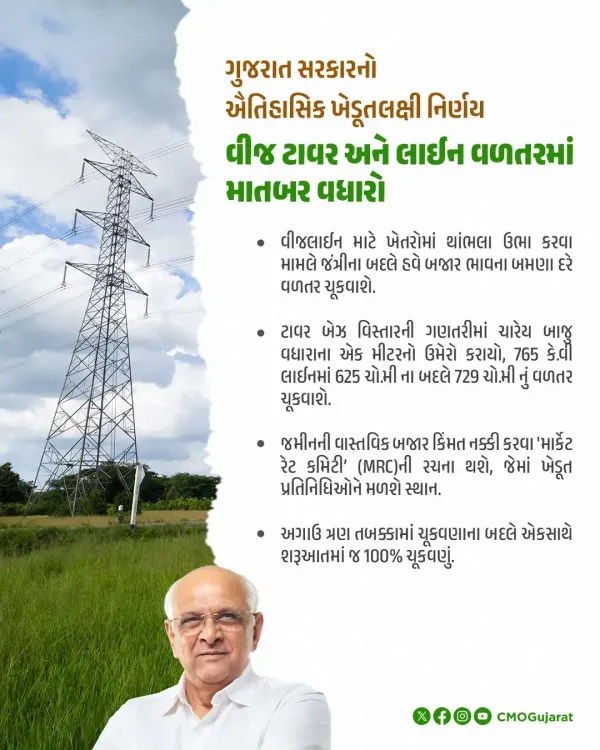
Gujarat CM Bhupendra Patel has approved a landmark revision to compensation norms for farmers whose land is used for electricity transmission lines and towers.
The new formula replaces 200% of the Jantri rate with twice the prevailing market rate of the affected land, a shift to a dynamic, market-linked benchmark.
A 1-metre perimeter around each tower base will now be included in the compensation area calculation.
All compensation will be paid in a single lump-sum instalment , ending staggered disbursements.
The decision is intended to reduce land-acquisition disputes that can delay Gujarat's expanding electricity transmission network .
The policy aligns Gujarat's norms with the spirit of the Land Acquisition Act, 2013 , which mandates market-value-based compensation for public infrastructure projects.
The Chief Minister's Office of Gujarat announced on Friday, 3 July 2026 that the state government, under the leadership of Chief Minister Bhupendra Patel, has taken a landmark decision to significantly raise compensation paid to farmers whose land is used for electricity transmission lines and towers.
Context
The post describes the decision as an 'ऐतिहासिक निर्णय' ('historic decision') in the interest of 'ધરતીપુત્રો' ('sons of the soil' — a common honorific for farmers). Under the revised policy, farmers will no longer be compensated at 200% of the Jantri rate — Gujarat's official government land valuation — but will instead receive twice the prevailing market rate of their land. This shift from a fixed administrative rate to a dynamic, market-linked benchmark represents a material upgrade in the compensation framework.
Additionally, the government has decided that a 1-metre perimeter around each tower base will be factored into the compensation calculation, and all compensation amounts will be disbursed to farmers in a single lump-sum instalment rather than in staggered payments.
Policy Backdrop
The Right to Fair Compensation and Transparency in Land Acquisition, Rehabilitation and Resettlement Act, 2013, established the national baseline that compensation for land used in public infrastructure projects must reflect market value. Gujarat's revised norm aligns with this principle by anchoring payouts to current market prices rather than Jantri rates, which critics have long argued lag behind actual land values, particularly in peri-urban and agriculturally productive zones.
Gujarat has been aggressively expanding its electricity transmission network to support industrial corridors, renewable energy integration, and rural electrification. As more high-voltage lines and towers are laid across farmland, disputes over inadequate compensation have periodically slowed project timelines. Several other states have undertaken similar revisions to pre-empt such friction.
Stakeholders and Impact
The primary beneficiaries are Gujarat's farming community, whose land is traversed by existing and upcoming transmission infrastructure. The move to market-rate compensation addresses a long-standing grievance that Jantri-based payouts undervalued agricultural land, especially in districts where land prices have risen sharply due to industrial or urban proximity.
Power utilities and transmission project developers will need to budget for higher land-use costs, though the single-instalment payment mechanism is expected to reduce administrative delays and legal disputes, potentially accelerating project completion. The Government of Gujarat has framed the decision as central to its farmer-welfare approach, using the phrase 'કિસાન હિતલક્ષી અભિગમ' ('farmer-interest-oriented approach') in its announcement.
What's Next
The revised compensation norms are expected to apply to both ongoing and new transmission projects across Gujarat's districts. Observers will watch whether the state incorporates corresponding budget provisions to cover the increased payout liability for power sector agencies. The rollout across active land-acquisition proceedings will be a key test of implementation speed and whether the single-instalment disbursement commitment is met in practice.
If executed effectively, the policy could serve as a template for other states seeking to balance infrastructure expansion with equitable treatment of landowners under India's existing land acquisition framework.
Point of View
The government reduces both under-compensation risk and bureaucratic delay — two factors that have historically generated farmer protests and stalled infrastructure timelines. The move fits a broader pattern of BJP-governed states recalibrating land acquisition terms ahead of electoral cycles, using welfare optics to neutralise rural discontent over rapid industrial and energy expansion. The real test will be whether the market-rate benchmark is applied transparently and consistently across districts with widely varying land valuations.
NationPress
3 Jul 2026
Frequently Asked Questions
What is the new compensation rate for Gujarat farmers whose land is used for power lines?
Farmers will now receive twice the prevailing market rate of their land, replacing the earlier formula of 200% of the Jantri (government land valuation) rate.
What is the Jantri rate in Gujarat?
The Jantri is Gujarat's official land valuation system that sets minimum rates for property transactions and was previously used as the basis for calculating compensation to farmers for land used in infrastructure projects.
Will farmers receive compensation in instalments or as a lump sum?
The Gujarat government has decided to pay the entire compensation amount to farmers in a single lump-sum instalment, eliminating staggered payments.
What is the tower base perimeter rule in the new Gujarat compensation policy?
A 1-metre perimeter around each electricity tower base will now be included in the compensation calculation, ensuring farmers are paid for the full land footprint affected by tower installation.
Which law governs land compensation for power infrastructure in India?
The Right to Fair Compensation and Transparency in Land Acquisition, Rehabilitation and Resettlement Act, 2013, sets the national standard requiring market-value-based compensation for land used in public infrastructure projects.