QS Rankings 2027: No Pakistani university in world's top 350
Synopsis
Pakistan's best university sits at rank 381 in QS 2027 — and not a single institution made the top 350. With public education spending below 1% of GDP, analysts argue the result is not a surprise but a policy choice, one that separates Pakistan from peers like India, Brazil, and the UAE who all have universities in the global top 200.
Key Takeaways
No Pakistani university ranked in the global top 350 in QS World University Rankings 2027 .
Quaid-i-Azam University (QAU) , Islamabad, is Pakistan's highest-ranked institution at 381st globally.
Pakistan's government spends less than 1% of GDP on education, according to analyst Faisal Bari writing in Dawn .
Countries with universities in the top 200 — including India , UAE , Brazil , and South Africa — all record higher per capita income and greater education spending as a share of GDP.
Experts cite outdated curricula, rote-learning dependence, insufficient research funding, and low faculty salaries as structural barriers to improvement.
No university in Pakistan has secured a place among the world's top 350 institutions in the QS World University Rankings 2027, according to local media reports. The country's highest-ranked institution, Quaid-i-Azam University (QAU) in Islamabad, came in at 381st globally — underscoring what analysts describe as a structural crisis in Pakistan's higher education sector.
Pakistan's Standing in QS 2027
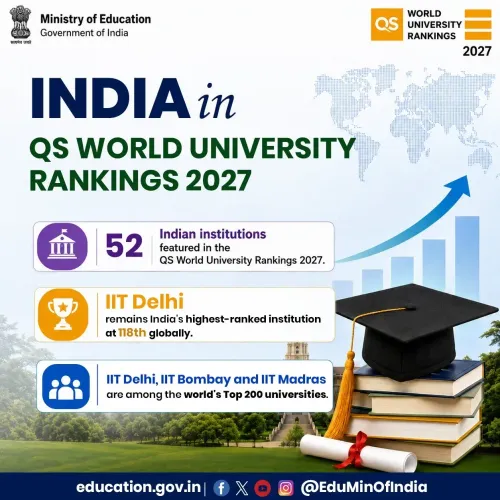
Quaid-i-Azam University, the nation's flagship public research institution, is the sole Pakistani entrant to register a notable global position, landing at rank 381. No other Pakistani university breached the top 350 threshold. By contrast, countries including India, Chile, Qatar, Brazil, Mexico, the UAE, Kazakhstan, and South Africa — all of which record higher per capita income and greater education spending as a share of GDP — have institutions ranked within the top 200.
The Education Funding Gap
Faisal Bari, a senior research fellow at the Institute of Development and Economic Alternatives (IDEAS) and an Associate Professor of economics at LUMS, offered a pointed assessment in the Pakistan-based daily Dawn. 'The rankings are, at best, a rough measure of quality. But they do reveal a lot. If we do not have a university in the top 350, it does say quite a bit about the priority accorded to education in Pakistan,' he wrote.
Bari directly linked the outcome to public spending, adding: 'If our government spends less than one per cent of GDP on education, including expenditure on school education, is it any surprise that we do not have any universities in the top 350?' Pakistan's sub-1% GDP allocation to education is among the lowest in South Asia and well below the UNESCO-recommended benchmark of 4–6%.
Quantity Without Quality
The ranking gap comes despite a notable expansion in Pakistan's higher education landscape over the past two decades. New universities have proliferated across the country, enrolment figures have risen, and thousands of graduates enter the job market annually. Yet, as an editorial in the Pakistan-based daily The Express Tribune noted, 'quantity has not necessarily translated into quality.' Employers routinely flag skill gaps among graduates, while international rankings continue to expose weaknesses in research output and innovation.
Critics argue that quality assurance in Pakistani institutions has become a largely bureaucratic exercise — institutions focus on meeting regulatory checklists while paying inadequate attention to actual learning outcomes. Curricula remain outdated, and teaching methods continue to rely heavily on rote learning, creating a widening mismatch between graduate skills and labour market demands.
The Structural Challenges Ahead
Beyond funding, Pakistan's universities face a shortage of resources for research and competitive faculty salaries — two pillars of any globally ranked institution. Bari raised a broader strategic question in his Dawn column: 'So, how do we get top-ranked universities? More importantly, should we even try for one to reach the top 100 or 200 when the entire higher education sector is plagued with serious challenges? Or should we focus on broader measures that align incentives with better performance across the sector?'
The Express Tribune editorial argued that higher education institutions must become centres of innovation addressing national challenges — water scarcity, climate change, and technological advancement — and that universities need to regularly review programmes to ensure real-world relevance. Whether Pakistan's policymakers will respond with structural reforms or continue the status quo remains the central question as the QS 2027 results reopen a long-running debate on education priorities.
Point of View
The outcome in global league tables is not a failure of universities; it is a reflection of political priorities. What is striking is that the debate in Pakistan keeps circling back to 'how do we crack the top 100?' rather than 'why do our graduates lack the skills employers need?' Chasing ranking metrics without fixing funding, curricula, and faculty pay would be, as past cycles suggest, an exercise in optics rather than reform.
NationPress
2 Oct 2026
Frequently Asked Questions
Where is Pakistan ranked in QS World University Rankings 2027?
Pakistan's highest-ranked institution, Quaid-i-Azam University (QAU) in Islamabad, came in at 381st globally in QS World University Rankings 2027. No Pakistani university made it into the top 350.
Why are no Pakistani universities in the QS top 350?
Analysts attribute the absence to Pakistan's public education spending falling below 1% of GDP — among the lowest in South Asia — leaving universities under-resourced for research, competitive faculty salaries, and infrastructure. Economist Faisal Bari, writing in Dawn, said the result reflects the 'priority accorded to education in Pakistan.'
Which countries with lower or comparable development have universities in the QS top 200?
India, Chile, Qatar, Brazil, Mexico, the UAE, Kazakhstan, and South Africa all have universities ranked within the global top 200. All these nations record higher per capita income than Pakistan and allocate a greater share of GDP to education.
What structural problems does Pakistan's higher education sector face?
Beyond funding, Pakistani higher education faces outdated curricula, heavy reliance on rote learning, weak research output, and skill mismatches flagged by employers. Quality assurance is often treated as a regulatory checkbox rather than a genuine measure of learning outcomes, according to an editorial in The Express Tribune.
Has Pakistan's higher education sector grown in recent years?
Yes — the number of universities and enrolment figures have increased significantly over the past two decades. However, experts note that this quantitative expansion has not translated into quality improvement, with international rankings and employer feedback both reflecting persistent gaps in graduate skills and research capability.