CM Bhupendra Patel Pays Tribute to Jalaram Bapa on Jayanti
Synopsis
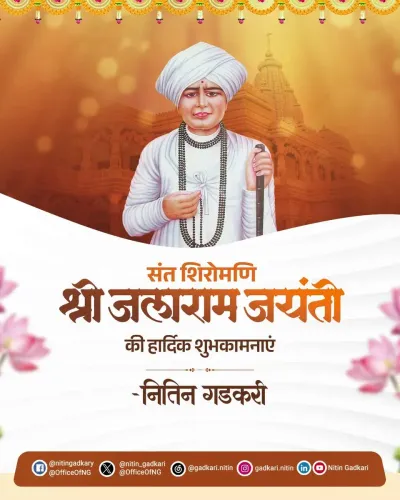
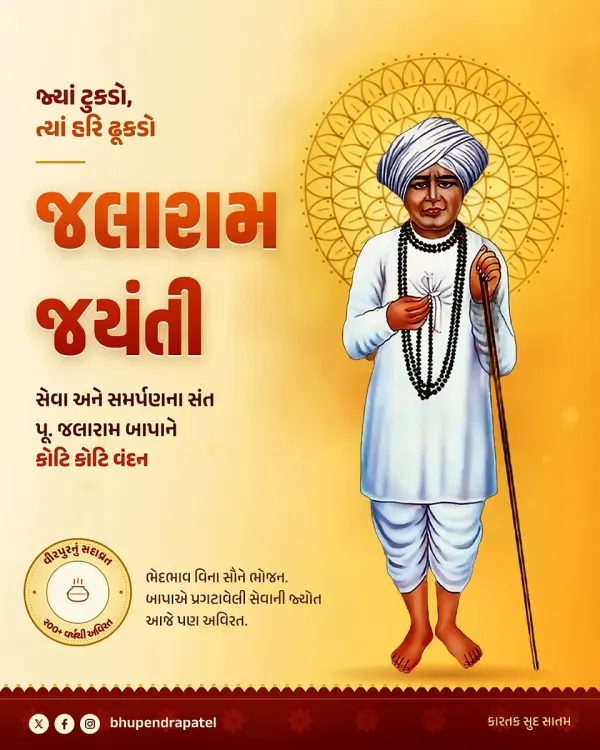
Gujarat Chief Minister Bhupendra Patel paid tribute to 19th-century Gujarati saint Jalaram Bapa on his birth anniversary, honouring the saint's tradition of feeding the hungry through the sadavrat at Virpur and his message of seva and social harmony.
Key Takeaways
Gujarat CM Bhupendra Patel posted a tribute to Sant Jalaram Bapa on his birth anniversary on 16 November 2026 .
Patel quoted a devotional couplet describing Jalaram Bapa as one who saw Ram in all beings.
Jalaram Bapa was a 19th-century Gujarati saint from Virpur, Rajkot district , renowned for running a perpetual free kitchen called the sadavrat .
CM Patel noted the sadavrat's flame still carries a message of seva (service) and samrasta (social harmony) today.
The Virpur temple remains an active centre of annual Jalaram Jayanti observances across Gujarat.
A saint who fed the hungry without question and saw service to the suffering as the highest form of devotion — Gujarat Chief Minister Bhupendra Patel invoked that timeless spirit on Monday, 16 November 2026, offering his reverential tribute to Sant Shiromani Jalaram Bapa on the occasion of the saint's birth anniversary.
Posting in Gujarati, CM Patel quoted a devotional couplet — 'Ram naam mein leen hai, dekhat sabmein Ram' (Absorbed in the name of Ram, he sees Ram in all) — before describing Jalaram Bapa as one who considered feeding the hungry and serving the distressed to be true worship of God. 'Crores of salutations on the birth anniversary of Sant Shiromani Pujya Jalaram Bapa,' he wrote.
The flame Jalaram Bapa lit in Virpur
Jalaram Bapa, the 19th-century Gujarati saint born in Virpur, a village in Rajkot district, Gujarat, built his entire life around one radical act of faith: feeding anyone who arrived at his door, no questions asked. The institution he created — the sadavrat, a perpetual free kitchen — became one of the most enduring expressions of seva in Gujarat's devotional tradition.
CM Patel noted that the flame of that sadavrat, first lit at Virpur, continues to carry its message to this day. 'The light of the sadavrat that Bapa ignited in Virpur still gives us all a message of seva and social harmony,' he wrote. The Virpur temple dedicated to Jalaram Bapa remains a living site of that tradition, drawing devotees from across Gujarat and beyond on Jalaram Jayanti each year.
A chief minister's salute to Gujarat's saint tradition
Gujarat chief ministers have long marked the jayantis of regional saints with public messages — a practice that roots political leadership in the state's deeply devotional cultural identity. Patel's tribute follows that pattern, drawing on the twin values of seva (selfless service) and samrasta (social harmony) that Jalaram Bapa embodied — values that also recur in Gujarat's contemporary governance vocabulary.
The message is simple, but its resonance is deep: a 19th-century saint's open kitchen still speaks to a 21st-century state.
Point of View
And CM Patel's Jalaram Jayanti message is a continuation of that well-worn practice. The twin values he highlights — seva and samrasta — also serve as rhetorical pillars in the BJP-led state's governance narrative, linking grassroots social harmony to a pre-political, spiritual legitimacy. By invoking the sadavrat specifically, Patel frames welfare and feeding the needy not as state policy but as an ancient, living cultural compact. It is a soft but deliberate alignment of political leadership with beloved regional sainthood.
NationPress
16 Nov 2026
Frequently Asked Questions
Who was Jalaram Bapa?
Jalaram Bapa was a 19th-century Gujarati saint born in Virpur, Rajkot district, Gujarat, renowned for his devotion to Lord Ram and for running a sadavrat — a perpetual free kitchen that fed anyone who arrived, regardless of caste or background.
What is the sadavrat associated with Jalaram Bapa?
The sadavrat is a continuous free kitchen that Jalaram Bapa established at Virpur. It reflects his belief that feeding the hungry is the highest form of devotion to God, and it continues to operate at the Virpur temple to this day.
Where is the Jalaram Bapa temple located?
The main temple dedicated to Jalaram Bapa is in Virpur, a village in Rajkot district, Gujarat. It is a major pilgrimage site, especially during Jalaram Jayanti celebrations.
Why did CM Bhupendra Patel post about Jalaram Bapa?
CM Patel posted on 16 November 2026 to mark Jalaram Jayanti, the birth anniversary of the revered Gujarati saint. Gujarat chief ministers have traditionally issued such messages on regional saint jayantis to honour local devotional heritage.
What values did Jalaram Bapa stand for?
Jalaram Bapa stood for seva (selfless service), feeding the needy, and seeing the divine in all human beings — values that CM Patel summarised in his post as 'seva and samrasta' (service and social harmony).