CM Dhami: 60 Lakh in Uttarakhand Get Free Grain Under PMGKAY
Synopsis
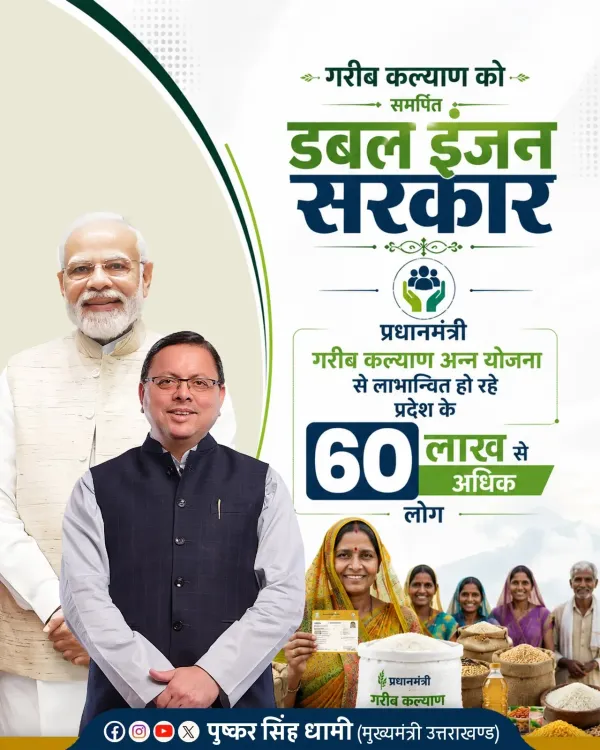
Uttarakhand CM Pushkar Singh Dhami says the Pradhan Mantri Garib Kalyan Anna Yojana is providing free foodgrains to over 60 lakh beneficiaries in the state, framing the central scheme as a pillar of food and social security under PM Modi's leadership.
Key Takeaways
Uttarakhand CM Pushkar Singh Dhami highlighted the Pradhan Mantri Garib Kalyan Anna Yojana (PMGKAY) on August 7, 2026 .
Over 60 lakh (6 million) beneficiaries in Uttarakhand are receiving free foodgrains under the scheme.
PMGKAY was originally launched in March 2020 as COVID-19 relief for National Food Security Act (NFSA) beneficiaries.
Dhami framed the scheme as providing 'economic support and social security' to poor, deprived, and needy sections of society.
The scheme is rooted in the National Food Security Act of 2013 and has since been made a permanent central government commitment.
Free food for over 60 lakh people — that is the scale of welfare delivery Uttarakhand Chief Minister Pushkar Singh Dhami highlighted on Friday, August 7, 2026, crediting Prime Minister Narendra Modi's leadership for sustaining the Pradhan Mantri Garib Kalyan Anna Yojana (PMGKAY) as a cornerstone of food security in the state.
In his post, CM Dhami wrote that under Modi's 'capable leadership,' welfare of the poor has been given the 'highest priority,' with PMGKAY ensuring free foodgrains reach the poor, deprived, and needy sections of society — providing them, as he put it, 'aarthik sambal aur samajik suraksha ka mazboot aadhar' ('a strong foundation of economic support and social security').
PMGKAY: From COVID Emergency to Permanent Safety Net
PMGKAY was first launched in March 2020 as an emergency response to the COVID-19 pandemic, supplying additional free grains to families already covered under the National Food Security Act (NFSA) of 2013. What began as a crisis measure has since evolved into one of the central government's flagship welfare commitments, extended repeatedly and eventually made a permanent feature of India's food security architecture.
Uttarakhand, a Himalayan state with a significant rural and economically vulnerable population — spread across remote hill districts where market access is limited — has been among the states where the scheme's reach carries particular weight. The CM's figure of more than 60 lakh beneficiaries represents a substantial share of the state's total population.
Welfare as Political Messaging in a BJP-Governed State
Dhami's post fits squarely into a broader pattern: BJP-governed states amplifying central welfare schemes as evidence of governance delivery, with the Prime Minister's name front and centre. The framing — poor families receiving not just food but 'social security' — signals an intent to position PMGKAY beyond a ration scheme and closer to a social contract.
The NFSA, the legal backbone of India's subsidised food system, covers roughly two-thirds of the country's population. PMGKAY layered free grains on top of that entitlement, removing even the nominal cost that NFSA beneficiaries previously paid. For households in Uttarakhand's hill districts, where seasonal unemployment and migration are common, that margin matters.
With central government decisions on scheme continuity and Uttarakhand's quarterly distribution cycles both on the horizon, the political salience of food security in the state is unlikely to fade. When 60 lakh people depend on a single scheme, every extension announcement is a news event — and every CM post a reminder of who is counting.
Point of View
With its dispersed hill population and high out-migration, food security schemes carry outsized political weight, making such public endorsements both administratively relevant and electorally purposeful.
NationPress
7 Aug 2026
Frequently Asked Questions
What is Pradhan Mantri Garib Kalyan Anna Yojana (PMGKAY)?
PMGKAY is a central government scheme that provides free foodgrains to poor families covered under the National Food Security Act. It was launched in March 2020 during the COVID-19 pandemic and has since been extended as a permanent food security measure.
How many people benefit from PMGKAY in Uttarakhand?
According to CM Pushkar Singh Dhami's post, over 60 lakh (6 million) beneficiaries in Uttarakhand receive free foodgrains under PMGKAY.
When was PMGKAY launched and why?
PMGKAY was launched in March 2020 as an emergency measure during the COVID-19 pandemic to supply additional free grains to National Food Security Act beneficiaries who were economically vulnerable during lockdowns.
What is the National Food Security Act and how does it relate to PMGKAY?
The National Food Security Act of 2013 provides subsidised foodgrains to roughly two-thirds of India's population. PMGKAY built on this by making the grains entirely free, removing even the nominal cost previously charged to NFSA beneficiaries.
Why is CM Dhami highlighting PMGKAY now?
CM Dhami's post aligns with the BJP's broader political messaging around welfare delivery, attributing the scheme's reach to PM Modi's leadership and reinforcing the central government's food security commitments to voters in Uttarakhand.