CM Dhami Announces Cath Labs at Two Uttarakhand Medical Colleges
Synopsis
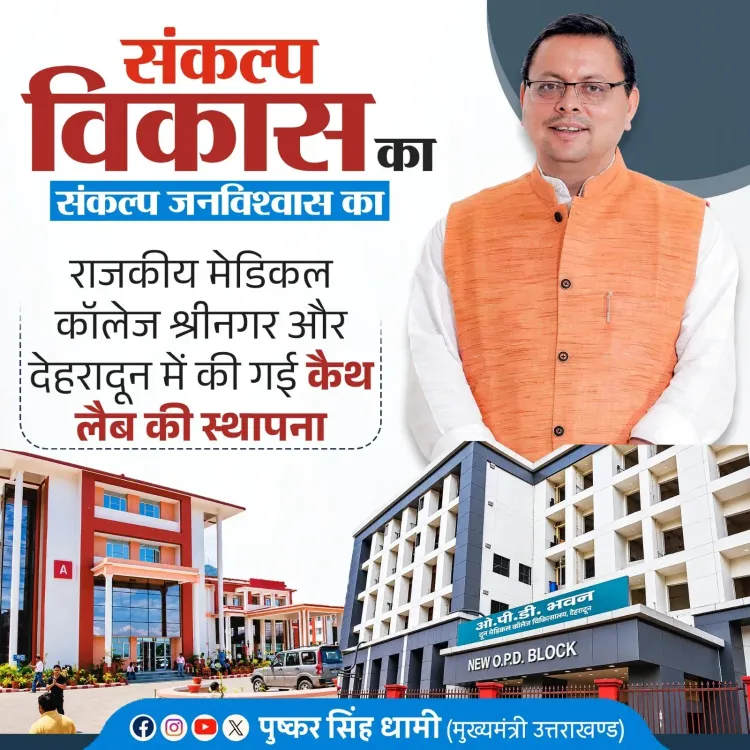
Chief Minister Pushkar Singh Dhami announces cath labs at Government Medical Colleges in Srinagar and Dehradun, promising that Uttarakhand cardiac patients will no longer need to travel to other states for advanced interventional care.
Key Takeaways
Cath labs established at Government Medical College Srinagar and Government Medical College Dehradun under CM Dhami's government.
The facilities offer interventional cardiac diagnostics and treatment — including angiography and angioplasty — within the state's public hospital system.
Patients previously had to travel to Delhi , Lucknow , or private hospitals for these procedures, adding cost and risk.
The investment aligns with the national Ayushman Bharat PMJAY framework launched in 2018 to strengthen tertiary care in states.
Operational status, utilisation data, and potential expansion to Kumaon-region colleges remain key metrics to watch.
Cardiac patients in the hills no longer have to pack a bag for Delhi or Lucknow. Uttarakhand Chief Minister Pushkar Singh Dhami announced on Tuesday, 3 November 2026 that catheterization laboratories — cath labs — have been established at Government Medical College Srinagar and Government Medical College Dehradun, marking a significant upgrade to the state's public-health infrastructure.
In his post, CM Dhami wrote: 'Rajkiya Medical College Srinagar aur Dehradun mein Cath Lab ki sthapna swasthya sevaon ke kshetra mein ek mahatvapurn uplabdhi hai' — ('The establishment of cath labs at Government Medical Colleges Srinagar and Dehradun is a significant achievement in the field of health services.'). He added that patients would no longer need to turn to other states for modern medical care, and described accessible, quality healthcare as the government's 'top priority.'
What a Cath Lab Actually Changes for Uttarakhand Patients
A cardiac catheterization laboratory is where interventional cardiologists diagnose and treat heart conditions — from coronary angiography to angioplasty and stent placement — without open-heart surgery. For a hilly, geographically dispersed state like Uttarakhand, access to this level of care inside the public system is not a routine upgrade. Until now, patients requiring these procedures at government facilities often had to travel to tertiary hospitals in Delhi, Lucknow, or private hospitals, adding cost, time, and risk to an already critical situation.
The two colleges now equipped — GMC Srinagar in the Pauri Garhwal belt and GMC Dehradun in the state capital — together serve a wide catchment of patients from the Garhwal region and the Doon Valley respectively. Placing cath labs in both institutions means the facility is available at opposite ends of the state's most populous corridor.
How This Fits Uttarakhand's Health Infrastructure Push
The move aligns with the broader national push under Ayushman Bharat Pradhan Mantri Jan Arogya Yojana, launched in 2018, which specifically targeted expansion of secondary and tertiary care capacity in states including Uttarakhand. Several Indian states upgraded government medical colleges with cath labs and advanced diagnostic units through the mid-2010s and into the 2020s; Uttarakhand's announcement follows that wider pattern of incremental, college-anchored health infrastructure investment.
For a state that has historically struggled with specialist retention and infrastructure investment in government facilities, anchoring advanced cardiac equipment within established medical colleges — rather than standalone district hospitals — also makes clinical and staffing sense. The colleges provide the resident specialist workforce to actually operate the labs.
What to Watch Next
The announcement establishes intent and installation; the real test will be utilisation. Whether the cath labs run at full operational capacity, how quickly patients begin accessing the service, and whether the state follows with similar upgrades at colleges in the Kumaon region will determine how transformative this step proves to be. Budget allocations for equipment maintenance and specialist manpower in the state's next health budget will be the clearest signal of long-term commitment.
For now, CM Dhami has planted a specific, verifiable marker: advanced cardiac care, inside the public system, at two of Uttarakhand's own medical colleges. The hill state's heart patients will be watching closely.
Point of View
Visible health-infrastructure additions to reinforce their governance narrative ahead of electoral cycles. Anchoring the investment in existing medical colleges — rather than greenfield hospitals — is strategically astute: it leverages existing specialist staff and reduces the risk of white-elephant facilities. The broader signal is that Uttarakhand is trying to close the 'medical migration' gap, where patients bleed money and time travelling to plains-based tertiary centres, a pain point that resonates deeply with hill constituencies. Whether the state can back the announcement with sustained operational budgets will determine if this becomes policy legacy or political optics.
NationPress
3 Nov 2026
Frequently Asked Questions
What is a cath lab and why does it matter for Uttarakhand?
A cath lab (cardiac catheterization laboratory) is a specialised facility for diagnosing and treating heart conditions — such as blocked arteries — through minimally invasive procedures like angioplasty. For Uttarakhand, where such facilities were previously unavailable in government colleges, it means patients with heart conditions can now receive advanced care locally without travelling to other states.
Which medical colleges in Uttarakhand have got the new cath labs?
Government Medical College Srinagar (in the Pauri Garhwal region) and Government Medical College Dehradun (in the state capital) have both been equipped with cath labs, as announced by Chief Minister Pushkar Singh Dhami on 3 November 2026.
Will these cath labs be free for patients under Ayushman Bharat?
The announcement does not specify pricing details, but the facilities are in government medical colleges that participate in the Ayushman Bharat PMJAY scheme, which covers secondary and tertiary care costs for eligible beneficiaries. Patients should check their eligibility and the services covered at the respective colleges.
How does this change healthcare for people in Uttarakhand's hill districts?
Previously, cardiac patients from Uttarakhand's hill districts needing interventional procedures had to travel to Delhi, Lucknow, or private hospitals — an expensive, time-consuming journey that could be dangerous in emergencies. With cath labs now at GMC Srinagar and GMC Dehradun, patients across the Garhwal region and Doon Valley have access to these services much closer to home.
Are there plans to set up more cath labs in Uttarakhand's Kumaon region?
CM Dhami's announcement covers Srinagar and Dehradun in the Garhwal belt. No formal announcement has been made regarding Kumaon-region colleges yet, but health analysts identify expansion to that region as a logical next step to ensure statewide coverage.