CM Dhami announces incentives for 5.2 lakh SHG women in Uttarakhand
Synopsis
Chief Minister Pushkar Singh Dhami reaffirmed that 5.2 lakh Self Help Group women in Uttarakhand will receive incentives in two direct installments, alongside honorarium hikes for Anganwadi workers, ASHA workers, Bhojanmatas, and helpers — a package first announced on November 9, 2026.
Key Takeaways
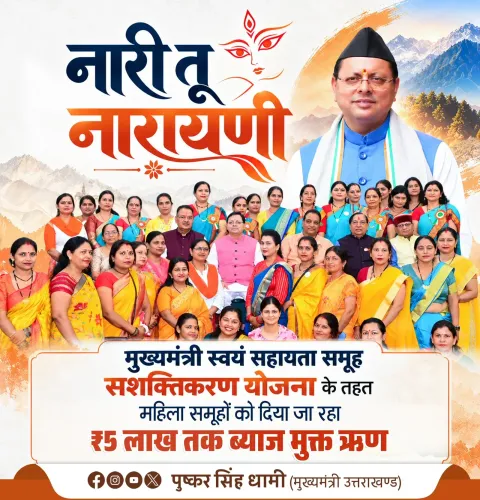
5 lakh 20 thousand women linked with Self Help Groups will receive incentive amounts in two direct installments.
The original announcement was made by CM Pushkar Singh Dhami on November 9, 2026 — Uttarakhand's Foundation Day.
Honorariums for Bhojanmatas, Anganwadi workers, Anganwadi helpers, and ASHA workers will also be increased.
Benefits will be delivered via direct bank transfer in two installments.
The move aligns with central schemes like DAY-NRLM and the National Health Mission supporting rural women workers.
Half a million women are set to receive direct financial support — and thousands of frontline workers a long-awaited pay rise — after Chief Minister Pushkar Singh Dhami of Uttarakhand reaffirmed a major welfare push for women across the state on Sunday, November 15, 2026.
Quoting himself from an earlier announcement, CM Dhami stated: 'On November 9, I announced that incentive amounts would be credited in two installments to the accounts of 5 lakh 20 thousand sisters linked with Self Help Groups. Along with this, the honorariums of Bhojanmatas [mid-day meal workers], Anganwadi workers, helpers, and ASHA sisters will also be increased.'
Who stands to gain — and why it matters
The beneficiaries span four of Uttarakhand's most critical but chronically underpaid categories of women workers. Anganwadi workers and helpers are the backbone of the Integrated Child Development Services scheme, delivering nutrition, early childhood care, and immunisation support at the village level. ASHA workers — Accredited Social Health Activists under the National Health Mission — are the last mile of India's rural health system, often working on performance-based incentives rather than a fixed salary. Bhojanmatas, who cook mid-day meals for schoolchildren, are among the lowest-compensated government-linked workers in any Indian state.
The 5.2 lakh Self Help Group members are part of a wider ecosystem built on schemes like the Deen Dayal Antyodaya Yojana – National Rural Livelihoods Mission (DAY-NRLM), which channels microfinance and livelihood support to rural women organised into community groups. For many of these women, SHG-linked incentive transfers are a rare direct cash inflow from the state.
Dhami's November 9 announcement — the two-installment plan
The original declaration came on November 9 — a date that carries symbolic weight in Uttarakhand as the state's Foundation Day, marking its formation in 2000. Timing a major women's welfare announcement to coincide with that occasion is consistent with the BJP government's pattern of bundling flagship announcements with high-visibility state occasions.
The incentive will be credited directly to beneficiaries' bank accounts in two tranches — a structure designed to ensure faster disbursal while keeping the fiscal outlay spread across the financial year. Exact amounts per installment and a revised honorarium scale for frontline workers have not yet been officially detailed.
A pattern of incremental honorarium revisions
Uttarakhand has periodically revised the pay of its frontline women workers, though activists and worker unions have long argued that honorariums remain well below minimum wage levels. The state's geography — a large share of its population in remote hill districts — makes ASHA and Anganwadi workers even more indispensable than in the plains, and also harder to replace. Any upward revision, however incremental, carries outsized practical impact in those communities.
With assembly elections on the horizon in multiple states and the broader national conversation around women's empowerment intensifying, moves like this one also carry clear political signalling — though for the 5.2 lakh women waiting on a bank credit, the politics matters far less than the deposit.
Point of View
Where ASHA and Anganwadi workers are disproportionately critical given the state's difficult terrain, even modest honorarium hikes carry substantive policy weight beyond optics. The two-installment structure for SHG transfers also signals careful fiscal management ahead of the year-end budget cycle. Longer term, the gap between announced revisions and actual minimum-wage parity for frontline workers remains a pressure point that could define CM Dhami's legacy on women's labour rights.
NationPress
15 Nov 2026
Frequently Asked Questions
How many women will benefit from CM Dhami's SHG incentive announcement?
5 lakh 20 thousand women linked with Self Help Groups in Uttarakhand are set to receive incentive amounts, credited directly to their bank accounts in two installments.
When did CM Dhami first announce the SHG incentive and honorarium hike?
CM Pushkar Singh Dhami first made the announcement on November 9, 2026 , which is Uttarakhand's Foundation Day, and reiterated it on November 15, 2026 .
Which categories of workers will get a pay hike in Uttarakhand?
The honorarium increase covers Bhojanmatas (mid-day meal cooks), Anganwadi workers , Anganwadi helpers , and ASHA workers across Uttarakhand.
What are Self Help Groups and how do they help women in Uttarakhand?
Self Help Groups are community-based microfinance collectives, primarily for rural women, supported under central schemes like DAY-NRLM . They provide savings, credit, and livelihood support, and are a key channel for state welfare transfers.
What do ASHA and Anganwadi workers do?
ASHA workers are Accredited Social Health Activists who deliver community-level health services under the National Health Mission. Anganwadi workers run child nutrition and early development centres under the Integrated Child Development Services scheme.