CM Dhami Backs Dairy Sector on World Milk Day
Synopsis
On World Milk Day, Uttarakhand Chief Minister Pushkar Singh Dhami reaffirmed state support for dairy farmers and milk production, linking the sector to rural self-employment and economic self-reliance in the Himalayan state.
Key Takeaways
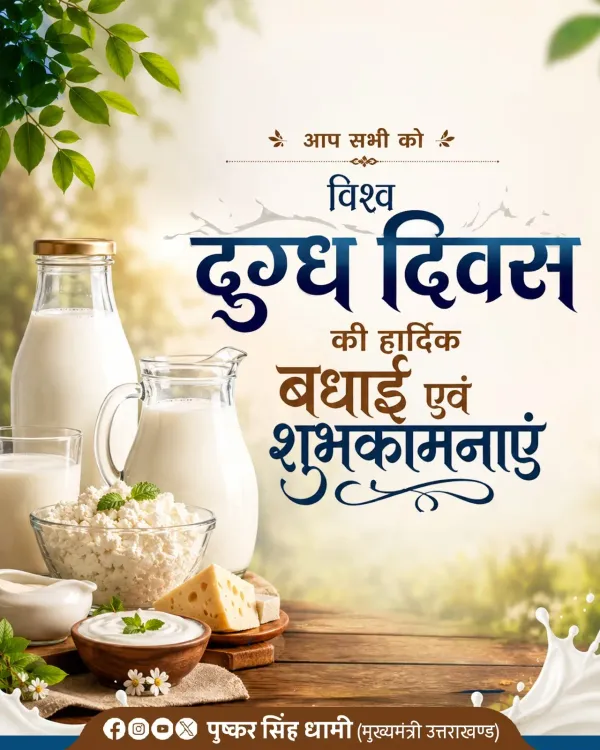
CM Pushkar Singh Dhami posted World Milk Day greetings on 1 June 2026 , pledging continued government support for dairy.
He described milk as the foundation of nutrition, health, and rural self-employment in Uttarakhand .
The state government is working to encourage livestock keepers through various schemes and make dairy more profitable.
India is the world's largest milk producer, a legacy of Operation Flood launched in 1970 .
Dairy promotion in hill states addresses out-migration and supports women's self-help groups in animal husbandry.
Concrete scheme names and budget allocations were not specified in the post.
Uttarakhand Chief Minister Pushkar Singh Dhami on Sunday, 1 June extended greetings on World Milk Day, reaffirming his government's commitment to expanding milk production across the state and strengthening the rural economy through dairy-sector support.
Context
In his post, CM Dhami wrote: 'दूध न केवल हमारे पोषण और स्वास्थ्य का आधार है, बल्कि यह ग्रामीण अर्थव्यवस्था और स्वरोजगार को सशक्त बनाने का भी महत्वपूर्ण माध्यम है' — 'Milk is not only the foundation of our nutrition and health, but also an important means of empowering the rural economy and self-employment.' He added that livestock keepers are being encouraged through various government schemes and that every effort is being made to make the dairy business more profitable and self-reliant.
World Milk Day, observed annually on 1 June, was established to highlight the role of dairy in global nutrition and rural livelihoods. India is the world's largest milk producer, a position built on the cooperative model pioneered by Operation Flood, launched in 1970 by the National Dairy Development Board.
Policy Backdrop
Uttarakhand, a Himalayan state with a predominantly rural population, has long relied on livestock and dairy as pillars of agricultural income. Hill regions face persistent challenges including seasonal employment gaps and out-migration of working-age residents, making animal husbandry a critical livelihood anchor for households that remain.
Successive state administrations have worked within the broader national framework of the 'White Revolution' to promote dairy cooperatives, women's self-help groups engaged in animal husbandry, and schemes that improve cattle breed quality and milk procurement infrastructure. The Dhami government has positioned livestock welfare and dairy promotion as part of a wider rural self-reliance agenda for the state.
Stakeholders and Impact
The primary beneficiaries of dairy-promotion policies in Uttarakhand are smallholder dairy farmers and rural households, particularly women who manage livestock in mountain villages. Enhanced procurement networks and scheme-linked incentives can directly raise on-farm incomes and reduce dependence on seasonal labour migration to the plains.
Stronger dairy output also feeds into nutritional security goals at the household level, given milk's role as an affordable, high-protein food source for children and adults alike. Self-help groups involved in dairy value chains — including processing and local sales — stand to benefit from any expansion of state support.
What's Next
Observers will watch Uttarakhand's upcoming budget session for concrete dairy-sector allocations, including milk procurement pricing, veterinary support schemes, and capital support for small dairy units. Any new animal husbandry policy announcements from the state government will be a measure of how the 1 June commitment translates into on-ground action.
With national dairy output targets rising and rural income diversification remaining a policy priority, CM Dhami's World Milk Day messaging signals that dairy will remain a focal point of Uttarakhand's rural development agenda in the months ahead.
Point of View
And dairy-linked self-employment is one of the few levers a state administration can pull to retain rural labour. By framing milk production within the 'Atmanirbhar' self-reliance vocabulary, Dhami aligns state messaging with the national BJP narrative. The real test will be whether the next budget session backs the rhetoric with measurable procurement and subsidy commitments.
NationPress
15 Oct 2026
Frequently Asked Questions
What did CM Dhami say on World Milk Day 2026?
CM Pushkar Singh Dhami extended greetings on World Milk Day and said his government is continuously working to promote milk production in Uttarakhand, encouraging livestock keepers through various schemes to make dairy more profitable and self-reliant.
When is World Milk Day celebrated?
World Milk Day is observed every year on 1 June . It was established to recognise the importance of dairy in global nutrition and rural livelihoods.
Why is dairy important for Uttarakhand's rural economy?
Uttarakhand is a Himalayan state where many rural households depend on livestock for income. Dairy provides year-round self-employment, supports women's self-help groups, and helps reduce seasonal out-migration by offering an alternative livelihood.
What is India's role in global milk production?
India is the world's largest milk producer, a position built on the cooperative dairy model established through Operation Flood , launched in 1970 by the National Dairy Development Board.
What schemes does the Uttarakhand government offer for dairy farmers?
CM Dhami's post referred to 'various schemes' for encouraging livestock keepers, but did not name specific programmes. Detailed scheme names and allocations are expected to emerge in the state's upcoming budget session.