CM Dhami Highlights Uttarakhand's GEP on World Environment Day
Synopsis
Uttarakhand Chief Minister Pushkar Singh Dhami marked World Environment Day 2026 by spotlighting the state's landmark adoption of Gross Environment Product, making Uttarakhand the first Indian state to formally measure environmental value alongside GDP.
Key Takeaways
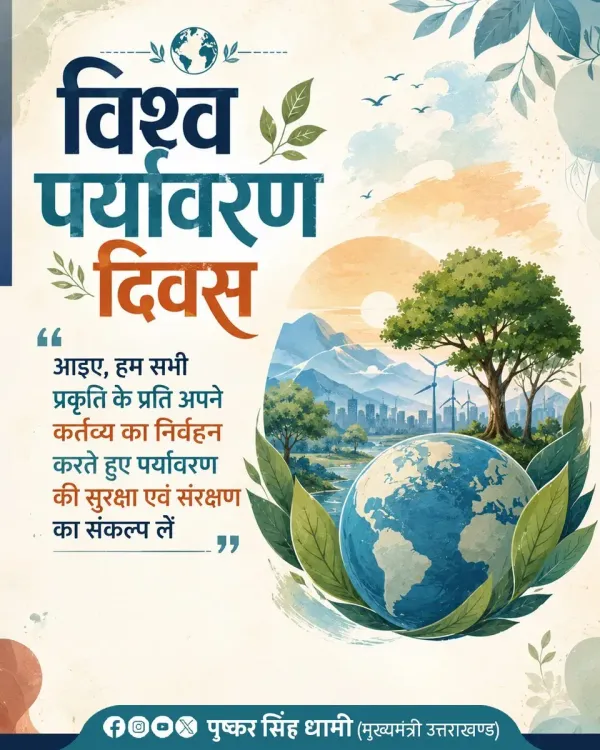
CM Pushkar Singh Dhami posted on 5 June 2026 to mark World Environment Day , reaffirming the ecology-economy balance as a governing principle.
Uttarakhand is the first state in India to implement the Gross Environment Product (GEP) framework, per the state government's claim.
GEP is designed to quantify environmental contributions — forests, rivers, biodiversity — alongside conventional GDP in economic planning.
The initiative aligns with India's National Action Plan on Climate Change (2008) and the state's own Climate Action Plan (2014) .
The move supports India's broader commitment to net-zero emissions by 2070 and international calls for natural-capital accounting.
The first official GEP report and potential replication proposals at the Conference of State Environment Ministers are key milestones to watch.
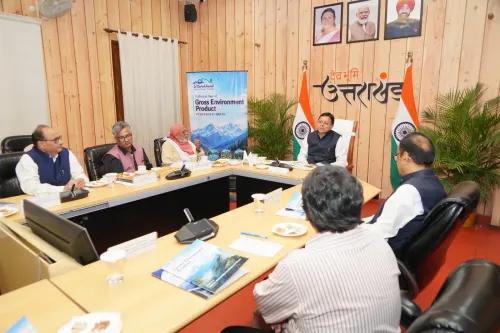
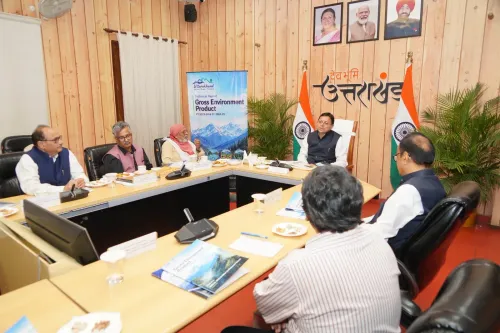
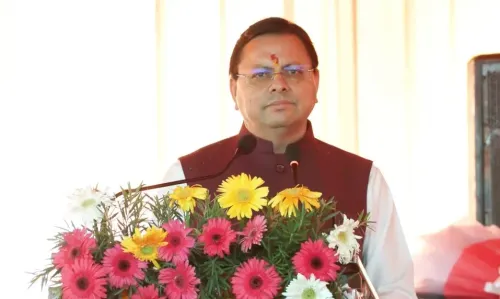
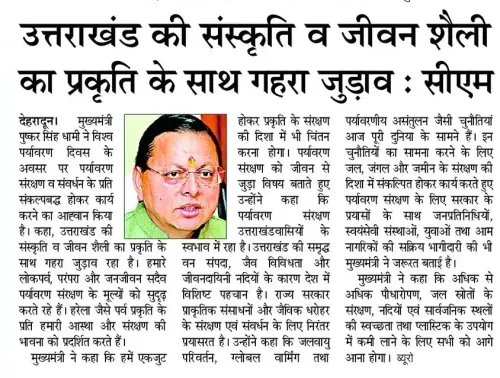
On World Environment Day, 5 June 2026, Uttarakhand Chief Minister Pushkar Singh Dhami reaffirmed his government's commitment to balancing ecological preservation with economic growth, highlighting that Uttarakhand has become the first state in India to implement the Gross Environment Product (GEP) framework.
Context
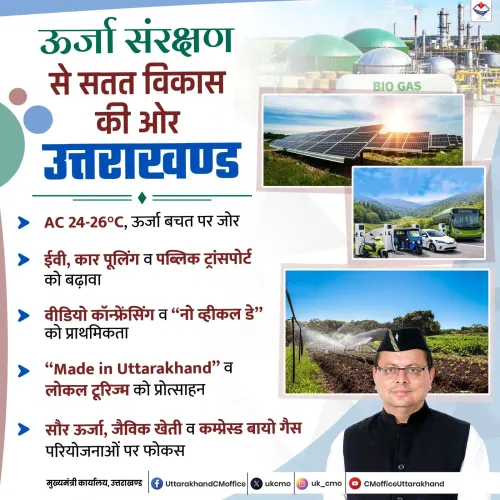
Posting in Hindi on the occasion of World Environment Day — the annual United Nations observance held every 5 June — CM Dhami extended greetings and underscored a guiding philosophy: 'इकोलॉजी और इकॉनमी' [ecology and economy] must advance together. He described nature conservation not merely as a duty but as 'the cornerstone of a secure future for coming generations.'
The post drew attention to Uttarakhand's status as a pioneer in natural-capital accounting, positioning the Himalayan state as a model for environment-sensitive development within India's federal structure.
Policy Backdrop
The Gross Environment Product is a supplementary metric designed to quantify a state's environmental contributions — forests, rivers, biodiversity, clean air — alongside conventional GDP. Several Indian states have explored supplementary environmental indices since the 2010s, but Uttarakhand is the first to formally adopt GEP as a planning instrument, according to the state government's own claim.
The move builds on a longer policy lineage: India's National Action Plan on Climate Change (2008) encouraged states to integrate environmental goals with development, and Uttarakhand's State Action Plan on Climate Change (2014) laid out sector-specific measures for sustainable Himalayan growth. The GEP initiative also aligns with India's international commitment to achieve net-zero emissions by 2070.
CM Dhami, who has led the state since 2021, has consistently positioned Uttarakhand's forest cover, river systems and eco-tourism potential as economic assets rather than constraints on development — a framing that the GEP framework institutionalises.
Stakeholders and Impact
Uttarakhand's economy is heavily dependent on forests, rivers and pilgrimage-linked tourism, making environmental health a direct livelihood concern for millions of residents. The state's forest department and eco-tourism operators stand to benefit from a metric that formally credits environmental upkeep in economic planning and potentially in fiscal transfers from the Centre.
Natural-capital accounting frameworks like GEP are also gaining traction globally, with bodies such as the United Nations promoting 'beyond-GDP' indicators. A successful Uttarakhand model could influence how other ecologically sensitive Indian states — from the Western Ghats to the Northeast — approach the development-conservation tension.
What's Next
Observers will watch for the release of Uttarakhand's first official GEP report, expected to be incorporated into the state's annual economic survey. Any formal proposal to replicate the model at the next Conference of State Environment Ministers would signal whether the initiative moves from a state experiment to a national template.
With global pressure mounting on nations to account for natural capital, Uttarakhand's early adoption of GEP could strengthen India's hand in international climate negotiations by demonstrating sub-national innovation in environmental accounting.
Point of View
The BJP-led state government signals that environmental credibility can coexist with a pro-development political identity. The move also has a competitive federal dimension: being the first Indian state to adopt GEP gives Uttarakhand a distinctive policy identity that could attract green finance and Centre-to-state fiscal incentives. Whether the framework delivers measurable outcomes, however, will depend on the rigour and transparency of the first GEP report.
NationPress
20 Oct 2026
Frequently Asked Questions
What is Gross Environment Product (GEP) in Uttarakhand?
Gross Environment Product is a state-level metric that quantifies the economic value of environmental assets such as forests, rivers and clean air alongside conventional GDP. Uttarakhand is the first Indian state to formally adopt it as a planning tool.
Why did CM Dhami mention GEP on World Environment Day?
CM Pushkar Singh Dhami used the occasion of World Environment Day on 5 June 2026 to highlight Uttarakhand's pioneering adoption of GEP as evidence that ecology and economic development can be pursued together.
Is Uttarakhand really the first state in India to implement GEP?
The state government claims Uttarakhand is the first Indian state to implement GEP. This claim has not been independently verified, and the detailed methodology and rollout date of the framework have not been officially published as of the available research.
How does GEP relate to India's climate commitments?
GEP-style natural-capital accounting aligns with India's 2070 net-zero target and the United Nations' push for 'beyond-GDP' indicators. A successful Uttarakhand model could support India's position in international climate negotiations.
What happens after Uttarakhand adopts GEP?
The next key step is the release of Uttarakhand's first official GEP report, likely as part of the state's annual economic survey. There is also the possibility of a formal proposal to replicate the model at the Conference of State Environment Ministers.