CM Dhami Launches Uttarakhand STI Policy-2026, Pushes Carbon Credits
Synopsis
Uttarakhand CM Pushkar Singh Dhami launched the state's Science, Technology and Innovation Policy-2026 and released two Gross Environment Product technical reports at a high-level meeting attended by PMO Principal Scientific Adviser Prof. Ajay Sood, directing that carbon credits and simplified water harvesting be integrated into the new policy framework.
Key Takeaways
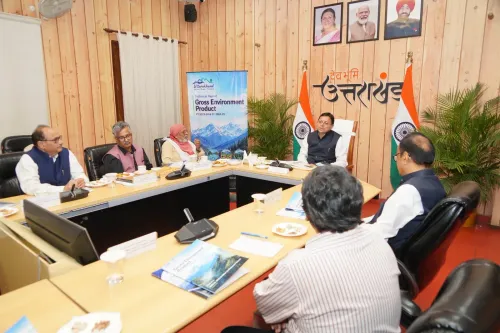
Uttarakhand STI Policy-2026 was formally launched by CM Pushkar Singh Dhami on 26 September 2026 at the Chief Minister's residence in Dehradun.
GEP technical reports for fiscal years 2023-24 and 2024-25 were released, covering economic valuation of the state's forests, water, biodiversity, soil conservation, and carbon absorption.
Ajay Sood , Principal Scientific Adviser to the PMO, attended alongside experts from multiple scientific and technical institutions.
CM Dhami directed that carbon credits be formally integrated into the STI Policy-2026, linking forest conservation and carbon sequestration to green finance mechanisms.
Dhami called for water harvesting to be simplified for ordinary citizens and stressed that development planning must account for ecological carrying capacity and local conditions.
Uttarakhand was the first Indian state to adopt Gross Environment Product as a metric alongside GDP, a framework it first announced in 2021 .
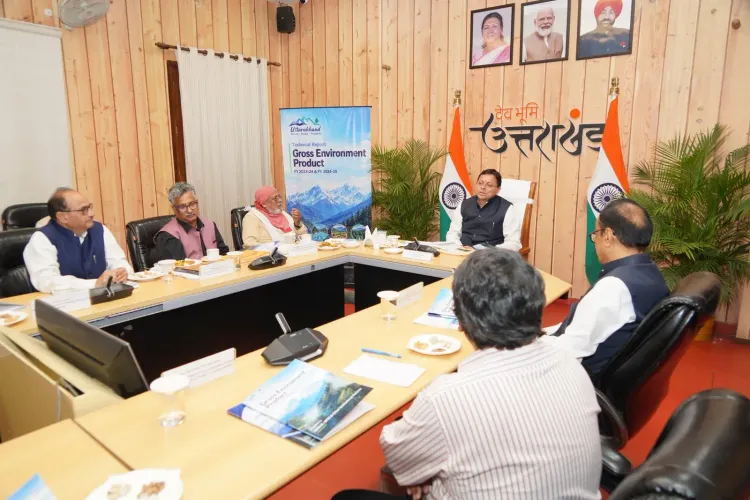
A Himalayan state just put a price tag on its forests, rivers, and biodiversity — and invited India's top scientist to help make it stick. Chief Minister Pushkar Singh Dhami chaired a high-level meeting at the Chief Minister's residence in Dehradun on Saturday, 26 September 2026, launching the Uttarakhand Science, Technology and Innovation Policy-2026 and releasing two consecutive annual technical reports on the state's Gross Environment Product (GEP) — covering 2023-24 and 2024-25.
PMO's Principal Scientific Adviser in the Room
The meeting carried unmistakable national weight. Prof. Ajay Sood, Principal Scientific Adviser to the Prime Minister's Office, sat alongside experts from multiple scientific and technical institutions. Together, they deliberated on the scientific foundations of GEP, methods for compiling and analysing environmental resource data, and the specific opportunities this framework holds for a Himalayan state like Uttarakhand. The presence of the PMO's top science voice signals that Uttarakhand's environmental accounting experiment is no longer a state curiosity — it is being watched at the national level.
What GEP Actually Does — and Why Uttarakhand Built It First
Uttarakhand became the first Indian state to formally adopt the Gross Environment Product metric in 2021, designing it to sit alongside conventional GDP as a complementary measure of ecological wealth. GEP puts a scientific and economic value on services that forests, rivers, soil, and biodiversity silently perform — carbon absorption, water regulation, biodiversity support, and more. The GEP technical reports for 2023-24 and 2024-25, released at Saturday's meeting, carry forward that valuation exercise across two fiscal years.
CM Dhami made the purpose explicit: 'GEP ke madhyam se rajya ki prakritik evam paryavaraniya sampada ke yogdan ka vaigyanik evam aarthik aakalan kiya ja sakta hai' — through GEP, the scientific and economic contribution of the state's natural and environmental wealth can be assessed. That assessment, he argued, must then flow directly into development plans and state policy, not sit in a technical report gathering dust.
Carbon Credits, Water Harvesting — the Directions Dhami Issued
The CM did not leave the meeting at the level of philosophy. He issued two concrete directions: first, that carbon credits must be integrated into the Uttarakhand STI Policy-2026, creating a formal framework to monetise the state's carbon absorption, forest conservation, and natural resource preservation efforts through verified credit mechanisms. Second, that water harvesting systems must be simplified so ordinary citizens — not just institutions — can actually use them.
On carbon credits, Dhami was pointed: efforts related to carbon sequestration, forest protection, and environmental services need a 'scientific and technical foundation,' and the potential of this sector deserves special attention. The instruction to embed carbon credits in a state STI policy — rather than a standalone environment scheme — is a structural choice, signalling that Uttarakhand wants innovation infrastructure and green finance to grow from the same root.
A Himalayan State Demanding Himalayan Solutions
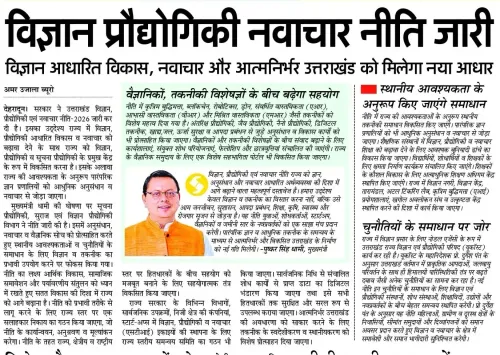
Dhami's overarching argument at the launch was geographic. Uttarakhand's terrain, ecology, and socio-economic conditions are distinct, he said, and demand solutions that generic national templates cannot deliver. The STI Policy-2026 is designed to promote sector-specific scientific research, identify emerging areas of science and technology relevant to the state, and strengthen research and development at the local level so that results actually reach communities and improve livelihoods.
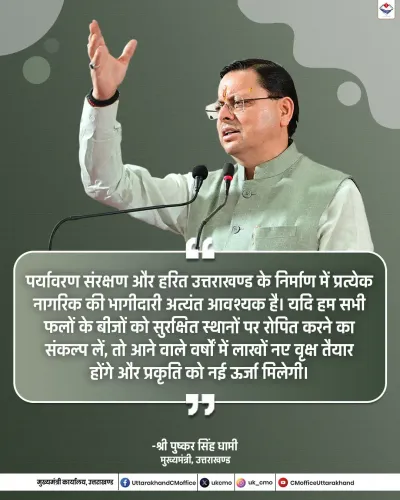
He stressed that development planning must account for the carrying capacity of natural resources, ecological sensitivity, and local conditions — and that local communities must be partners in conservation, not bystanders. Linking resource protection to livelihood opportunities for hill populations, he said, is itself an effective strategy for conservation.
With India's Himalayan states facing accelerating climate pressures and the national government deepening its focus on green growth, Uttarakhand's bet is that environmental accounting and innovation policy, fused together, can make conservation economically self-sustaining — not just a cost the state bears for the rest of the country.
Point of View
Rather than treating them as a separate green-finance initiative, reflects a maturing understanding that innovation policy and climate finance must be architecturally linked. For a state that generates enormous ecological value for the broader Indo-Gangetic plain while bearing the costs of conservation, this move is also a long-term argument for ecological compensation. The broader question is whether the GEP framework will attract institutional investment and drive measurable livelihood improvements for hill communities, or remain a sophisticated valuation exercise that development planning absorbs slowly.
NationPress
26 Sept 2026
Frequently Asked Questions
What is the Uttarakhand Science Technology and Innovation Policy 2026?
The Uttarakhand STI Policy-2026 is a state policy launched by CM Pushkar Singh Dhami on 26 September 2026 to promote region-specific scientific research, identify emerging technology sectors relevant to Uttarakhand, and support innovation-driven development tailored to the state's Himalayan geography and socio-economic conditions. It includes directives to integrate carbon credits and simplify water harvesting for citizens.
What is Gross Environment Product (GEP) and why is Uttarakhand using it?
Gross Environment Product is a metric that assigns a scientific and economic value to ecosystem services — such as carbon absorption, water regulation, biodiversity, and soil conservation — that a region's natural assets provide. Uttarakhand became the first Indian state to adopt GEP in 2021 to complement conventional GDP with an ecological dimension, helping planners account for natural wealth in development decisions.
Who is Prof. Ajay Sood and why was he at the Dehradun meeting?
Prof. Ajay Sood is the Principal Scientific Adviser to the Government of India, based in the Prime Minister's Office. He attended the 26 September 2026 meeting in Dehradun along with experts from scientific and technical institutions to advise on the scientific basis of GEP and its application for a Himalayan state like Uttarakhand.
How will carbon credits be included in Uttarakhand's new STI policy?
CM Dhami directed that carbon credits be formally integrated into the Uttarakhand STI Policy-2026, creating a framework to monetise the state's carbon sequestration, forest conservation, and environmental service efforts through verified credit mechanisms. Specific implementation details were not disclosed at the launch.
What GEP reports were released at the Dehradun meeting on 26 September 2026?
Two GEP technical reports were released: one covering fiscal year 2023-24 and one covering fiscal year 2024-25. They present an economic valuation of Uttarakhand's natural resources and environmental services, including forests, water bodies, biodiversity, soil conservation, and carbon absorption.