CM Dhami Announces 50% Electricity Subsidy for Uttarakhand Consumers
Synopsis
Uttarakhand CM Pushkar Singh Dhami has announced a 50 per cent electricity subsidy for domestic consumers using up to 100 units monthly, with the threshold raised to 200 units for high Himalayan residents, aiming to ease household financial burdens across the state.
Key Takeaways
Uttarakhand CM Pushkar Singh Dhami announced the subsidy scheme on 26 May 2026 .
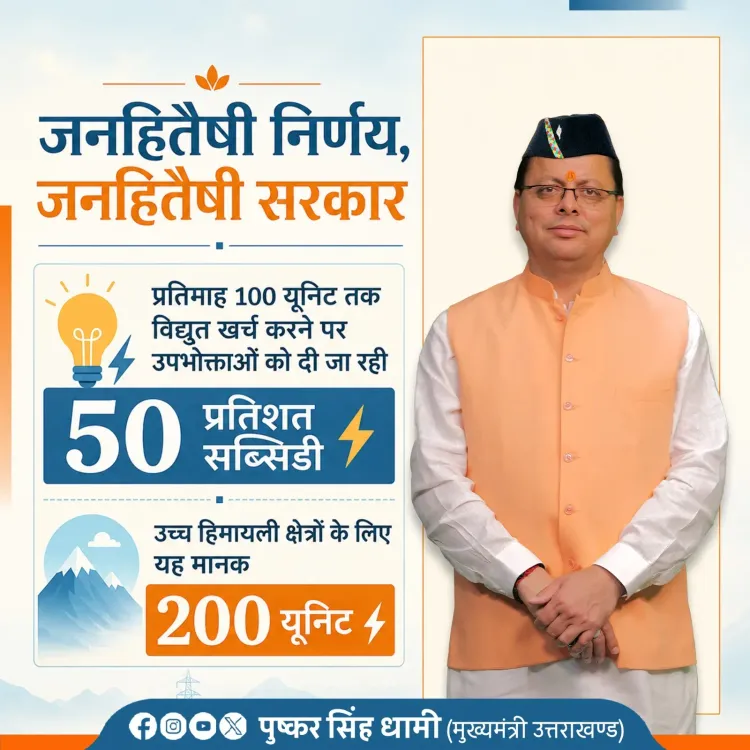
Domestic consumers using up to 100 units per month will receive a 50 per cent subsidy on electricity bills.
Residents of high Himalayan regions get an extended threshold of 200 units under the same subsidy rate.
The scheme is aimed at reducing the financial burden on ordinary citizens and low-income households.
Uttarakhand Electricity Regulatory Commission tariff frameworks have historically differentiated subsidies by region since 2019-2020 .
Full implementation details, including disbursement mechanisms, are expected in 2026-27 budget and regulatory documents.
Uttarakhand Chief Minister Pushkar Singh Dhami on Tuesday, 26 May 2026, announced a tiered electricity subsidy scheme for domestic consumers in the state, offering 50 per cent relief on power bills for households consuming up to 100 units per month, with an extended threshold of 200 units for residents of high Himalayan regions.
Context
In a post on X, CM Dhami stated: 'प्रदेश में 100 यूनिट तक विद्युत खर्च करने वाले उपभोक्ताओं को 50 प्रतिशत सब्सिडी दी जा रही है' ('Consumers using up to 100 units of electricity in the state are being given a 50 per cent subsidy'). He added that the initiative would provide relief on electricity bills for ordinary citizens and reduce their financial burden. The higher 200-unit threshold for high Himalayan areas directly acknowledges the geographic and logistical challenges of power delivery in those zones.
Policy Backdrop
Uttarakhand is a Himalayan state endowed with significant hydropower resources, yet its remote high-altitude communities face disproportionately higher electricity access and distribution costs. The Uttarakhand Electricity Regulatory Commission had introduced region-differentiated domestic consumer subsidies in its tariff orders as far back as 2019-2020, recognising the terrain-related cost disparities between plains and mountain zones. The present announcement builds on that lineage, formalising a tiered structure that directly targets low-consumption households — typically the most economically vulnerable.
Across India, state governments have routinely deployed targeted electricity subsidies as welfare instruments, particularly in hilly or remote regions where supply infrastructure inflates end-user costs. Uttarakhand's dual-threshold model — 100 units for general consumers and 200 units for high Himalayan residents — reflects an attempt to calibrate fiscal support against geographical realities rather than applying a uniform statewide rate.
Stakeholders and Impact
The primary beneficiaries are domestic consumers in the lower-income bracket who keep monthly usage at or below 100 units, a group that typically includes daily-wage earners, small farmers, and rural households. Residents of high Himalayan districts — where winters are prolonged and heating needs push consumption higher — stand to gain additionally from the 200-unit ceiling, which prevents them from losing subsidy eligibility during peak-demand months.
The measure is framed as a direct reduction in household financial burden, potentially freeing disposable income for other essential expenditure. State finances will absorb the subsidy outgo, making the scheme's long-term fiscal sustainability a key variable to watch as the 2026-27 budget cycle progresses.
What's Next
Detailed implementation modalities — including disbursement mechanisms, beneficiary identification, and any revisions to unit caps — are expected to be reflected in forthcoming Uttarakhand Electricity Regulatory Commission orders and state budget documents for 2026-27. Observers will track whether the subsidy is extended, revised upward, or linked to broader national schemes for universal electricity access. The scheme's rollout will also test the state's administrative capacity to verify consumption data and route relief efficiently to eligible households across difficult terrain.
Point of View
Using targeted utility relief to consolidate support among low-income and rural voters. The dual-threshold design — distinguishing plains consumers from high Himalayan households — signals a degree of policy sophistication that goes beyond blanket freebies, acknowledging Uttarakhand's unique geographic cost structure. However, the scheme's fiscal weight on a hill state with limited own-tax revenue will be closely scrutinised; subsidy sustainability depends heavily on how efficiently the Uttarakhand Electricity Regulatory Commission operationalises the disbursement mechanism. Nationally, this move mirrors a broader pattern of state governments competing on power-sector welfare, a trend that puts pressure on electricity distribution companies' balance sheets even as the Centre pushes for financially healthier discoms.
NationPress
10 Oct 2026
Frequently Asked Questions
What is the electricity subsidy announced by CM Dhami in Uttarakhand?
Uttarakhand CM Pushkar Singh Dhami has announced a 50 per cent subsidy on electricity bills for domestic consumers who use up to 100 units per month, with the threshold raised to 200 units for residents of high Himalayan areas.
Who is eligible for the 200-unit electricity subsidy in Uttarakhand?
Residents of high Himalayan regions in Uttarakhand are eligible for the 50 per cent subsidy on electricity bills for consumption up to 200 units per month, a higher threshold than the 100-unit limit for general consumers.
When did CM Dhami announce the electricity subsidy scheme?
The announcement was made by Chief Minister Pushkar Singh Dhami on 26 May 2026 via a post on X.
How will the Uttarakhand electricity subsidy reduce household expenses?
By covering 50 per cent of the electricity bill for eligible consumers, the scheme directly lowers the monthly outgo on power for low-consumption households, freeing up income for other essential needs.
What is the background of electricity subsidies in Uttarakhand?
The Uttarakhand Electricity Regulatory Commission introduced region-differentiated domestic consumer subsidies in its 2019-2020 tariff orders to account for the higher distribution costs in mountainous and remote areas of the state.