CM Dhami: Development Means Nothing Without Last-Mile Reach
Synopsis
Uttarakhand CM Pushkar Singh Dhami invokes the Antyodaya principle, declaring that his government considers development meaningful only when it reaches the most marginalised person — a pointed benchmark for welfare delivery across the state's remote Himalayan districts.
Key Takeaways
CM Pushkar Singh Dhami on November 10, 2026 declared that development is 'meaningful only when its benefits reach the person standing at the last end of society.' The statement draws on the Antyodaya governing ideal, rooted in Indian political thought since the late 1970s and central to BJP welfare framing from 2014 onward.
Uttarakhand presents acute last-mile delivery challenges — high-altitude villages, seasonal roads, and persistent out-migration make remote welfare reach a logistical as much as a political test.
The BJP has governed Uttarakhand since 2017 ; Dhami has led the administration since July 2021 .
The remark sets a public yardstick: scheme rollout and benefit delivery in hilly districts become the measurable test of this philosophy.
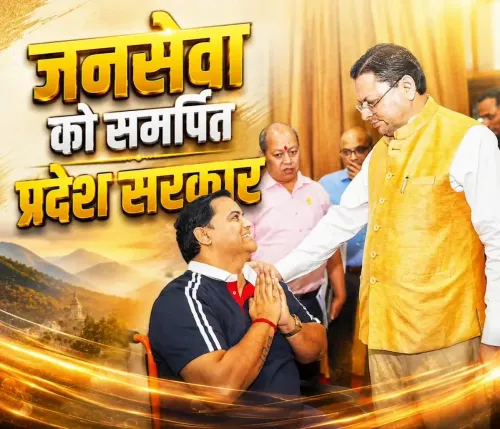
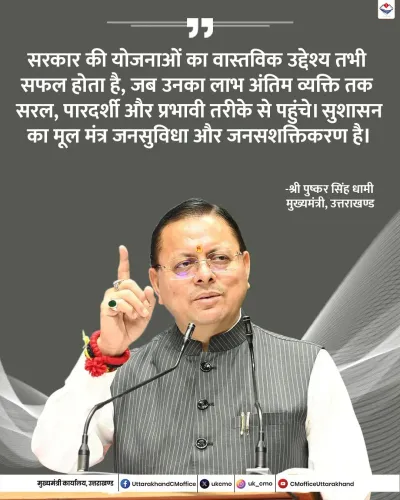
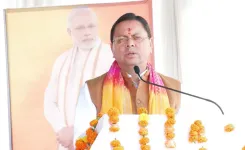
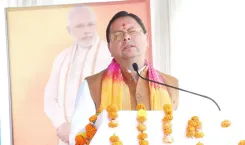
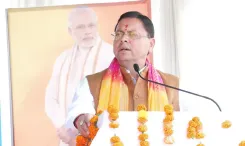
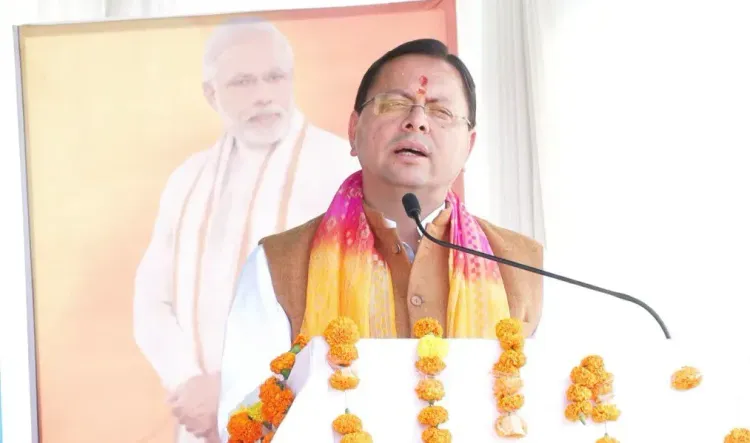
Development that stops at the city limits is not development at all — it is merely infrastructure for the already-comfortable. Reaffirming that principle, the Chief Minister's Office of Uttarakhand on Tuesday, November 10, 2026 quoted Chief Minister Pushkar Singh Dhami laying down the governing philosophy of his administration in a single, unambiguous line.
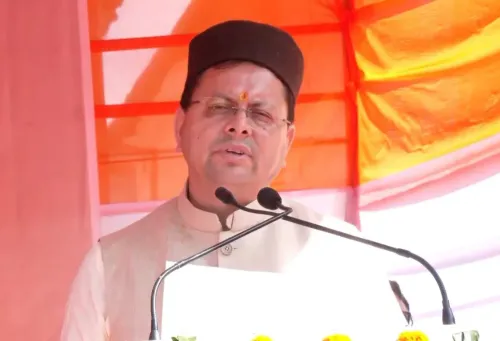
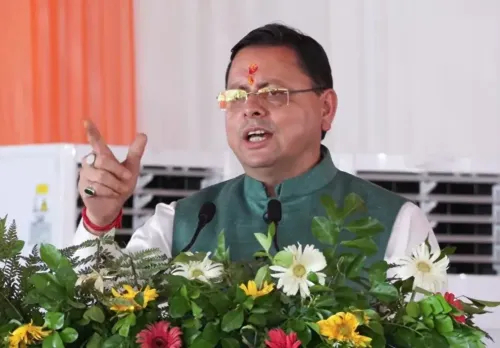
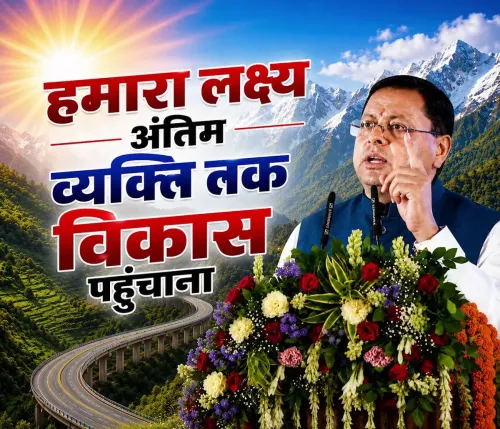
Speaking in Hindi, CM Dhami said: 'Hamari sarkar ka maanna hai ki vikas tabhi sarthak hai jab iska laabh samaj ke antim chhor par khade vyakti tak pahunche' — 'Our government believes that development is meaningful only when its benefits reach the person standing at the last end of society.' The sentiment is rooted in the decades-old Antyodaya ideal: governance that orients itself toward the most marginalised, not the most visible.
Antyodaya in the Hills: What 'Last Person' Means in Uttarakhand
In a state like Uttarakhand — where dozens of villages cling to Himalayan ridges, road connectivity remains seasonal, and migration hollows out remote communities — the 'last person' is not an abstraction. It is a widow in a high-altitude hamlet waiting for a pension transfer, or a family in a border district whose children walk hours to the nearest government school. The terrain itself is the obstacle; last-mile delivery here is a literal, logistical challenge, not just a policy phrase.
The BJP government in Uttarakhand has governed the state since 2017, and CM Dhami, who has led the administration since July 2021, has repeatedly anchored his public messaging around welfare outreach to economically weaker and geographically isolated populations. The state sits within a national framework — built more prominently from 2014 onward — that explicitly borrows the Antyodaya vocabulary to frame flagship welfare schemes targeting Below Poverty Line families, tribal communities, and remote rural populations.
A Governing Principle or a Delivery Report Card?
The critical question for any government that invokes 'Antyodaya' is whether the philosophy survives contact with bureaucratic reality. Uttarakhand's hilly districts consistently rank among the harder terrains for scheme implementation in northern India — monitoring benefit delivery across dispersed, altitude-challenged villages demands sustained administrative will, not just political rhetoric. The statement by CM Dhami resets the public benchmark: citizens and watchdog institutions now have a declared yardstick against which to measure state welfare rollouts.
What to watch next: rollout updates on state welfare schemes targeting remote villages and monitoring reports on benefit delivery in Uttarakhand's hilly districts will tell whether the philosophy is finding its footing on ground that is, quite literally, hard to reach.
Point of View
The Chief Minister's Office is signalling continuity with a welfare-first identity that the party has cultivated since 2014. The sharper political subtext is accountability: in Uttarakhand, where out-migration and geographic isolation are persistent crises, a government that claims the Antyodaya mantle invites scrutiny of whether welfare architecture is actually penetrating the most remote constituencies. The statement reads less as a fresh policy announcement and more as a reaffirmation of governing intent — one that will be tested, repeatedly, against delivery data from the mountains.
NationPress
10 Nov 2026
Frequently Asked Questions
What did Uttarakhand CM Pushkar Singh Dhami say about development?
CM Dhami said his government believes development is meaningful only when its benefits reach the person standing at the last end of society — invoking the Antyodaya principle of inclusive, last-mile governance.
What is the Antyodaya principle in Indian governance?
Antyodaya, meaning 'upliftment of the last person,' is a governing philosophy first formalised in India during the late 1970s and later adopted prominently by the BJP from 2014 onward to frame welfare schemes targeting the poorest and most marginalised citizens.
How long has Pushkar Singh Dhami been Chief Minister of Uttarakhand?
Pushkar Singh Dhami has been Chief Minister of Uttarakhand since July 2021, leading the BJP government in the state.
Why is last-mile welfare delivery difficult in Uttarakhand?
Uttarakhand's high-altitude villages, seasonal road connectivity, and significant out-migration make reaching remote communities a genuine logistical challenge, meaning 'last-mile delivery' in the state is a literal terrain problem as much as a policy one.
Since when has the BJP governed Uttarakhand?
The BJP has governed Uttarakhand since 2017, with Pushkar Singh Dhami taking charge as Chief Minister in July 2021.