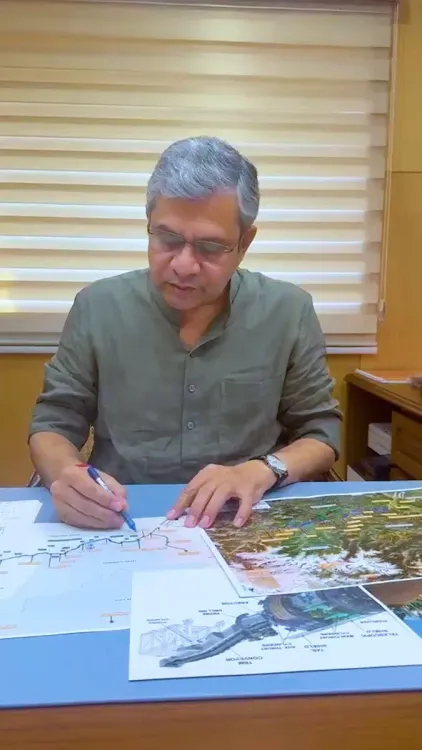
CM Dhami Hails Rishikesh-Karnaprayag Rail as Historic Milestone
Synopsis
Uttarakhand CM Pushkar Singh Dhami praised the Rishikesh-Karnaprayag Rail Project on 22 October, calling it a historic milestone that will boost pilgrimage tourism, create local jobs, and strengthen strategic connectivity in the Himalayan state.
Key Takeaways
Uttarakhand CM Pushkar Singh Dhami publicly championed the Rishikesh-Karnaprayag Rail Project on 22 October 2026 , attributing its progress to PM Modi's leadership.
The project is a 125-km broad-gauge line connecting Rishikesh to Karnaprayag through difficult Himalayan terrain involving extensive tunnels and bridges.
The project received Cabinet approval in 2010 , reflecting a long gestation period before accelerated execution under the current government.
Dhami highlighted three key benefits: boosting pilgrimage and tourism , generating local employment , and strengthening strategic connectivity near the China and Nepal borders.
The project aligns with India's broader policy of building dual-use Himalayan infrastructure serving both civilian economy and military logistics near the Line of Actual Control.
A 125-kilometre broad-gauge railway line cutting through some of the Himalayas' most forbidding terrain is rewriting what connectivity means for Uttarakhand — and Uttarakhand Chief Minister Pushkar Singh Dhami wants every citizen to feel the weight of that ambition. On Thursday, 22 October 2026, Dhami took to X to salute the Rishikesh-Karnaprayag Rail Project, calling it a landmark that will transform the hill state's economy, pilgrimage economy, and strategic posture in one stroke.
In his post, Dhami wrote — 'यह महत्वाकांक्षी परियोजना पूर्ण होने पर न केवल इंजीनियरिंग कौशल का अद्भुत उदाहरण बनेगी, बल्कि सामरिक दृष्टि से भी अत्यंत महत्वपूर्ण सिद्ध होगी' — ('This ambitious project, on completion, will not only stand as a remarkable example of engineering skill, but will also prove to be extremely important from a strategic standpoint'). He credited Prime Minister Narendra Modi's vision and leadership as the driving force behind the project's momentum.
What the Rishikesh-Karnaprayag Line Actually Does
The project connects Rishikesh — the gateway to Uttarakhand's famous Char Dham pilgrimage circuit — to Karnaprayag, deep in the Chamoli district, threading through valleys, ridges, and rivers that have historically made road travel slow, dangerous, and seasonally unreliable. The corridor involves an extensive network of tunnels and bridges to negotiate the Himalayan geology, making it one of the most technically demanding rail projects in India's infrastructure pipeline.
The line received Cabinet approval as far back as 2010, underscoring just how long this vision has been in gestation — and, implicitly, how complex its execution has proven. Its revival and acceleration under the current administration has become a flagship talking point for both the state and central governments when citing their developmental record in hill states.
Pilgrims, Jobs, and the LAC Dimension
Dhami's post frames the project's benefits along three distinct axes. First, tourism and pilgrimage: the Char Dham circuit — Yamunotri, Gangotri, Kedarnath, and Badrinath — draws millions of devotees annually, and a reliable rail corridor would dramatically ease access, reduce travel time, and extend the viable pilgrim season. Second, local employment: construction activity is already a direct employer; operations and the broader economic multiplier from increased tourist footfall are the downstream promise. Third, and perhaps most consequentially, strategic connectivity near the border.
Uttarakhand shares borders with both China and Nepal. India's military planners have long treated Himalayan rail and road infrastructure as dual-use assets — civilian arteries that double as logistics corridors for rapid troop and supply movement toward the Line of Actual Control. Dhami's explicit invocation of the word 'saamarik' (strategic) in his post signals that this dimension is not incidental; it is central to the project's national importance.
A Pattern Across the Himalayas
The Rishikesh-Karnaprayag project is not an isolated bet. It sits within a broader national effort to stitch together Himalayan states — Himachal Pradesh, Sikkim, Arunachal Pradesh — with rail and all-weather road links that previous decades left incomplete. The logic is consistent: high-cost, geologically punishing infrastructure whose strategic and social returns justify the investment over the long term. For hill communities that have historically been among India's most connectivity-deprived, the argument is both economic and a question of basic equity.
When fully commissioned, the Rishikesh-Karnaprayag line will mark a generational shift in how the Alaknanda valley — home to pilgrimage towns, hydro projects, and defence outposts alike — connects to the rest of India. The countdown has begun.
Point of View
Religious sentiment, and national security into a single political narrative. The explicit reference to 'strategic importance' is telling: it elevates what could have been a routine connectivity update into a border-security statement, resonating with a national audience anxious about India's Himalayan frontier. For a project that has been in gestation since 2010, credit attribution and milestone communication have become as important as the engineering itself. The pattern mirrors similar messaging around Himalayan projects in Himachal and Sikkim, suggesting a coordinated playbook for the BJP's mountain-state political economy.
NationPress
23 Oct 2026
Frequently Asked Questions
What is the Rishikesh-Karnaprayag Rail Project?
The Rishikesh-Karnaprayag Rail Project is a 125-km broad-gauge railway line being built to connect Rishikesh with Karnaprayag in Uttarakhand's Chamoli district, passing through highly challenging Himalayan terrain with multiple tunnels and bridges. It was first approved by the Cabinet in 2010.
Why is the Rishikesh-Karnaprayag rail line strategically important?
Uttarakhand shares borders with both China and Nepal. The rail corridor is considered a dual-use infrastructure asset — it will serve civilian tourism and pilgrimage traffic while also improving military logistics near the Line of Actual Control in case of any security contingency.
How will the Rishikesh-Karnaprayag rail project benefit pilgrims?
The new rail line will provide a reliable, all-weather route to the Char Dham pilgrimage circuit — covering Yamunotri, Gangotri, Kedarnath, and Badrinath — reducing travel time and making access significantly easier for millions of devotees who currently depend on slow or weather-disrupted road journeys.
What did CM Dhami say about the Rishikesh-Karnaprayag project?
CM Pushkar Singh Dhami said the project will serve as a 'remarkable example of engineering skill' and will be 'extremely important from a strategic standpoint.' He also credited Prime Minister Narendra Modi's vision and leadership for giving new momentum to Uttarakhand's development through this railway.
When was the Rishikesh-Karnaprayag rail project approved?
The Rishikesh-Karnaprayag railway line received Cabinet approval in 2010 and was subsequently included in national infrastructure plans for strategic border connectivity. Its execution has involved considerable complexity due to the difficult Himalayan geology along the route.