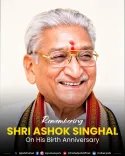
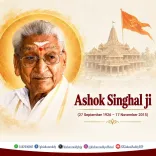
CM Dhami pays tribute to VHP's Ashok Singhal on birth anniversary
Synopsis
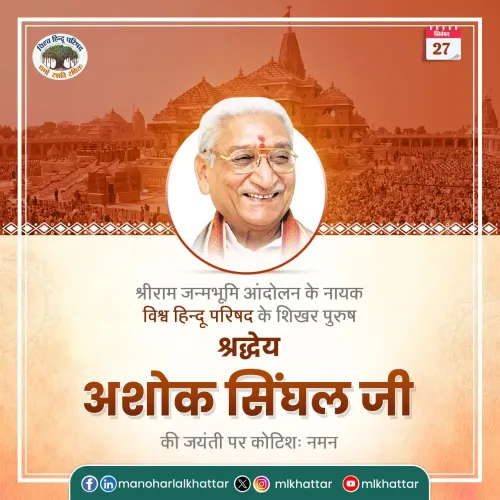
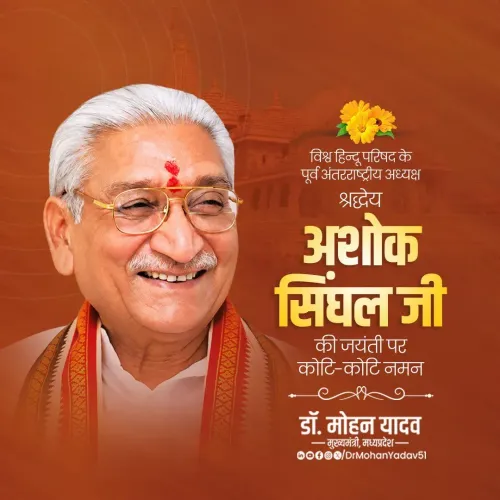
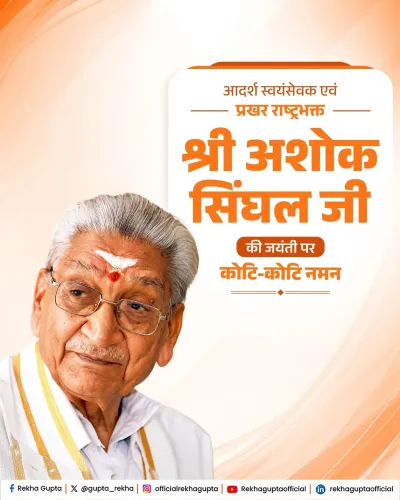
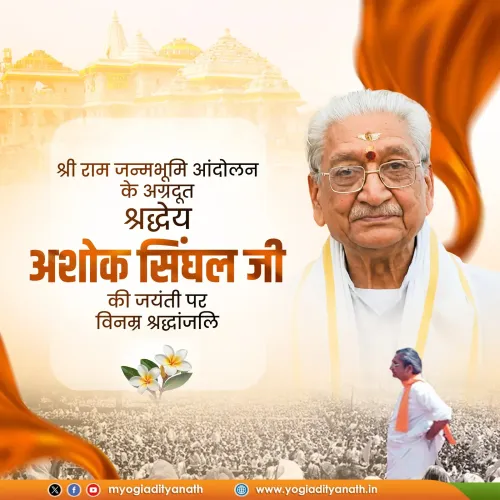
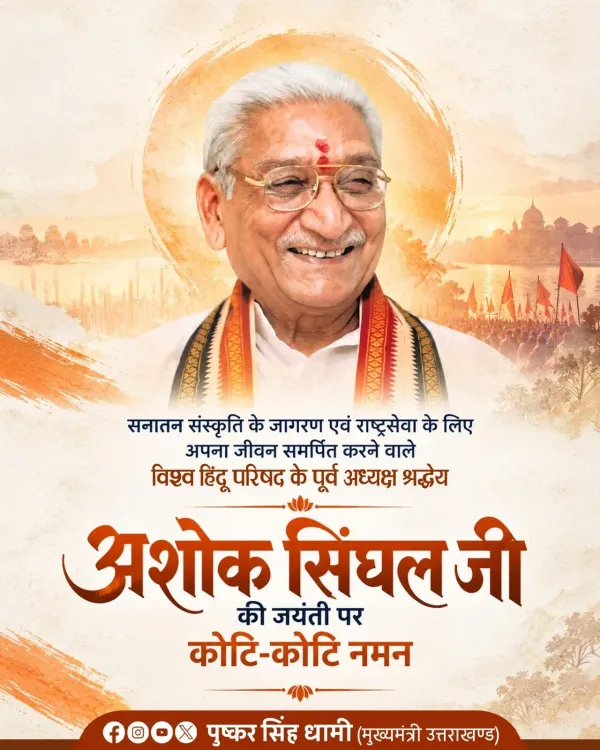
Uttarakhand CM Pushkar Singh Dhami paid tribute to former VHP president Ashok Singhal on his birth anniversary on 27 September 2026, honouring his role in the Ram Janmabhoomi movement and his decades of work building Hindu social organisations.
Key Takeaways
CM Pushkar Singh Dhami posted a tribute to former VHP president Ashok Singhal on his birth anniversary on 27 September 2026 .
Dhami praised Singhal's 'pivotal role' in the Ram Janmabhoomi movement and his lifelong dedication to Hindu society and national service.
Ashok Singhal led the Vishva Hindu Parishad , founded in 1964 , and was a central figure in the Ayodhya agitation through the 1980s and 1990s .
Singhal passed away in 2015 , before the Supreme Court's 2019 verdict and the temple's consecration in January 2024 .
The tribute reflects the BJP 's established practice of publicly honouring Sangh Parivar figures on key anniversaries, affirming ideological continuity.
A life given entirely to Hindu society, cultural revival, and national service — Uttarakhand Chief Minister Pushkar Singh Dhami invoked that legacy on Sunday, 27 September 2026, as he paid tribute to Vishva Hindu Parishad's former president Ashok Singhal on his birth anniversary.
Posting on X in Hindi, CM Dhami offered 'koti-koti naman' ('a billion salutations') to Singhal, writing: 'Your pivotal role in the Shri Ram Janmabhoomi movement and your tireless efforts to awaken public consciousness will always be remembered.' He added that Singhal's 'firm willpower, organisational skill, and dedication to the national interest will continue to inspire future generations to work with devotion towards Indian culture, society, and the nation.'
Who was Ashok Singhal and why does he still loom large
Ashok Singhal served as the president of the Vishva Hindu Parishad (VHP), the Hindu cultural and service organisation founded in 1964. He dedicated decades to building the VHP into a mass-mobilisation force and became one of the central figures of the Ram Janmabhoomi agitation, the long-running campaign that sought the construction of a temple at Lord Rama's birthplace in Ayodhya. Singhal passed away in 2015, but his name has remained a touchstone within the wider Sangh Parivar network.
The VHP's involvement in the Ram Janmabhoomi movement intensified through the 1980s and 1990s, a period that reshaped Indian political and social life in ways whose consequences are still being reckoned with today. Singhal was regarded as one of its most consequential architects — credited with sustaining organisational momentum across hundreds of districts at a time when mass communication was nothing like what it is now.
BJP's Sangh Parivar continuity — a well-worn ritual, still deliberate
The tribute from CM Dhami fits a recognisable pattern: BJP leaders routinely mark the birth anniversaries of prominent VHP and Sangh Parivar figures with public statements on social media, underscoring the ideological continuum between the ruling party and its broader organisational family. These commemorations are rarely accidental in timing or language — they serve as reaffirmations of shared heritage and shared purpose.
For Dhami, a chief minister who has consistently positioned Uttarakhand as a state with deep cultural and spiritual significance — home to the char dham pilgrimage circuit — invoking Singhal's legacy carries particular resonance. The state's identity is intertwined with Hindu tradition, and tributes of this kind reinforce that positioning ahead of any heritage or cultural initiatives the government might signal in the months ahead.
The Ram Janmabhoomi chapter, once a movement, now stands as a concluded political and legal chapter — the Supreme Court delivered its verdict in 2019 and the temple at Ayodhya was consecrated in January 2024. Invoking Singhal today is, in part, a claim to that history: a reminder of who built the road that led there.
Ashok Singhal did not live to see the temple's consecration. That absence makes commemorations like this one carry a particular poignancy — honouring the architect who shaped the movement but never stood inside its completed monument.
Point of View
Tributes to figures like Singhal shift function: they no longer rally support for a cause in progress but instead cement a victor's narrative about who built the road. For Dhami personally, associating Uttarakhand's governance brand with cultural guardianship deepens the state's positioning as India's spiritual heartland — a soft-power asset with real electoral utility. The pattern is predictable, but predictability is precisely the point: consistency of commemoration signals continuity of ideology.
NationPress
27 Sept 2026
Frequently Asked Questions
Who was Ashok Singhal?
Ashok Singhal was the former president of the Vishva Hindu Parishad (VHP), the Hindu cultural organisation founded in 1964. He was one of the most prominent leaders of the Ram Janmabhoomi movement seeking a temple at Ayodhya and passed away in 2015.
What is the Vishva Hindu Parishad (VHP)?
The Vishva Hindu Parishad is a Hindu cultural and service organisation founded in 1964. It played a central role in the Ram Janmabhoomi agitation from the 1980s onward and remains a key part of the broader Sangh Parivar network.
What role did Ashok Singhal play in the Ram Janmabhoomi movement?
Ashok Singhal was one of the chief organisers and ideological drivers of the Ram Janmabhoomi movement, helping build mass mobilisation across India through the 1980s and 1990s in support of constructing a temple at Ayodhya.
Why did CM Dhami post a tribute to Ashok Singhal?
CM Pushkar Singh Dhami posted the tribute on 27 September 2026 to mark Ashok Singhal's birth anniversary, honouring his contributions to Hindu society, the VHP, and the Ram Janmabhoomi movement.
Was Ashok Singhal alive when the Ayodhya temple was consecrated?
No. Ashok Singhal passed away in 2015, several years before the Supreme Court's 2019 verdict on the Ayodhya dispute and the temple's consecration in January 2024.