Pralhad Joshi calls for sustainable tourism on World Tourism Day
Synopsis
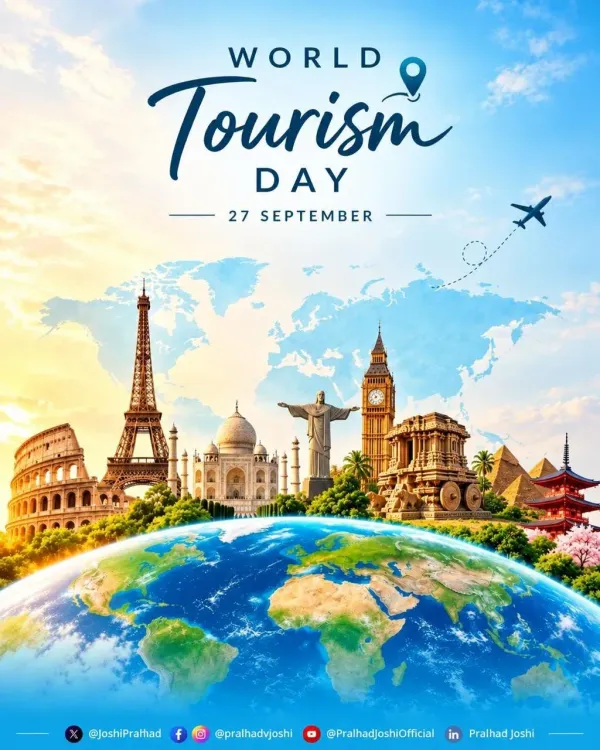
Union Minister Pralhad Joshi marked World Tourism Day on 27 September 2026 with a bilingual English-Kannada call to embrace sustainable tourism, preserve India's heritage sites, and create local economic opportunities — underscoring both national ambition and Karnataka's rich cultural legacy.
Key Takeaways
Union Minister Pralhad Joshi posted a World Tourism Day message on 27 September 2026 urging sustainable and responsible tourism.
The post was bilingual — English and Kannada — reflecting both national reach and Joshi's Karnataka roots.
He called for preservation of heritage sites, promotion of cleanliness, and economic benefit for local communities through tourism.
World Tourism Day has been observed every 27 September since 1980 , established by the UN World Tourism Organization .
Karnataka hosts UNESCO World Heritage Sites such as Hampi and Pattadakal, giving the bilingual appeal added regional significance.
The message links conservation directly to livelihood creation — a recurring theme in India's current tourism policy framing.
On World Tourism Day, 27 September 2026, Union Minister Pralhad Joshi called on Indians to champion sustainable tourism, protect heritage sites, and let the country's civilisational richness draw the world — framing tourism not merely as leisure but as an engine of opportunity for local communities.
A pledge in two languages, one message
Posting in both English and Kannada, Joshi wrote: 'ನಮ್ಮ ನಾಡಿನ ಸಾಂಸ್ಕೃತಿಕ ಹಾಗೂ ಐತಿಹಾಸಿಕ ಸಂಪತ್ತನ್ನು ಗೌರವಿಸೋಣ, ಜವಾಬ್ದಾರಿಯುತ ಪ್ರವಾಸೋದ್ಯಮವನ್ನು ಉತ್ತೇಜಿಸೋಣ' — 'Let us honour the cultural and historical wealth of our land and promote responsible tourism.' The bilingual appeal is deliberate: Karnataka, his home state, is itself home to UNESCO World Heritage Sites including Hampi and Pattadakal, making the Kannada-language outreach more than symbolic.
In English, the minister urged citizens to embrace sustainable tourism, support local communities, and preserve heritage — 'showcasing India's timeless richness to the world while creating new opportunities for our people.' The message explicitly links conservation with livelihood, a framing that runs through current governmental tourism discourse.
World Tourism Day and India's growing stake
World Tourism Day has been observed every 27 September since 1980, established by the UN World Tourism Organization to spotlight tourism's cultural and economic dimensions. For India — a country of ancient temples, Himalayan vistas, coastal diversity, and living folk traditions — the occasion doubles as a platform to assert global positioning in a fiercely competitive travel market.
Indian ministers across portfolios regularly use global observance days to reinforce the country's cultural assets and economic potential. Joshi's post fits that pattern, but the dual-language delivery, grounded in his Karnataka roots, gives it a state-level texture that purely Delhi-centric messaging often misses.
Sustainability at the centre
The minister's emphasis on cleanliness and sustainable tourism — 'ಸ್ವಚ್ಛತೆ ಹಾಗೂ ಸುಸ್ಥಿರ ಪ್ರವಾಸೋದ್ಯಮಕ್ಕೆ ಆದ್ಯತೆ ನೀಡುವ ಸಂಕಲ್ಪ ಮಾಡೋಣ' ('let us resolve to prioritise cleanliness and sustainable tourism') — echoes a policy direction that has gained traction as heritage-site overcrowding and environmental strain have become real management challenges at iconic destinations across the country.
The call to 'support local communities' also signals awareness that the economic gains from tourism remain unevenly distributed, and that grassroots benefit is increasingly a benchmark against which tourism policy is measured.
India's tourism story is still being written — and on days like this, the pen is in every traveller's hand as much as every policymaker's.
Point of View
Such messaging from senior ministers helps set the normative tone for state-level policy. Whether it translates into enforceable sustainable-tourism guidelines at iconic sites remains the real policy question to watch.
NationPress
27 Sept 2026
Frequently Asked Questions
When is World Tourism Day celebrated?
World Tourism Day is celebrated every year on 27 September . It was established in 1980 by the UN World Tourism Organization to highlight the cultural, social, and economic value of tourism.
What did Pralhad Joshi say on World Tourism Day 2026?
Union Minister Pralhad Joshi called on citizens to embrace sustainable tourism, support local communities, preserve heritage sites, and prioritise cleanliness — framing responsible tourism as a way to showcase 'India's timeless richness' and create new opportunities.
Why did Pralhad Joshi post in Kannada on World Tourism Day?
Joshi is a senior BJP leader from Karnataka , a state with a rich tourism heritage including UNESCO sites like Hampi and Pattadakal. The Kannada-language portion of his post targets domestic audiences in Karnataka and reflects his strong state-level political base.
What is sustainable tourism and why does India promote it?
Sustainable tourism involves minimising environmental and cultural impact while maximising economic benefit for local communities. India promotes it because overcrowding and environmental degradation at heritage sites have become significant challenges, and the government aims to ensure tourism revenue reaches grassroots communities.
What are India's major UNESCO World Heritage tourism sites?
India has several UNESCO World Heritage Sites popular with tourists, including the Taj Mahal in Agra, Hampi and Pattadakal in Karnataka, the Qutb Minar complex in Delhi, Kaziranga National Park in Assam, and the Sun Temple at Konark in Odisha, among others.