CM Dhami: Uttarakhand to be World's Spiritual Capital
Synopsis
Chief Minister Pushkar Singh Dhami has declared that Uttarakhand is being developed as the world's spiritual capital, with the Manaskhand temple circuit in Kumaon set for infrastructure upgrades matching those already undertaken in the Kedarkhand region of Garhwal.
Key Takeaways
CM Pushkar Singh Dhami reaffirmed on 21 June 2026 that Uttarakhand is being developed as the spiritual capital of the world.
The government is extending temple development to the Manaskhand (Kumaon) circuit, modelled on the Kedarkhand (Garhwal) upgrades.
Policy lineage includes the PRASAD scheme (2014–15) , the Char Dham all-weather road project (2016) , and a 2022 tourism policy push for lesser-known circuits.
Key beneficiaries include Kumaon hill communities , temple committees, pilgrims, and regional tourism operators.
The twin-circuit strategy aims to distribute pilgrimage revenue more evenly across Uttarakhand's two divisions.
Specific Manaskhand project details and budget allocations are expected to be announced at the next state assembly session or tourism summit.
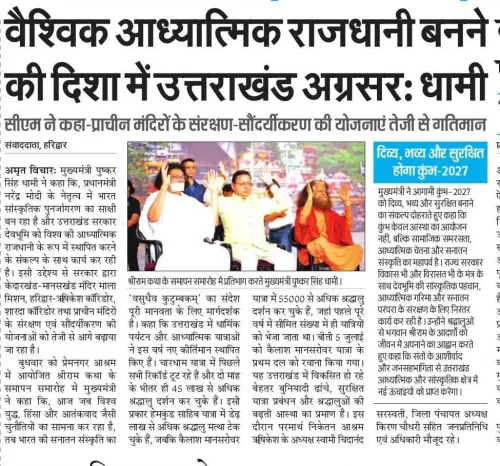
The Chief Minister's Office of Uttarakhand on Sunday, 21 June 2026 shared a statement from Chief Minister Pushkar Singh Dhami reaffirming the state government's commitment to developing Uttarakhand as the spiritual capital of the world, with a specific pledge to extend temple development from the Kedarkhand circuit to the Manaskhand region.
Context
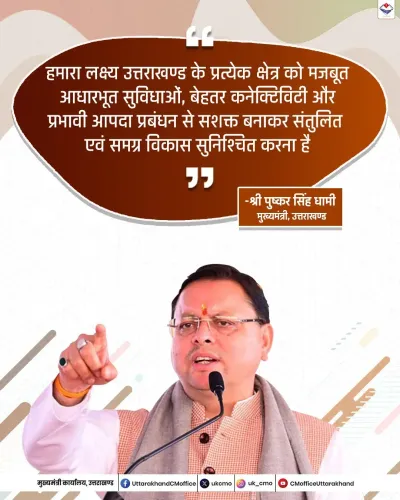
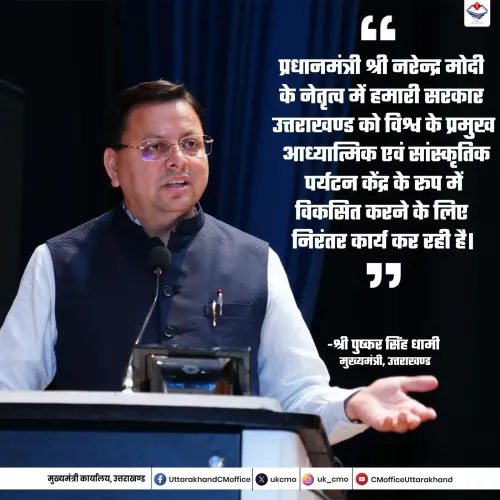
Speaking through the official CMO account, CM Dhami stated: 'Uttarakhand poore vishwa ki aadhyatmik rajdhani bane, iske liye hum nirantar karya kar rahe hain' ('We are continuously working towards making Uttarakhand the spiritual capital of the entire world'). He added that temple development in the Manaskhand region — the Kumaon division's pilgrimage cluster — is being ensured on the same lines as the development already undertaken in Kedarkhand, the Garhwal division's storied pilgrimage circuit centred on Kedarnath.
The statement signals a deliberate policy of geographic balance: ensuring that the eastern Kumaon hills receive infrastructure investment comparable to the more internationally recognised Garhwal shrines.
Policy Backdrop
Uttarakhand's temple development push has deep roots. Following the devastating 2013 Kedarnath floods, the state launched large-scale reconstruction and pilgrimage infrastructure upgrades from 2014 onward. The central government's PRASAD scheme, introduced in 2014–15, identified Uttarakhand sites for funded spiritual tourism amenities, and the Char Dham all-weather road project was approved in 2016 to improve connectivity to the four major shrines — Yamunotri, Gangotri, Kedarnath and Badrinath.
A 2022 state tourism policy update prioritised expansion beyond the core Char Dham circuit, explicitly targeting lesser-known temple clusters. The Manaskhand corridor — encompassing ancient Kumaon shrines — has since been positioned as the next frontier of this strategy, mirroring the Kedarkhand model in terms of road access, pilgrim facilities and heritage conservation.
Stakeholders and Impact
The primary beneficiaries of the Manaskhand push are hill communities in Kumaon, whose local economies depend heavily on seasonal pilgrimage traffic. Temple committees managing shrines in the circuit stand to receive infrastructure support, while tourism operators across the state anticipate a broader spread of visitor footfall beyond the already-saturated Char Dham routes.
For pilgrims, parallel development of both circuits means more options, reduced congestion at peak sites, and improved safety infrastructure across a wider geography. The framing of Uttarakhand as a 'world spiritual capital' also carries soft-power implications, positioning the state as a destination for the global Hindu diaspora and international spiritual tourists.
What's Next
Concrete progress on the Manaskhand temple projects — including any new budget allocations, inauguration timelines or project lists — is expected to emerge at the next Uttarakhand state assembly session or an upcoming state tourism summit. CM Dhami's administration has made religious tourism a centrepiece of its economic development narrative, and sustained delivery on the Manaskhand promise will be a key metric by which that agenda is judged. A successful twin-circuit model could also serve as a template for other Himalayan states seeking to monetise spiritual heritage without overloading a single pilgrimage corridor.
Point of View
Two regions with distinct identities and voter bases. This announcement fits a broader national pattern of governments deploying heritage and pilgrimage infrastructure as visible, non-controversial development deliverables. The real test will be whether Manaskhand receives the institutional and budgetary muscle that Kedarkhand has accumulated over a decade of post-flood reconstruction.
NationPress
19 Sept 2026
Frequently Asked Questions
What is Manaskhand in Uttarakhand?
Manaskhand refers to the ancient Kumaon division's cluster of Hindu pilgrimage temples, historically documented in texts as a sacred region, and now being developed by the Uttarakhand government as a major pilgrimage circuit alongside the Garhwal-based Kedarkhand.
What did CM Dhami say about Uttarakhand's spiritual capital status?
CM Pushkar Singh Dhami stated that the government is continuously working to make Uttarakhand the spiritual capital of the entire world, and that Manaskhand temples will be developed on the same lines as Kedarkhand.
What is the difference between Kedarkhand and Manaskhand?
Kedarkhand covers the Garhwal region's pilgrimage circuit, anchored by Kedarnath temple, while Manaskhand covers the Kumaon region's temple cluster; the state government is now working to bring both circuits to comparable levels of infrastructure and development.
What schemes support temple development in Uttarakhand?
Key central and state schemes include the PRASAD scheme (2014–15) for spiritual tourism amenities, the Char Dham all-weather road project (2016), and a 2022 state tourism policy that prioritised expansion beyond the core Char Dham circuit.
How does Uttarakhand plan to become a world spiritual capital?
The state government under CM Dhami is investing in temple infrastructure, pilgrim facilities, and road connectivity across both the Kedarkhand and Manaskhand circuits, aiming to attract domestic pilgrims, the global Hindu diaspora, and international spiritual tourists.