CM Fadnavis: 75% Farmers Get Day Power, AI Governance Launched
Synopsis
Chief Minister Devendra Fadnavis told the Maharashtra Legislative Council on 24 June 2026 that 75% of farmers now receive daytime electricity, with full coverage targeted by year-end. He also launched the Maha-AI Model, MahaDBT 2.0, and announced a women's safety committee and Ashadhi Wari pilgrim assurances.
Key Takeaways
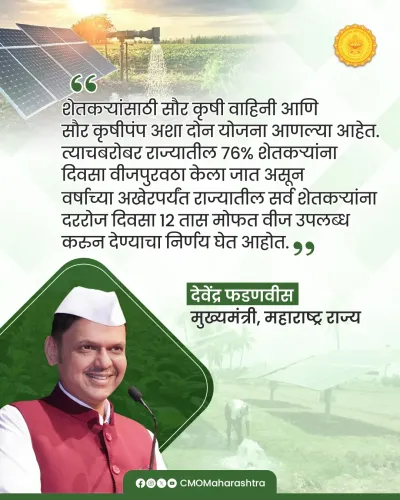
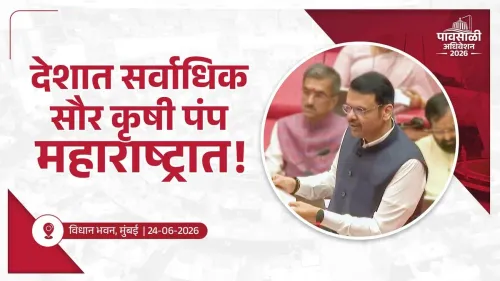
75% of Maharashtra farmers currently receive daytime electricity supply; the state targets 100% coverage by end of 2026 .
A 'Grid Support Charge' has been introduced to protect ordinary electricity consumers as agricultural supply is expanded.
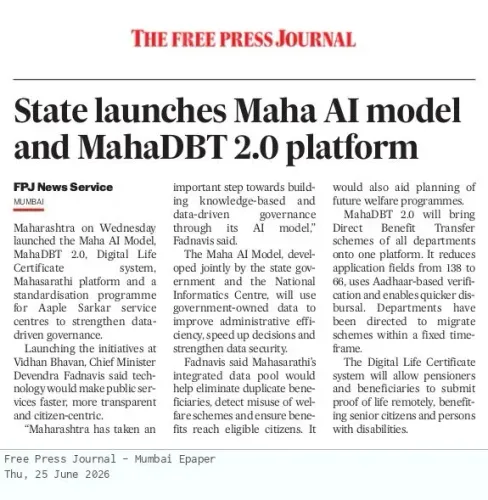
CM Fadnavis launched the Maha-AI Model , MahaDBT 2.0 , MahaSarthi, and a Digital Life Certificate service to advance data-driven governance.
A committee of women members will be formed to address women's safety, as announced during the Vidhan Parishad session.
The state assured that Ashadhi Wari pilgrims heading to Pandharpur will face no inconvenience during the annual pilgrimage.
A prisoner rehabilitation initiative under the Chief Minister's leadership has recorded successful outcomes, continuing a programme of jail-based vocational training.
The Chief Minister's Office of Maharashtra published a day-end summary on Wednesday, 24 June 2026, outlining key announcements made by Chief Minister Devendra Fadnavis during the Legislative Council question hour of the 2026 Monsoon Session, covering agricultural power supply, a new grid charge, women's safety, prisoner rehabilitation, pilgrimage management, and the launch of the state's Maha-AI model alongside digital welfare platforms.
Context
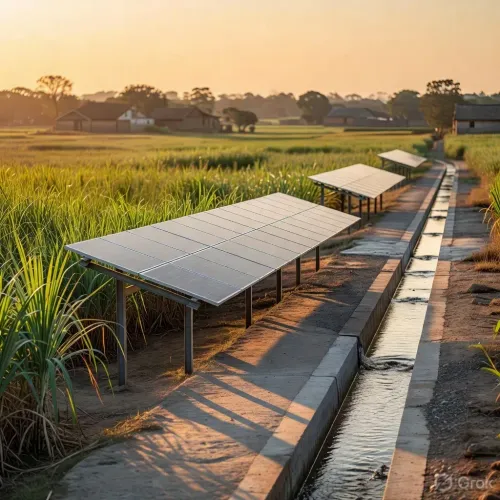
Speaking during the Vidhan Parishad question hour, CM Fadnavis stated that 75 per cent of farmers in Maharashtra now receive daytime electricity supply. He added that the state government would endeavour to extend daytime power to the remaining 25 per cent of farmers by the end of this year. The announcement signals continued momentum on a long-standing agricultural power reform that successive Maharashtra governments have pursued through grid separation and solar pump schemes since at least 2017-18.
The Chief Minister also defended the introduction of a 'Grid Support Charge' (ग्रीड सपोर्ट चार्ज), describing it as a measure designed to protect the interests of ordinary electricity consumers. The charge is framed as a mechanism to stabilise grid finances as daytime agricultural supply is expanded without burdening the broader consumer base.
Policy Backdrop
Maharashtra's push for daytime agricultural power is rooted in the recognition that nocturnal electricity supply forces farmers to operate pumps in unsafe conditions and reduces crop productivity. The state has layered solar feeder separation projects and subsidy programmes over successive administrations to shift farm supply to daylight hours. Reaching 75 per cent coverage represents a significant milestone in that phased effort.
On the digital governance front, CM Fadnavis inaugurated the Maha-AI Model, describing it as an important step toward data-driven administration. Alongside it, he launched MahaSarthi, MahaDBT 2.0, and a Digital Life Certificate (डिजिटल हयातीचा दाखला) service. MahaDBT, the state's Direct Benefit Transfer platform, has been a cornerstone of welfare delivery in Maharashtra since the late 2010s; version 2.0 signals an upgrade intended to improve targeting and reduce leakage.
Stakeholders and Impact
The daytime power commitment directly affects millions of farming households across Maharashtra, particularly in water-stressed regions of Vidarbha, Marathwada, and north Maharashtra, where dependence on irrigation pumps is highest. The Grid Support Charge will be watched closely by urban and peri-urban consumers and electricity distribution companies seeking financial sustainability.
CM Fadnavis also announced the formation of a committee of women members to address women's safety — a recurring legislative commitment that now takes institutional form within the session. Separately, the Chief Minister assured that Ashadhi Wari pilgrims (आषाढी वारीत भाविक) heading to Pandharpur would face no inconvenience, with state machinery coordinating logistics for the annual pilgrimage that draws millions of devotees. A prisoner rehabilitation initiative credited to the Chief Minister's leadership was also highlighted, continuing a programme of vocational training and reintegration that dates to earlier Fadnavis-era jail reforms.
What's Next
The government's self-imposed deadline of year-end 2026 for achieving 100 per cent daytime farm power will be a key benchmark in upcoming assembly sessions and budget documents. Operational details of the Maha-AI Model — including data governance safeguards and integration with existing e-service portals — are expected to emerge as the platform is rolled out across departments. The women's safety committee, once constituted, will be expected to submit recommendations within the current legislative calendar.
Point of View
Digital modernisation, and public order — within a single legislative session cycle. Framing the Grid Support Charge as a consumer-protection measure is a politically calibrated move, pre-empting criticism that expanded farm subsidies raise tariffs for urban households. The simultaneous launch of Maha-AI alongside MahaDBT 2.0 positions Maharashtra at the frontier of state-level AI governance, a space where the political dividend is as significant as the administrative one. The year-end deadline for 100% daytime farm power, however, sets a concrete accountability marker that opposition benches will track closely.
NationPress
23 Sept 2026
Frequently Asked Questions
How many farmers in Maharashtra get daytime electricity supply?
As of June 2026, 75 per cent of farmers in Maharashtra receive daytime electricity. Chief Minister Devendra Fadnavis stated the government aims to cover the remaining 25 per cent by the end of 2026.
What is the Grid Support Charge in Maharashtra?
The Grid Support Charge is a levy introduced by the Maharashtra government to protect ordinary electricity consumers and maintain grid financial stability as daytime agricultural power supply is expanded.
What is the Maha-AI Model launched by CM Fadnavis?
The Maha-AI Model is a state government initiative aimed at building data-driven administration in Maharashtra. It was inaugurated by CM Devendra Fadnavis alongside MahaDBT 2.0, MahaSarthi, and a Digital Life Certificate service.
What arrangements has Maharashtra made for Ashadhi Wari 2026?
CM Devendra Fadnavis assured the Maharashtra Legislative Council that Ashadhi Wari pilgrims travelling to Pandharpur will face no inconvenience, with the state coordinating logistics and safety arrangements for the annual pilgrimage.
What did CM Fadnavis announce for women's safety in Maharashtra?
During the 2026 Monsoon Session, CM Fadnavis announced the formation of a committee of women members dedicated to addressing women's safety concerns in Maharashtra.