CM Fadnavis: Maharashtra Leads Nation in Solar Farm Pumps
Synopsis
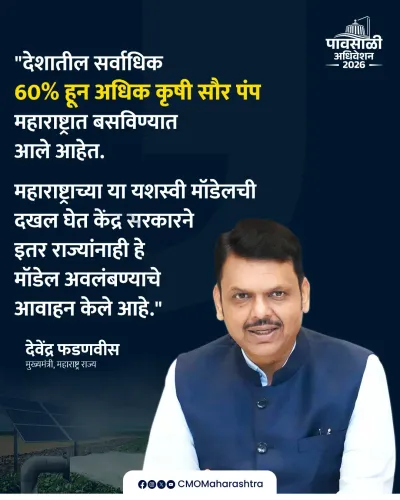
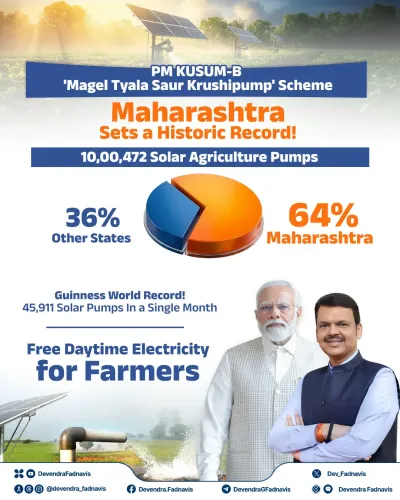
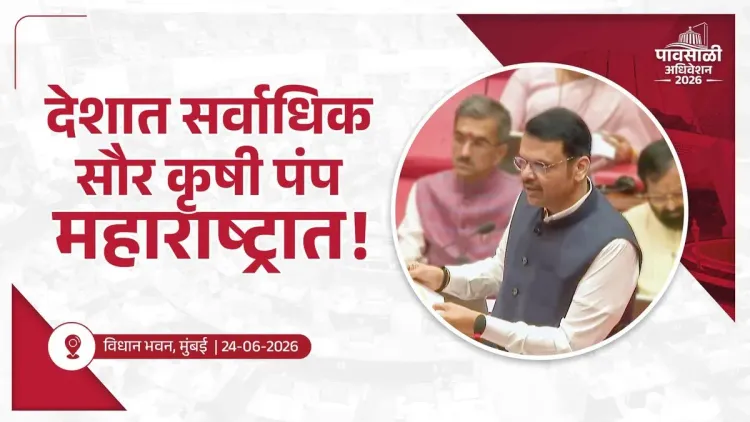
Maharashtra Chief Minister Devendra Fadnavis told the state Legislative Council on 24 June 2026 that Maharashtra accounts for 60 per cent of India's solar agricultural pump installations, and that the Central Government has written to all states urging them to adopt the 'Maharashtra Model'.
Key Takeaways
CM Devendra Fadnavis announced that Maharashtra has installed 60 per cent of India's total solar agricultural pumps.
The Central Government has issued a formal communication to all states advising them to replicate the 'Maharashtra Model' for solar pump deployment.
The announcement was made in the Maharashtra Legislative Council (Vidhan Parishad) in Mumbai on 24 June 2026 during the Monsoon Session.
Maharashtra's head start is partly attributed to its state solar policy introduced in 2015 and its participation in the Centre's PM-KUSUM scheme since 2019 .
Key beneficiaries include farmers who gain reliable irrigation power and DISCOMs that reduce the subsidy burden on grid electricity.
State-level budget allocations and tender activity for solar pumps in 2026-27 will be a key indicator of how quickly other states follow the advisory.
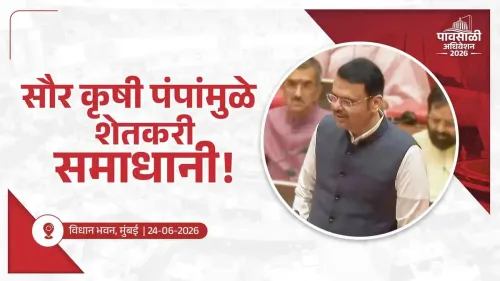
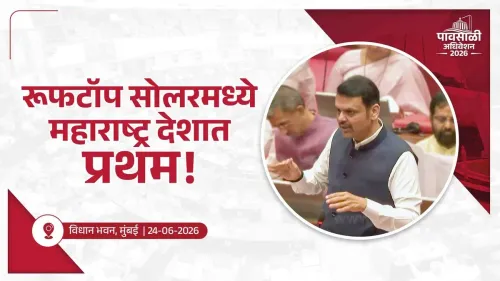
Maharashtra Chief Minister Devendra Fadnavis announced on Wednesday, 24 June 2026, that Maharashtra has installed 60 per cent of all solar agricultural pumps deployed across India, and that the Central Government has written to all states advising them to replicate the 'Maharashtra Model' for solar pump adoption. The announcement was made on the floor of the Maharashtra Legislative Council (Vidhan Parishad) in Mumbai during the ongoing Monsoon Session 2026.
Context
Speaking in the upper house, Fadnavis cited the figure to underscore the state's outsized contribution to India's renewable energy push in agriculture. In his post on X, he wrote in both English and Marathi: 'देशातील एकूण सौर कृषी पंपांपैकी 60 टक्के पंप महाराष्ट्रात बसविण्यात आले आहेत' — 'Of the total solar agricultural pumps in the country, 60 per cent have been installed in Maharashtra.' He added that the Centre has formally communicated to all states, urging them to follow the 'Maharashtra Model.'
The statement came during a session focused on agricultural and infrastructure policy, signalling that solar pump deployment has become a flagship metric for the ruling dispensation in the state.
Policy Backdrop
The Central Government's Pradhan Mantri Kisan Urja Suraksha evam Utthaan Mahabhiyan (PM-KUSUM) scheme, launched in 2019, provides subsidies to farmers for installing off-grid solar pumps, aiming to reduce dependence on diesel and subsidised grid electricity. Maharashtra had already laid groundwork with its own state solar policy introduced in 2015, which included dedicated components for agricultural solar pumps, giving it a head start over most other states.
India's broader National Solar Mission has consistently prioritised decentralised solar energy for agriculture as a tool to reduce the fiscal burden of power subsidies and cut farm-sector carbon emissions. Maharashtra's early institutional readiness — combining state policy, farmer outreach, and tender pipelines — is widely cited in official reviews as a reason for its high installation numbers.
Stakeholders and Impact
Farmers across Maharashtra are the primary beneficiaries, gaining reliable daytime irrigation power independent of erratic grid supply and costly diesel. The shift also eases the financial strain on state electricity distribution companies (DISCOMs), which have historically provided heavily subsidised or free power to the agricultural sector.
If other states act on the Centre's advisory and adopt elements of the Maharashtra framework — including its procurement, subsidy-disbursement, and farmer-onboarding mechanisms — the national solar pump count could scale significantly in the 2026-27 budget cycle. Agriculture departments in states with large irrigation deficits stand to gain the most from replicating the model.
What's Next
Attention will now turn to whether the Central Government's advisory letter translates into accelerated state-level budget allocations and fresh tender issuances for solar pumps before the close of the financial year. Progress under PM-KUSUM is expected to be reviewed during the winter session of Parliament, where Maharashtra's numbers may be held up as a national benchmark.
For CM Fadnavis, the announcement reinforces a broader infrastructure-and-energy narrative ahead of potential state-level electoral cycles, positioning Maharashtra as a model for policy execution that the Centre itself endorses.
Point of View
A politically significant distinction for a BJP-governed state seeking to demonstrate governance credibility. The Central advisory, if widely acted upon, could accelerate PM-KUSUM's stalled rollout in laggard states and reduce the Centre's fiscal exposure to agricultural power subsidies over time. For Fadnavis personally, anchoring the announcement in a legislative session rather than a press event gives it institutional weight and insulates it from being dismissed as electoral messaging. The broader arc here is India's push to decouple farm-sector energy from the grid — Maharashtra's model, if it holds up to scrutiny, could become the template for that transition.
NationPress
23 Sept 2026
Frequently Asked Questions
What is the 'Maharashtra Model' for solar agricultural pumps?
The 'Maharashtra Model' refers to Maharashtra's approach to deploying solar agricultural pumps at scale, combining a state solar policy (introduced in 2015), central scheme subsidies under PM-KUSUM, streamlined farmer onboarding, and structured tender pipelines. The Central Government has cited this model in an advisory to all states.
What is PM-KUSUM and how does Maharashtra fit in?
PM-KUSUM (Pradhan Mantri Kisan Urja Suraksha evam Utthaan Mahabhiyan) is a Central Government scheme launched in 2019 that subsidises solar pumps for farmers to reduce dependence on diesel and grid electricity. Maharashtra, with its early state solar policy, has been among the top performers under this scheme.
What did CM Fadnavis say in the Maharashtra Legislative Council on 24 June 2026?
CM Devendra Fadnavis told the Maharashtra Legislative Council during the Monsoon Session 2026 that Maharashtra has installed 60 per cent of the country's total solar agricultural pumps, and that the Central Government has written to all states advising them to adopt the 'Maharashtra Model.'
How do solar agricultural pumps benefit farmers in Maharashtra?
Solar agricultural pumps give farmers reliable daytime irrigation power without depending on erratic grid supply or expensive diesel. They lower operating costs for farmers and reduce the subsidy burden on state electricity distribution companies.
Will other states now adopt Maharashtra's solar pump model?
The Central Government has formally advised all states to replicate the 'Maharashtra Model.' Whether states act on this depends on their budget allocations and tender activity in 2026-27, which will be closely watched as a measure of PM-KUSUM's national progress.