CM Fadnavis's Solar Pump Model Gets Central Govt Nod
Synopsis
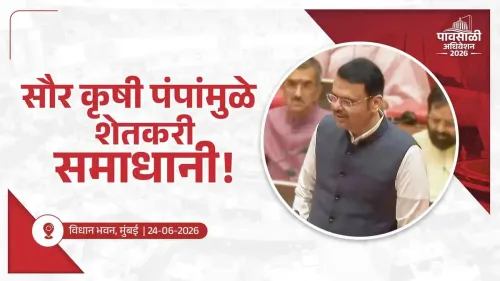
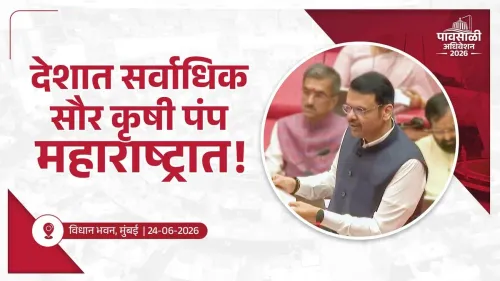
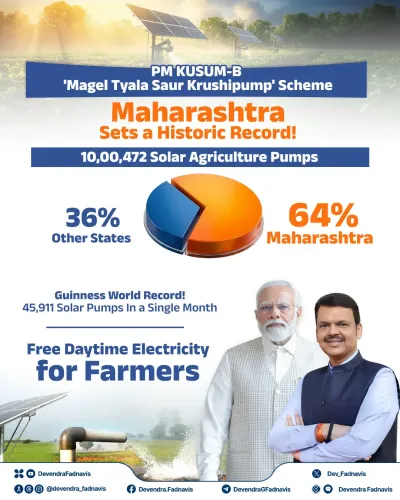
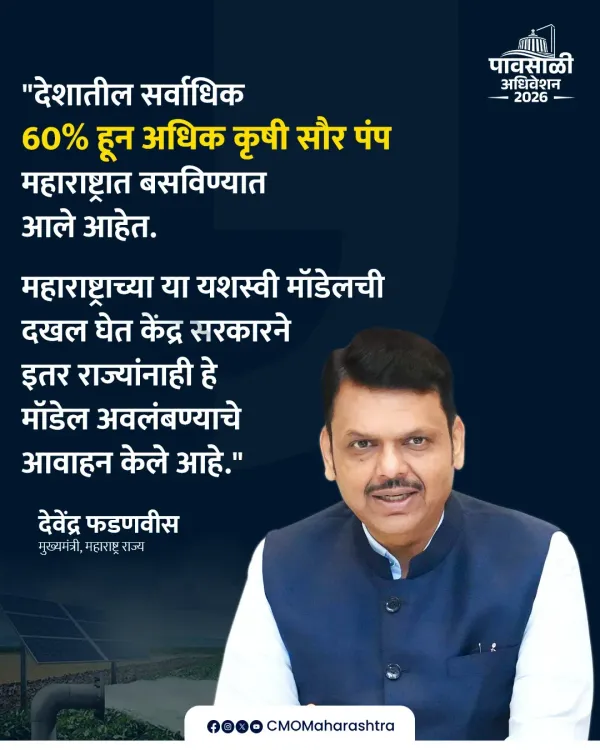
The Chief Minister's Office of Maharashtra announced on June 24, 2026 that the state's model for deploying solar agricultural pumps has received recognition from the Central Government, spotlighting CM Devendra Fadnavis's renewable energy push for farmers under the national PM-KUSUM framework.
Key Takeaways
The Chief Minister's Office of Maharashtra announced on June 24, 2026 that the state's solar agricultural pump model has been acknowledged by the Central Government .
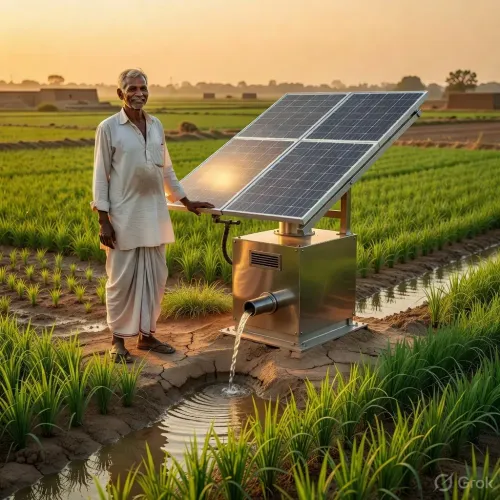
Chief Minister Devendra Fadnavis has led the state's drive to install solar-powered irrigation pumps, reducing farmers' reliance on diesel and erratic grid power.
The Central Government's PM-KUSUM scheme, launched in 2019 , subsidises solar pumps for farmers across India to cut fuel costs and emissions.
Maharashtra's scalable deployment model is being referenced at the national level as a potential template for wider adoption under PM-KUSUM.
The recognition could lead to formal coordination between the Ministry of New and Renewable Energy and Maharashtra to incorporate the state's practices into revised national guidelines.
The Chief Minister's Office of Maharashtra announced on Wednesday, June 24, 2026 that the state's model for installing solar agricultural pumps has received recognition from the Central Government, marking a significant endorsement of Chief Minister Devendra Fadnavis's renewable energy push in the farm sector.
Context
The CMO's post — 'सौर कृषी पंप बसविण्यात महाराष्ट्र मॉडेलची केंद्र सरकारकडून दखल!' ('The Maharashtra model for installing solar agricultural pumps has been acknowledged by the Central Government!') — signals that Maharashtra's approach to scaling solar-powered irrigation has caught New Delhi's attention. The state has been implementing a structured rollout of solar pumps to reduce farmers' dependence on erratic grid power and costly diesel.
Chief Minister Devendra Fadnavis has championed renewable energy integration in agriculture as part of the state's broader climate and fiscal goals. Solar pumps lower input costs for farmers while cutting carbon emissions from the agricultural sector.
Policy Backdrop
The Central Government's PM-KUSUM (Pradhan Mantri Kisan Urja Suraksha evam Utthaan Mahabhiyan) scheme, launched in 2019, provides subsidies to replace diesel-powered irrigation pumps with solar alternatives. The scheme was designed to reduce the farm sector's fuel bill and align agricultural energy use with India's national renewable energy targets.
Several states developed distinct implementation frameworks under PM-KUSUM. Maharashtra's model — focusing on scalable, ground-level deployment — has emerged as one that the Ministry of New and Renewable Energy has referenced in discussions around widening the scheme's reach. Effective state-level blueprints are increasingly being studied for possible integration into revised national guidelines.
Stakeholders and Impact
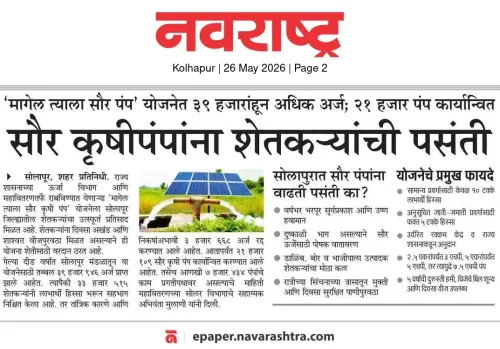
Maharashtra's farming community stands to benefit most directly. Solar pumps eliminate dependence on diesel — a volatile-cost input — and provide reliable daytime irrigation power independent of grid availability. For smallholder farmers in rain-shadow regions of the state, this can be transformative for crop yields and income stability.
At the national level, the acknowledgment matters because it could accelerate the adoption of Maharashtra's operational practices in other states under PM-KUSUM's framework. State governments looking to improve their own solar pump rollout rates may look to the Maharashtra model as a reference point.
What's Next
The central government's recognition could translate into formal coordination between New Delhi and Mumbai on refining PM-KUSUM implementation guidelines. Observers will watch for any announcements from the Ministry of New and Renewable Energy that incorporate Maharashtra's approach into updated national protocols or inter-state knowledge-sharing initiatives.
For Chief Minister Fadnavis, the endorsement strengthens the political and policy case for deepening solar infrastructure investment in Maharashtra's agricultural districts — and positions the state as a model for climate-aligned farm policy across India.
Point of View
It is a rare moment of centre-state alignment on agricultural energy policy that carries both developmental and political weight. The endorsement could also sharpen competitive pressure on other states to accelerate their own solar irrigation programmes. Longer term, it signals that the centre-state policy feedback loop on green agriculture is becoming more systematic.
NationPress
23 Sept 2026
Frequently Asked Questions
What is the Maharashtra solar agricultural pump model?
Maharashtra developed a scalable, structured approach to installing solar-powered irrigation pumps for farmers, reducing dependence on diesel and unreliable grid electricity. The model has now been acknowledged by the Central Government as a reference for wider national adoption.
What is the PM-KUSUM scheme?
PM-KUSUM (Pradhan Mantri Kisan Urja Suraksha evam Utthaan Mahabhiyan) is a Central Government scheme launched in 2019 that provides subsidies to farmers for replacing diesel pumps with solar-powered irrigation pumps, aiming to cut energy costs and carbon emissions in agriculture.
Why did the Central Government acknowledge Maharashtra's solar pump model?
Maharashtra's model for deploying solar agricultural pumps at scale has been recognised for its effective implementation under the PM-KUSUM framework. The Central Government, through the Ministry of New and Renewable Energy, has referenced successful state models to improve national rollout strategies.
How do solar agricultural pumps benefit farmers in Maharashtra?
Solar pumps eliminate the need for expensive diesel and reduce dependence on unreliable grid power, providing farmers with consistent daytime irrigation. This lowers input costs and can improve crop yields, particularly in rain-shadow and grid-deficient regions of Maharashtra.
What happens next after the Central Government recognises Maharashtra's solar pump model?
The recognition could lead to formal coordination between the Ministry of New and Renewable Energy and the Maharashtra government to incorporate the state's practices into revised PM-KUSUM guidelines, and may serve as a template for other states to improve their own solar irrigation programmes.