CM Fadnavis: Maharashtra Tops India in Off-Grid Solar Pumps
Synopsis
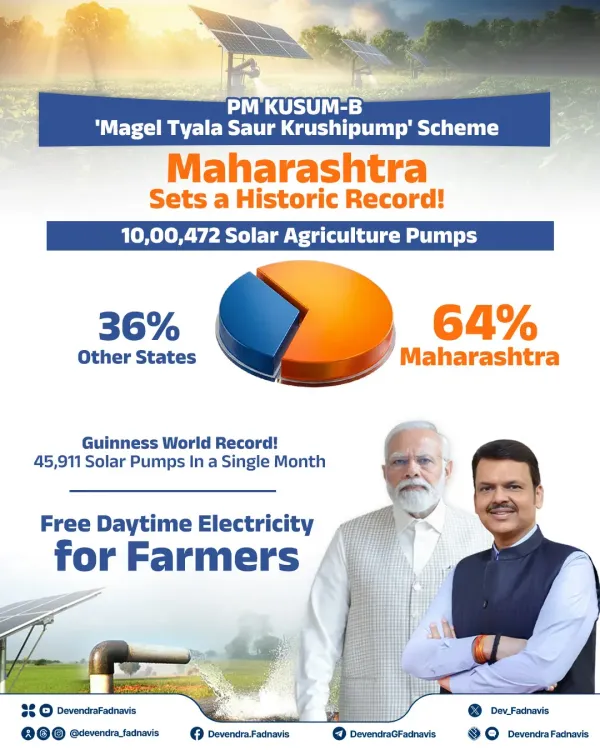
Maharashtra Chief Minister Devendra Fadnavis announced that the state has crossed 10 lakh off-grid solar pump installations, the highest in India. He said Maharashtra accounts for 64 per cent of the national total of 15.62 lakh solar pumps, calling it a historic milestone for the state's farmers under the renewable energy push.
Key Takeaways
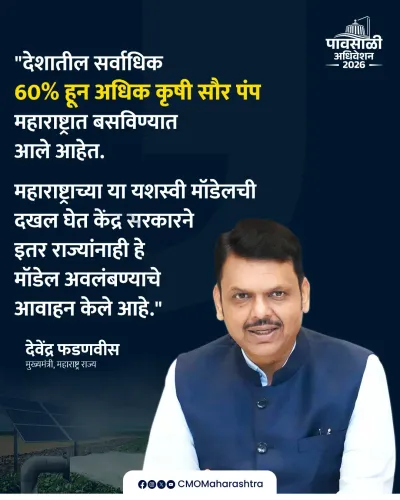
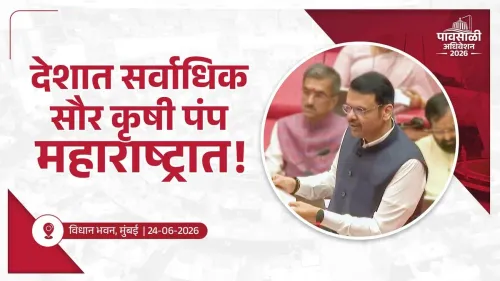
Maharashtra has installed over 10 lakh off-grid solar pumps, per CM Devendra Fadnavis .
The state accounts for 64 per cent of India's total 15.62 lakh solar pumps.
Deployment is anchored in the Union government's PM-KUSUM scheme, launched in 2019 .
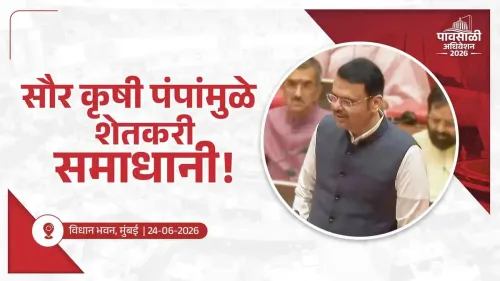
Solar pumps cut diesel dependence and lower input costs for farmers.
The push supports India's 500 GW non-fossil capacity target by 2030 .
Comparable scaling is visible in Rajasthan and Madhya Pradesh .
Maharashtra Chief Minister Devendra Fadnavis on Wednesday announced that the state has crossed the 10 lakh mark in off-grid solar pump installations, claiming the highest tally in the country. In a post on X, the senior BJP leader said Maharashtra now accounts for a 64 per cent share of India's total 15.62 lakh solar pumps deployed for farmers.
'Proud to announce a historic milestone for Maharashtra's farmers,' the Chief Minister wrote, adding that the pumps were 'lighting up fields and transforming lives.' He tagged Prime Minister Narendra Modi and signed off with the line, 'When Maharashtra's farmers thrive, India thrives.'
Context
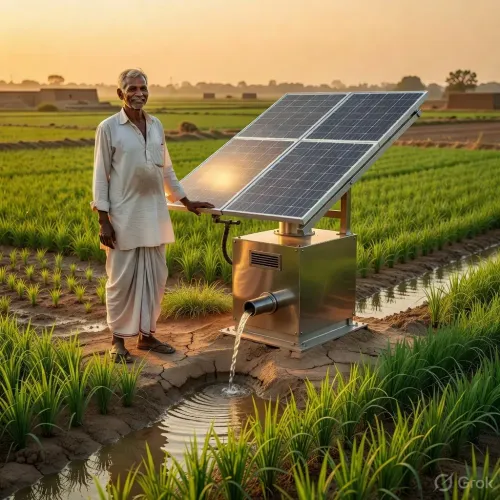
Off-grid solar pumps allow farmers to draw groundwater for irrigation without relying on diesel generators or an erratic electricity grid. They are particularly valuable in rain-fed and remote agricultural belts, where last-mile power supply has historically been patchy and operating costs have eaten into thin farm margins.
Maharashtra, with one of India's largest agricultural workforces and significant tracts of dryland farming in regions such as Marathwada and Vidarbha, has been an aggressive adopter of solarised irrigation. The Chief Minister's announcement positions the state as the front-runner in the national rollout.
Policy backdrop
The bulk of solar pump deployment in India runs through the Pradhan Mantri Kisan Urja Suraksha evam Utthaan Mahabhiyan (PM-KUSUM) scheme, launched by the Union government in 2019. The programme subsidises standalone solar pumps, supports solarisation of existing grid-connected pumps, and enables farmers to set up small solar power plants on barren land.
Maharashtra has layered its own state-level initiatives on top of PM-KUSUM, including dedicated agriculture feeders and targeted distribution for marginal farmers. The cumulative effect, as flagged by Mr Fadnavis, is a sharp concentration of installations in the state relative to the national base.
Stakeholders and impact
The primary beneficiaries are Maharashtra's farmers, particularly small and marginal cultivators who previously depended on diesel pumps or waited for limited daytime power. A shift to solar lowers recurring fuel costs, reduces exposure to fluctuating diesel prices, and frees up grid capacity for other users.
For the state exchequer, large-scale solar pump adoption helps trim the agricultural power subsidy burden carried by distribution utilities. At the national level, every additional off-grid solar pump contributes to India's broader target of 500 GW of non-fossil power capacity by 2030, an objective the Union government has repeatedly reiterated.
Comparable scaling is under way in Rajasthan and Madhya Pradesh, both states with extensive dry-farming zones. Maharashtra's lead, if sustained, will set a benchmark for implementation pace among large agrarian states.
What's next
The next markers to watch will be the state's revised solar pump targets in upcoming agriculture and energy department announcements, along with any supplementary budget allocations to expand the rollout into remaining talukas. Officials are also expected to detail progress on grid-connected pump solarisation, a parallel track under PM-KUSUM that complements the off-grid push.
For Mr Fadnavis, the milestone doubles as a political message — projecting Maharashtra as a delivery-focused state on a flagship central scheme, and tying farmer welfare to the renewable energy transition. With assembly-level scrutiny of agrarian distress remaining sharp, further announcements on irrigation, power tariffs and farm input costs are likely to follow in the coming weeks.
Point of View
Blending farmer welfare politics with India's climate commitments. By tying the milestone to PM Modi, CM Fadnavis signals continued state-Centre alignment on PM-KUSUM, a politically useful narrative in an agrarian state still grappling with distress. The bigger arc is the steady mainstreaming of solar irrigation as both a subsidy-relief tool for state utilities and a delivery metric in BJP-governed states. Sustained execution, rather than headline numbers, will determine whether the model is replicable nationally.
NationPress
19 Sept 2026
Frequently Asked Questions
How many solar pumps has Maharashtra installed?
Maharashtra has installed over 10 lakh off-grid solar pumps, according to Chief Minister Devendra Fadnavis. He said this is the highest tally in the country and represents a 64 per cent share of India's total of 15.62 lakh solar pumps.
What is the PM-KUSUM scheme?
PM-KUSUM, or Pradhan Mantri Kisan Urja Suraksha evam Utthaan Mahabhiyan, is a Union government scheme launched in 2019. It subsidises standalone solar pumps, supports solarisation of existing pumps, and enables farmers to set up small solar power plants on barren land.
Why are off-grid solar pumps important for farmers?
They allow farmers to irrigate fields without depending on diesel or an unreliable electricity grid. This lowers fuel costs, reduces exposure to diesel price swings, and provides predictable daytime power for irrigation in remote and rain-fed regions.
What is India's renewable energy target?
India has set a target of 500 GW of non-fossil power capacity by 2030. Solar irrigation programmes such as PM-KUSUM contribute to this goal while simultaneously reducing the agricultural power subsidy burden on state utilities.
Which other states are scaling solar pumps?
Rajasthan and Madhya Pradesh are among the other states scaling up solar pump deployment under PM-KUSUM. Both have extensive dry-farming zones where standalone solar pumps offer a cost-effective alternative to diesel and grid power.