CM Fadnavis: Solar schemes free 1.43 lakh Maharashtra farmers from grid
Synopsis
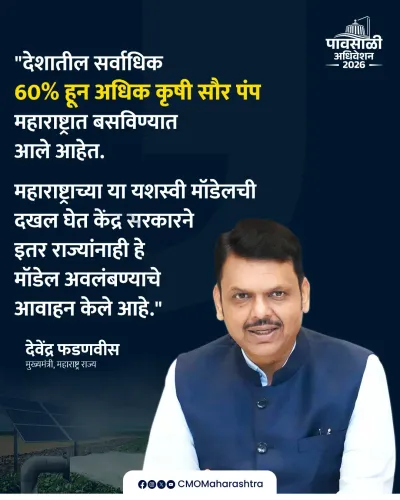
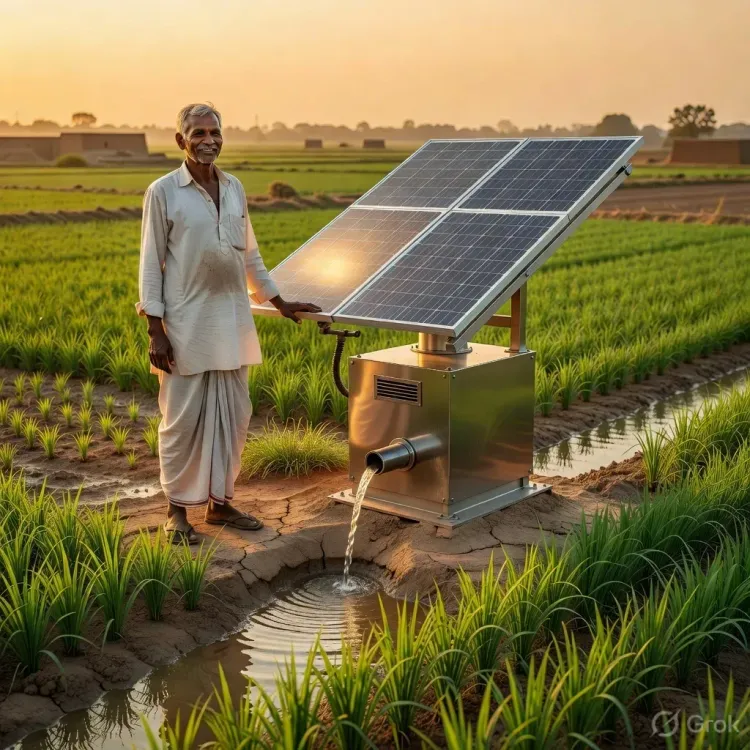
On Independence Day 2026, Maharashtra's CMO announced that 1.43 lakh farmers have achieved 'energy independence' through PM-KUSUM and the state's Mukhyamantri Saur Krishi Yojana, reducing dependence on grid power and diesel irrigation.
Key Takeaways
1.43 lakh farmers in Maharashtra have benefited from combined solar agriculture schemes, per the CMO's Independence Day announcement.
Two schemes are credited: the Central government's PM-KUSUM (launched 2019) and the state's own Mukhyamantri Saur Krishi Yojana .
The government frames the outcome as 'ऊर्जा स्वातंत्र्य' (energy independence), positioning solar access as a structural shift, not merely a subsidy.
Solar pumps reduce farmers' dependence on erratic grid power and diesel , cutting input costs and improving irrigation reliability.
The announcement was timed to Independence Day, 15 August 2026 , drawing a deliberate parallel between national freedom and energy freedom.
On Independence Day, 15 August 2026, the Chief Minister's Office of Maharashtra highlighted a milestone in rural energy access — announcing that 1.43 lakh farmers across the state have gained what the government is calling 'ऊर्जा स्वातंत्र्य' ('energy independence') through the combined push of two solar agriculture schemes.
Two schemes, one mission: cutting the cord on grid power
The post, addressed to Chief Minister Devendra Fadnavis, credits the PM-KUSUM scheme — the Central government's flagship solar agriculture programme launched in 2019 — and the state's own Mukhyamantri Saur Krishi Yojana for together transforming the energy situation of over a lakh farmers. The framing is deliberate: the word taqadeer (destiny) signals this is being pitched not as a subsidy, but as a structural shift.
PM-KUSUM (Pradhan Mantri Kisan Urja Suraksha evam Utthaan Mahabhiyan) was designed to install solar pumps, grid-connected solar plants and standalone systems on farmland, reducing dependence on diesel and subsidised grid electricity. Maharashtra layered its own Mukhyamantri Saur Krishi Yojana on top, targeting farmers who remained outside the Central scheme's reach or needed complementary support.
Why Independence Day timing matters
Releasing the beneficiary figure on 15 August is a conscious political choice — framing solar energy access as a form of freedom, echoing the post's own language of 'ऊर्जा स्वातंत्र्य'. For Maharashtra's farming communities, dependence on erratic grid supply and expensive diesel pumps has long been a source of agrarian stress. A solar pump changes the economics of irrigation fundamentally: zero fuel cost, predictable daytime power, and no waiting on the state electricity board's schedule.
The broader push behind rural solar in India
Maharashtra's announcement sits inside a national pattern. Central and state governments have pursued parallel solar agriculture programmes with a dual goal: reduce the fiscal burden of power subsidies to farmers — which runs into thousands of crores annually — and expand India's renewable energy footprint into its villages. For the state exchequer, every farmer on a solar pump is one less demand on a strained power subsidy bill. For the farmer, it is a hedge against power cuts and rising input costs.
The government's next challenge will be scale: how many more installations are in the pipeline, and whether the 1.43 lakh figure represents the ceiling of current rollout or the floor of a larger ambition.
On the 79th Independence Day, Maharashtra's solar count is a number to watch — because the states that solve farm power solve half of rural India's productivity puzzle.
Point of View
Central plus state, also lets the Fadnavis government claim credit alongside the Modi government, reinforcing coalition messaging ahead of any future electoral cycle. The real policy test, however, is whether the 1.43 lakh figure represents genuine last-mile penetration among rain-fed and small landholders, or is concentrated among larger farmers better positioned to access scheme benefits. Scaling solar irrigation equitably remains the harder, less headline-friendly half of the story.
NationPress
30 Sept 2026
Frequently Asked Questions
What is the Mukhyamantri Saur Krishi Yojana in Maharashtra?
The Mukhyamantri Saur Krishi Yojana is a Maharashtra state government scheme that provides solar pumps and energy solutions to farmers, complementing the Central government's PM-KUSUM scheme to reduce dependence on grid electricity and diesel for irrigation.
How many farmers benefited from solar schemes in Maharashtra?
According to the Chief Minister's Office of Maharashtra, 1.43 lakh farmers have benefited from the combined implementation of PM-KUSUM and the Mukhyamantri Saur Krishi Yojana, as announced on Independence Day 2026.
What is PM-KUSUM and when was it launched?
PM-KUSUM (Pradhan Mantri Kisan Urja Suraksha evam Utthaan Mahabhiyan) is a Central government scheme launched in 2019 to install solar pumps and solar power plants for farmers across India, reducing their reliance on diesel and subsidised grid electricity.
What does 'energy independence' mean for Maharashtra farmers?
In this context, 'energy independence' or ऊर्जा स्वातंत्र्य refers to farmers gaining access to solar-powered irrigation, freeing them from dependence on erratic state grid supply and expensive diesel pumps, thereby lowering input costs and improving productivity.
What is Devendra Fadnavis's role in Maharashtra's solar farm scheme?
Devendra Fadnavis is the Chief Minister of Maharashtra and has highlighted the state's implementation of both PM-KUSUM and the Mukhyamantri Saur Krishi Yojana as part of his government's push to improve energy access and reduce costs for the state's farming communities.