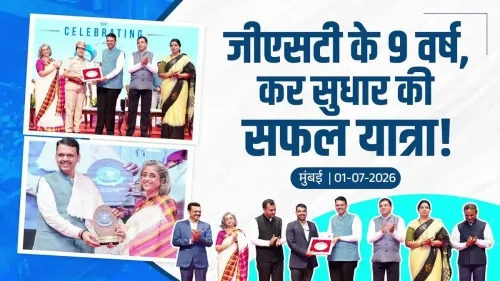
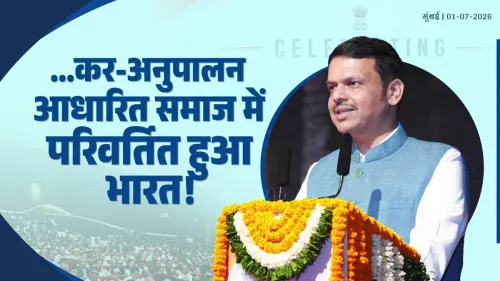
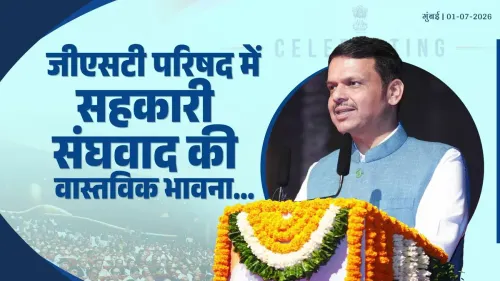
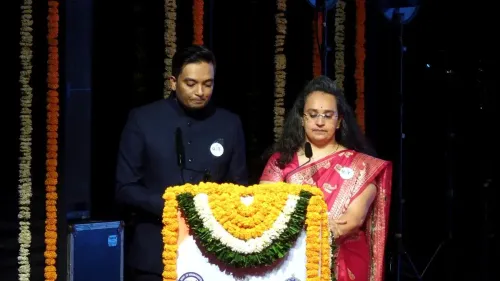
CM Fadnavis at 9th GST Day Celebrations in Mumbai
Synopsis
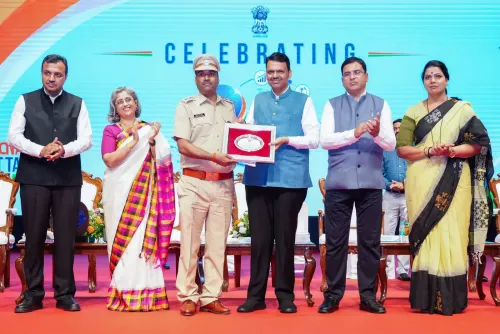
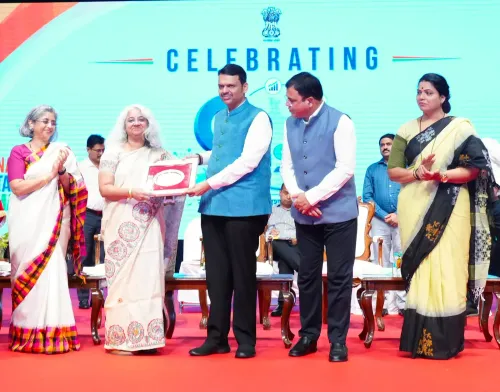
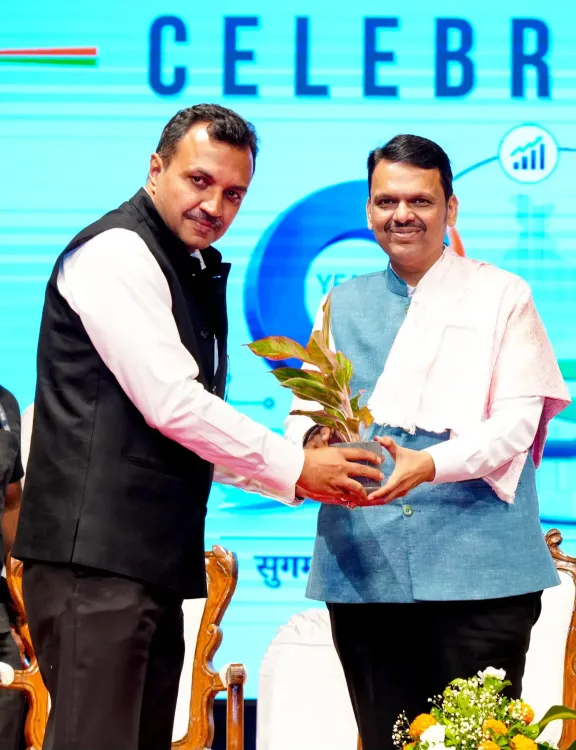
Chief Minister Devendra Fadnavis attended the 9th GST Day Celebrations in Mumbai on 1 July 2026, alongside MoS Ashish Jaiswal and Mayor Ritu Tawde, marking nine years of India's unified indirect tax system under the theme 'Smooth Tax System, Empowered India'.
Key Takeaways
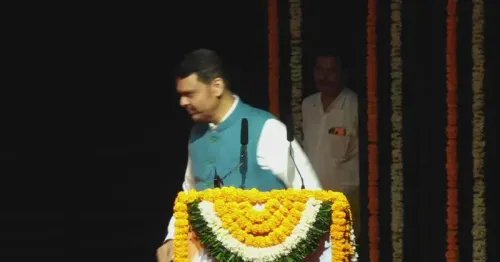
CM Devendra Fadnavis was the chief guest at the 9th GST Day Celebrations, 2026 held in Mumbai on 1 July 2026 .
The event's theme was 'Smooth Tax System, Empowered India' ( सुगम कर व्यवस्था, सशक्त भारत ).
Minister of State Adv.
Ashish Jaiswal and Mumbai Mayor Ritu Tawde were among the senior dignitaries present.
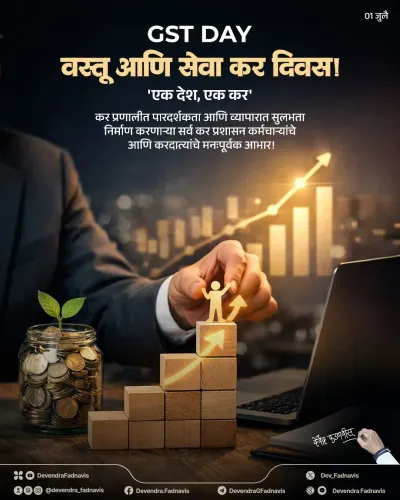
GST Day is observed on 1 July each year to mark the rollout of the Goods and Services Tax on 1 July 2017 , replacing excise, VAT, service tax, and entry taxes.
Maharashtra is one of India's largest contributors to national GST collections, making its official participation in such events significant.
Upcoming GST Council deliberations are expected to focus on rate rationalisation, compensation cess wind-down, and MSME relief measures.
The Chief Minister's Office of Maharashtra announced that Chief Minister Devendra Fadnavis graced the 9th GST Day Celebrations, 2026 as the chief guest in Mumbai on 1 July 2026 at 3:30 PM, marking nine years since the nationwide rollout of the Goods and Services Tax.
The event, themed 'सुगम कर व्यवस्था, सशक्त भारत' ('Smooth Tax System, Empowered India'), was also attended by Minister of State Adv. Ashish Jaiswal, Mumbai Mayor Ritu Tawde, and senior government officials, signalling Maharashtra's institutional commitment to the unified indirect tax framework.
Context
GST Day is observed every year on 1 July to commemorate the landmark rollout of the Goods and Services Tax on 1 July 2017, when India replaced a fragmented web of central and state levies — including excise duty, service tax, VAT, and entry taxes — with a single, unified indirect tax structure. The 2026 edition marks the ninth anniversary of that constitutional overhaul.
Maharashtra, as one of India's largest contributors to national GST collections, has consistently participated in these annual commemorations at a high level of official representation. Chief Minister Fadnavis, who has overseen state-level GST administration across multiple terms in office, lent his presence to underscore the state government's alignment with the broader national tax-reform agenda.
Policy Backdrop
GST was introduced following a constitutional amendment that created the GST Council — a federal body comprising the Union Finance Minister and state counterparts — as the apex decision-making authority on rates, exemptions, and compliance norms. The system introduced an input tax credit mechanism designed to eliminate the cascading effect of earlier taxes and reduce the cost of doing business.
Over nine years, the GST framework has evolved through successive Council meetings that have rationalised rates, expanded the digital compliance infrastructure, and addressed sector-specific concerns. Ongoing agenda items before the Council include rate rationalisation, the wind-down of the compensation cess extended to states post-2022, and potential simplifications for micro, small, and medium enterprises (MSMEs).
Stakeholders and Impact
Businesses across Maharashtra — from large manufacturers to small traders — are key stakeholders in the GST ecosystem, relying on seamless invoice matching and timely refunds to manage working capital. Annual GST Day events serve as a platform for the state administration to engage with the trade and industry community, address compliance concerns, and highlight improvements in the digital tax infrastructure.
State governments, including Maharashtra, have a direct fiscal interest in robust GST collections, as their share of integrated GST and state GST receipts funds a significant portion of public expenditure. High-level participation by CM Fadnavis and Mayor Tawde signals that both state and municipal leadership view tax-system stability as central to Maharashtra's economic governance.
What's Next
The GST Council is expected to continue deliberations on rate simplification and MSME-focused relief measures in upcoming meetings, with Maharashtra likely to play an active role given its economic weight. The 9th GST Day celebrations may also provide a platform for the state to present data on compliance improvements and revenue buoyancy achieved over the past year.
As the compensation cess framework approaches its final phase, states will watch closely for any Council decisions that could affect their fiscal transfers — making forums like today's event an important channel for signalling state-level priorities to the Centre.
Point of View
Marathi, and Hindi — reflects the Maharashtra government's effort to communicate economic governance achievements to multiple constituencies simultaneously. With the GST Council's agenda increasingly focused on rate rationalisation and MSME simplification, high-profile state participation in such commemorations also functions as soft lobbying for Maharashtra's interests in upcoming Council decisions. The event fits a broader pattern of ruling dispensations using GST anniversary platforms to reinforce a narrative of tax-system maturity and administrative modernisation.
NationPress
30 Sept 2026
Frequently Asked Questions
What is GST Day and why is it celebrated on 1 July?
GST Day is observed on 1 July every year to mark the launch of the Goods and Services Tax on 1 July 2017 , when India replaced multiple indirect taxes — including excise duty, VAT, and service tax — with a single unified framework. The 2026 edition marks the ninth anniversary of this reform.
Who attended the 9th GST Day Celebrations in Mumbai?
Chief Minister Devendra Fadnavis was the chief guest at the 9th GST Day Celebrations, 2026 in Mumbai . Minister of State Adv. Ashish Jaiswal , Mumbai Mayor Ritu Tawde , and senior officials were also present.
What was the theme of the 9th GST Day 2026 event in Maharashtra?
The theme of the event was 'Smooth Tax System, Empowered India' , expressed in Hindi as सुगम कर व्यवस्था, सशक्त भारत , reflecting the focus on simplifying tax compliance and strengthening the national economy.
How much does Maharashtra contribute to India's GST collections?
Maharashtra is consistently among the top contributors to India's national GST collections, given its large industrial and services base. Specific figures for 2026 are subject to official GST Council and state finance department disclosures.
What are the key issues before the GST Council in 2026?
The GST Council is deliberating on rate rationalisation , the wind-down of the compensation cess extended to states, and potential simplifications for MSMEs — all of which have direct implications for state revenues and business compliance costs.