CM Fadnavis forms women MLAs panel on conversion, harassment
Synopsis
Chief Minister Devendra Fadnavis has announced a special committee of women MLAs in Maharashtra to examine and recommend measures against religious conversion and sexual harassment, signalling a legislative push on two politically sensitive social issues.
Key Takeaways
Chief Minister Devendra Fadnavis announced the formation of a special committee of women MLAs in Maharashtra on June 25, 2026 .
The committee's dual mandate covers religious conversion and sexual harassment of women.
The committee is anchored in the Maharashtra Legislative Assembly , giving it formal powers to examine evidence and recommend action.
Maharashtra has not yet enacted a standalone anti-conversion law , making the committee's recommendations potentially significant for state legislation.
Formal notification, terms of reference, and membership are yet to be officially published.
Recommendations are expected to be tabled during the monsoon or winter assembly session .
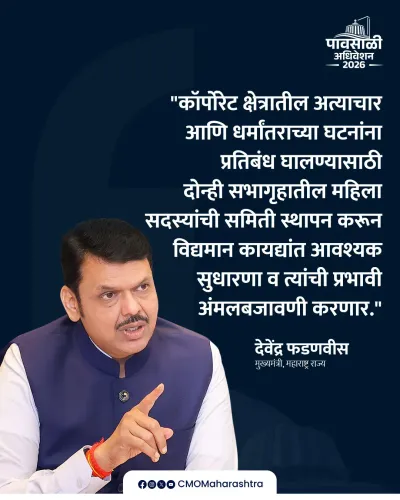
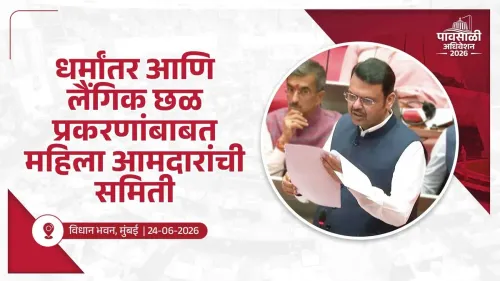
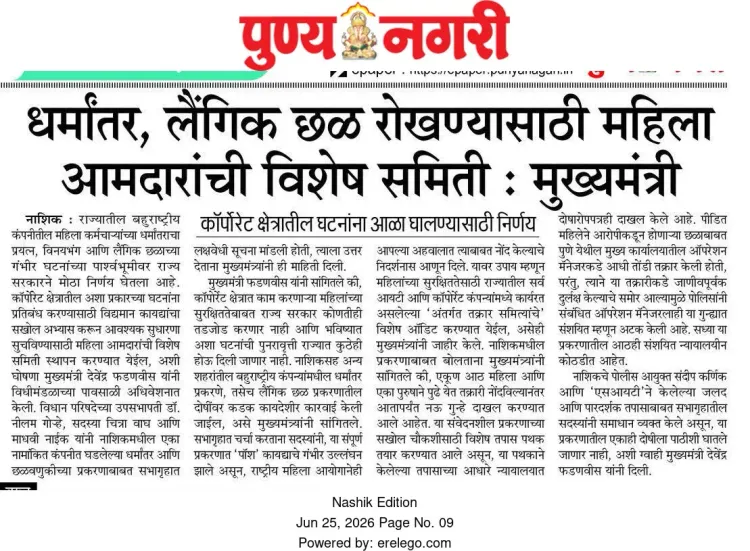
Mumbai, June 25: The Chief Minister's Office of Maharashtra announced on Thursday, June 25, 2026, that Chief Minister Devendra Fadnavis has constituted a special committee of women legislators to examine measures against religious conversion and sexual harassment of women in the state.
The CMO post, shared in Marathi, stated: 'धर्मांतर, लैंगिक छळ रोखण्यासाठी महिला आमदारांची विशेष समिती' — meaning 'A special committee of women MLAs to prevent religious conversion and sexual harassment.' The announcement was attributed directly to Chief Minister Devendra Fadnavis.
Context
The proposed body brings together elected women members of the Maharashtra Legislative Assembly under a formal committee structure to deliberate on two distinct but politically sensitive issues: coercive or fraudulent religious conversion, and gender-based harassment. By anchoring the committee in the legislature, the government gives it formal standing to call witnesses, examine evidence, and recommend legislative or executive action.
Maharashtra has historically moved swiftly on women's safety legislation, particularly after the 2012 Nirbhaya case prompted states across India to strengthen fast-track courts and state-level redressal mechanisms for gender-based offences.
Policy Backdrop
The question of regulating religious conversions has been a recurring legislative theme across Indian states. Between 2003 and 2021, several state governments enacted or amended anti-conversion statutes requiring prior notice or official permission for conversions, particularly those alleged to involve inducement or coercion. Maharashtra has not yet enacted a standalone anti-conversion law, making the committee's terms of reference significant for the state's legislative direction.
On sexual harassment, Maharashtra operates under both the central Prevention of Sexual Harassment (POSH) Act and state-level mechanisms. A dedicated legislative committee of women MLAs would add a layer of political oversight and could recommend stronger state-specific provisions or stricter enforcement frameworks.
Stakeholders and Impact
The most direct stakeholders are women citizens of Maharashtra, particularly those who may be vulnerable to coercive conversion practices or workplace and public-space harassment. Women MLAs drawn from across party lines — if the committee is constituted on a cross-party basis — would bring diverse constituency perspectives to the deliberations.
Civil society organisations working on gender rights and religious freedom are also expected to engage closely with the committee's proceedings. The committee's eventual recommendations could influence both the state's criminal justice priorities and any future legislation tabled in the Maharashtra Legislative Assembly.
What's Next
The formal notification constituting the committee, along with its precise terms of reference and membership list, is expected to be issued by the state government in the coming days. Observers will watch whether the committee's mandate covers only legislative recommendations or also includes on-ground fact-finding visits.
Any report or interim recommendations are likely to be tabled during the monsoon or winter assembly session of the Maharashtra legislature. The committee's work could set a template for similar bodies in other states grappling with the intersection of gender safety and religious conversion concerns.
Point of View
A step Maharashtra has not yet taken. The committee's cross-party composition, if any, will be the clearest signal of whether this is a consensus-building exercise or a ruling-party-driven policy push.
NationPress
25 Jun 2026
Frequently Asked Questions
What is the special committee of women MLAs announced by CM Fadnavis?
It is a legislative committee comprising women members of the Maharashtra Legislative Assembly, constituted by Chief Minister Devendra Fadnavis to examine and recommend measures to prevent religious conversion and sexual harassment of women in Maharashtra.
Why is Maharashtra forming a committee on religious conversion?
Maharashtra currently lacks a standalone anti-conversion law, and the committee is expected to study the issue and potentially recommend legislation or executive measures to regulate coercive or fraudulent conversions in the state.
Who are the members of the Maharashtra women MLAs committee on conversion and harassment?
The specific membership and terms of reference had not been officially notified as of the June 25, 2026 announcement; the formal committee notification is expected to be issued in the coming days.
What powers will the special committee of women MLAs have?
As a formal legislative committee, it is expected to have powers to call witnesses, examine evidence, conduct fact-finding, and table recommendations before the Maharashtra Legislative Assembly.
When will the committee submit its report?
No deadline has been officially announced, but observers expect any interim or final recommendations to be tabled during the monsoon or winter session of the Maharashtra legislature.