CM Fadnavis Pays Tribute to CV Raman on Birth Anniversary
Synopsis
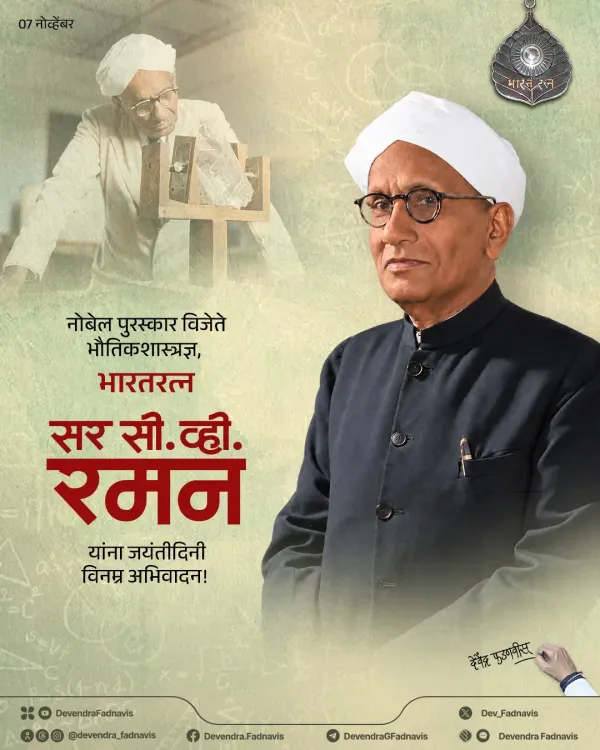
Maharashtra CM Devendra Fadnavis paid tribute to Bharat Ratna Sir C. V. Raman on his birth anniversary, honouring the discoverer of the Raman Effect and first Asian Nobel laureate in Physics as a symbol of India's scientific legacy.
Key Takeaways
Maharashtra Chief Minister Devendra Fadnavis posted a tribute to Sir C.
Raman on his birth anniversary, 7 November 2026 .
Raman discovered the Raman Effect in 1928 , demonstrating inelastic scattering of light through transparent mediums.
He won the Nobel Prize in Physics in 1930 , becoming the first Asian laureate in any science Nobel.
The Government of India awarded him the Bharat Ratna in 1954 .
28 February is observed as National Science Day in India since 1987 to commemorate the announcement of the Raman Effect.
The tribute reflects a broader political effort in Maharashtra to promote scientific temper and STEM education among youth.
A pioneer who bent light and rewrote physics — Maharashtra Chief Minister Devendra Fadnavis honoured Bharat Ratna Sir C. V. Raman on his birth anniversary on Saturday, 7 November 2026, saluting the legendary physicist as a symbol of curiosity, perseverance, and Indian scientific genius.
Posting in both English and Marathi, CM Fadnavis wrote: 'Honouring the legendary Indian physicist, whose remarkable journey stands as a testament to the power of curiosity, perseverance and innovation, the first Asian Nobel Laureate, Bharat Ratna Dr C. V. Raman, on his Birth Anniversary!' In Marathi, he extended a 'vinamra abhivadan' — a humble salute — to the man he called 'Bharatratna Sir C. V. Raman'.The discovery that made Asia's first Nobel laureate
Chandrasekhara Venkata Raman was born on 7 November 1888. His path to the Nobel was forged in 1928, when he discovered what is now known as the Raman Effect — the inelastic scattering of light as it passes through a transparent medium, which reveals the molecular composition of matter. The finding was not just a scientific milestone; it was a declaration that world-class physics could emerge from colonial India, without the full resources of a Western institution behind it. In 1930, the Nobel Committee awarded him the Nobel Prize in Physics, making him the first Asian — and the first person outside Europe or America — to win a science Nobel. India later conferred upon him the Bharat Ratna, the nation's highest civilian honour, in 1954.28 February, National Science Day, and Raman's living legacy
Raman's legacy is not merely archival. Since 1987, the Government of India has observed 28 February as National Science Day — the date in 1928 on which the Raman Effect was first announced — turning a single discovery into an annual national conversation about science, education, and innovation. For Maharashtra, a state with one of India's densest concentrations of research institutions, universities, and industrial R&D, tributes to Raman carry particular resonance. Political leaders across parties have long invoked his memory to reinforce the importance of scientific temper — a value enshrined in the Indian Constitution — and to signal support for STEM education among the next generation. A man who proved that curiosity, applied with rigour, can illuminate the universe — Raman's birth anniversary remains less a ceremonial footnote and more an annual reminder of what Indian science is capable of.Point of View
The post signals Maharashtra's self-image as India's intellectual and industrial engine. The bilingual framing — English and Marathi — is a deliberate choice, widening the appeal from the state's academic community to its broader Marathi-speaking electorate. As India intensifies its push to become a global science and technology hub, anchoring that ambition to the Raman legacy gives the tribute a forward-looking edge beyond routine commemoration.
NationPress
7 Nov 2026
Frequently Asked Questions
When is CV Raman's birth anniversary?
C. V. Raman was born on 7 November 1888 , and his birth anniversary is observed every year on 7 November.
What is the Raman Effect?
The Raman Effect is the inelastic scattering of light as it passes through a transparent medium, discovered by C. V. Raman in 1928 . It allows scientists to identify molecular compositions and won Raman the 1930 Nobel Prize in Physics .
Why is 28 February celebrated as National Science Day in India?
National Science Day is observed on 28 February every year since 1987 to mark the date in 1928 when C. V. Raman first announced the discovery of the Raman Effect.
Was CV Raman the first Asian Nobel Prize winner?
Yes. C. V. Raman became the first Asian to win a Nobel Prize in a science category when he received the Nobel Prize in Physics in 1930 for the discovery of the Raman Effect.
What Bharat Ratna did CV Raman receive?
C. V. Raman was awarded the Bharat Ratna , India's highest civilian honour, in 1954 in recognition of his extraordinary contributions to science.