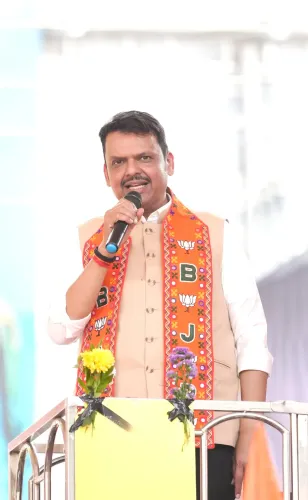
CM Fadnavis Promises Mumbai's Marathi Residents a Home of Their Own
Synopsis
The Chief Minister's Office of Maharashtra has posted a commitment attributed to CM Devendra Fadnavis pledging that Marathi-speaking residents of Mumbai will have homes of their own right, signalling a renewed state focus on affordable urban housing in India's most housing-stressed city.
Key Takeaways
The Chief Minister's Office of Maharashtra posted on 8 July 2026 affirming a housing commitment for Marathi residents of Mumbai.
The Marathi phrase used — हक्काचे घर — means 'a home of one's own right,' framing housing as entitlement.
The post was tagged directly to CM Devendra Fadnavis , personally associating him with the pledge.
Maharashtra has operated the Slum Rehabilitation Authority since the mid-1990s and participates in the central Pradhan Mantri Awas Yojana framework.
Mumbai faces severe housing shortages driven by high property prices and large-scale migration, making Marathi-community housing a politically and socially significant issue.
Specific scheme details, budgetary figures, and timelines are yet to be announced publicly.
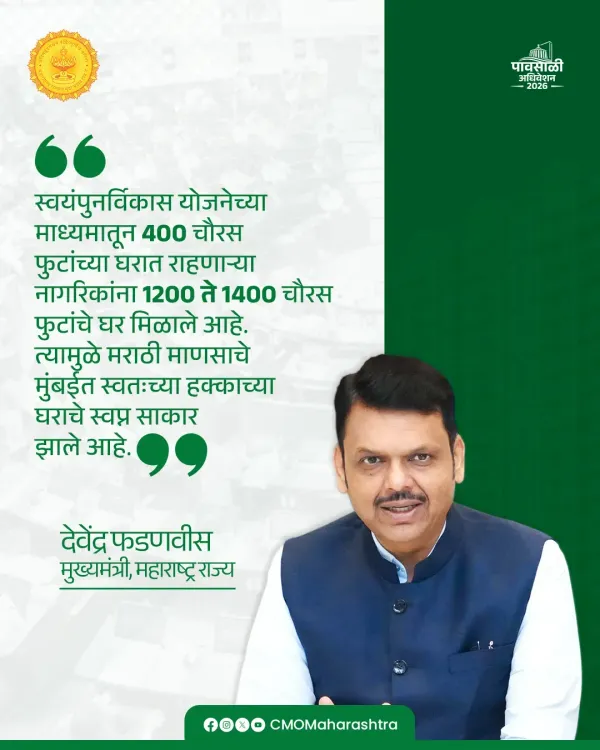
The Chief Minister's Office of Maharashtra on Wednesday, 8 July 2026, posted a message on behalf of Chief Minister Devendra Fadnavis affirming the state government's commitment to providing Marathi-speaking residents of Mumbai with their own rightful homes, signalling a renewed policy push on urban affordable housing.
The post, written in Marathi, reads: 'मुंबई मधील मराठी माणसाला स्वतःच्या हक्काचे घर' — 'A home of their own right for the Marathi person in Mumbai.' The message, tagged directly to Devendra Fadnavis, frames housing access as a matter of entitlement rather than charity, a framing with deep resonance in Mumbai's politically charged demographic landscape.
Context
Mumbai is India's financial capital and one of its most acutely housing-stressed cities, where decades of rapid migration and soaring property prices have left a large share of residents — including long-settled Marathi-speaking families — unable to afford formal housing. The city's informal settlements house millions, and the gap between demand and supply of affordable units has persisted across administrations.
The Chief Minister's Office tagging @Dev_Fadnavis directly underscores that this commitment is personally associated with the Chief Minister, elevating it beyond a routine departmental announcement.
Policy Backdrop
Maharashtra has operated the Slum Rehabilitation Authority (SRA) since the mid-1990s to redevelop informal settlements in Mumbai, with mixed results in terms of pace and beneficiary coverage. At the national level, the Pradhan Mantri Awas Yojana (PMAY), launched in 2015, has provided a framework and central funding for affordable housing across states, including Maharashtra.
Successive Maharashtra governments have pursued a dual track — market-driven redevelopment through private builders and targeted welfare schemes for economically weaker sections. The current message from the CMO signals continued, and possibly intensified, focus on the second track, specifically oriented toward Marathi-speaking communities in the city.
Stakeholders and Impact
The primary beneficiaries identified in the post are Marathi-speaking families in Mumbai — a constituency with considerable political salience in Maharashtra. Urban low-income households across the city also stand to be affected by any expanded housing scheme flowing from this commitment.
Housing policy in Mumbai inevitably intersects with questions of migration, regional identity, and urban space. Statements that emphasise the rights of the Marathi 'manoos' (common person) carry both welfare and political weight, and are closely watched by community organisations, opposition parties, and urban planners alike.
What's Next
The key question is whether this post presages a specific scheme announcement, a budgetary allocation, or a legislative step in the Maharashtra assembly. Observers will watch for details on any new Mumbai-specific housing programme, including eligibility criteria, unit targets, and timelines.
With urban housing remaining a central concern for millions of Mumbai residents, the Fadnavis government's ability to translate this stated commitment into measurable outcomes will be closely scrutinised by civil society groups and political rivals in the months ahead.
Point of View
A framing that has historically energised Marathi identity politics in Mumbai. This positions the BJP-led state government squarely in a space long contested by regional parties who claim custodianship of the Marathi 'manoos.' Whether the post precedes a concrete scheme rollout or functions primarily as a political statement of intent, it reflects the enduring centrality of housing access to Maharashtra's urban electoral arithmetic. The real test will be in the specifics: unit counts, beneficiary definitions, and delivery timelines.
NationPress
8 Jul 2026
Frequently Asked Questions
What did the Maharashtra CM's Office announce about housing in Mumbai?
The Chief Minister's Office of Maharashtra posted a commitment on 8 July 2026, attributed to CM Devendra Fadnavis, pledging that Marathi-speaking residents of Mumbai will have homes of their own right, though specific scheme details have not yet been made public.
What does 'hakkache ghar' mean in the Maharashtra housing context?
'Hakkache ghar' is a Marathi phrase meaning 'a home of one's own right.' Its use frames housing access as an entitlement for Marathi residents of Mumbai, rather than a welfare concession, which carries significant political resonance in the city.
What housing schemes does the Maharashtra government already run in Mumbai?
Maharashtra operates the Slum Rehabilitation Authority (SRA), established in the mid-1990s, to redevelop informal settlements in Mumbai. The state also participates in the central government's Pradhan Mantri Awas Yojana (PMAY), launched in 2015, for affordable housing.
Why is housing for Marathi families in Mumbai a political issue?
Mumbai's rapid migration and high property prices have squeezed long-settled Marathi-speaking families out of formal housing. This intersects with longstanding debates about regional identity, making housing access a recurring and politically sensitive issue in Maharashtra.
What should we watch for next regarding this Maharashtra housing pledge?
Observers should watch for specific announcements from the Maharashtra government on new Mumbai-focused housing schemes, including eligibility rules, unit targets, budgetary allocations, and any related legislation in the Maharashtra assembly.