CM Fadnavis Resolves 20-Year Narmada Water Dispute for Maharashtra
Synopsis
The Chief Minister's Office of Maharashtra announced on 8 July 2026 that a 20-year-old Narmada water dispute has been resolved, with the state set to receive 10 TMC of water — a development credited to Chief Minister Devendra Fadnavis and significant for drought-prone north Maharashtra.
Key Takeaways
The Chief Minister's Office of Maharashtra announced on 8 July 2026 that a water dispute pending for 20 years has been resolved.
Maharashtra is set to receive 10 TMC of water from the Narmada River under the resolution.
The development is attributed to Chief Minister Devendra Fadnavis .
The Narmada Water Disputes Tribunal's 1979 award had originally granted Maharashtra an entitlement of 9.5 TMC , but operationalisation remained stalled for decades.
Farmers and communities in north Maharashtra and drought-prone districts stand to be the primary beneficiaries.
Full delivery of water depends on operationalisation through the Narmada Control Authority and canal infrastructure upgrades inside Maharashtra.
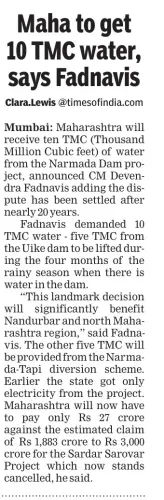
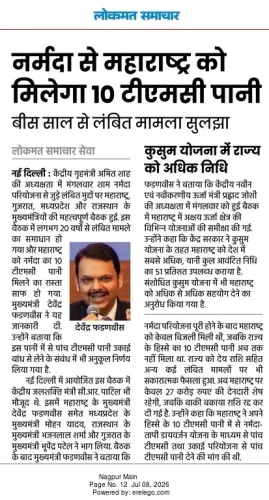
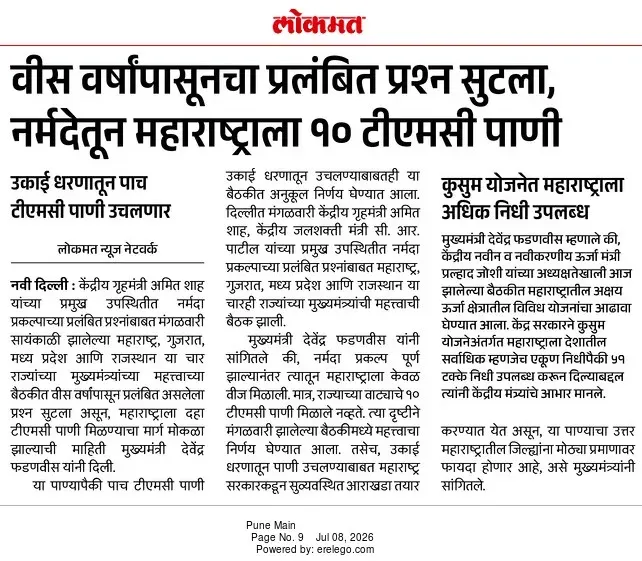
The Chief Minister's Office of Maharashtra announced on Wednesday, 8 July 2026 that a water-sharing dispute pending for over two decades has been resolved, securing 10 TMC (thousand million cubic feet) of Narmada river water for the state — a development attributed to Chief Minister Devendra Fadnavis.
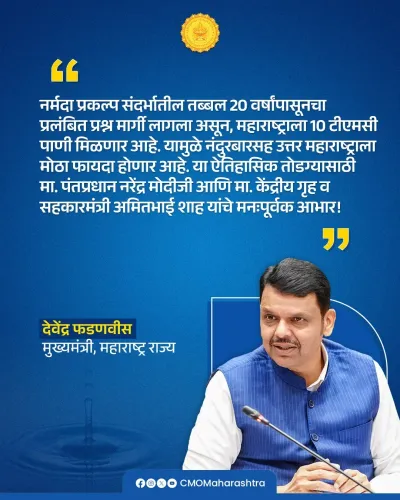
The post, shared by the official CMO Maharashtra handle as a reply, stated in Marathi: '20 वर्षांपासूनचा प्रलंबित प्रश्न सुटला, नर्मदेतून महाराष्ट्राला 10 टीएमसी पाणी' — meaning, 'A question pending for 20 years has been resolved; Maharashtra gets 10 TMC water from the Narmada.'
Context
The Narmada River, originating in Madhya Pradesh and flowing through Gujarat, has Maharashtra and Rajasthan as co-riparian states. The Narmada Water Disputes Tribunal, set up by the central government, delivered its final award in 1979, granting Maharashtra an entitlement of 9.5 TMC from the Narmada basin. Despite this legal allocation, actual operationalisation of Maharashtra's share remained stalled for years, requiring fresh political agreements between the concerned states.
Periodic reviews of Narmada water releases have been conducted under the Narmada Control Authority since the early 2000s, particularly to address seasonal water shortages in Maharashtra's northern districts. The announcement now claims a resolution to a dispute that had remained unresolved for roughly 20 years.
Policy Backdrop
Interstate river-water allocations in India have a long history of remaining partially unimplemented, often for decades after tribunal awards are issued. Maharashtra has repeatedly sought operationalisation of its Narmada share to supplement water supplies in the Tapi basin and north Maharashtra — regions that are frequently drought-prone.
The Sardar Sarovar Project, the major multipurpose dam on the Narmada, plays a central role in determining actual water deliveries to downstream states through its reservoir operations and canal systems. Comparable long-pending interstate water disputes exist in the Krishna, Godavari, and Mahadayi river basins, making this resolution, if fully operationalised, a significant precedent.
Stakeholders and Impact
The primary beneficiaries of this development would be farmers and communities in Maharashtra's water-stressed northern and Vidarbha districts, where dependence on erratic monsoon rainfall has long made agriculture precarious. An assured supply of 10 TMC of Narmada water could provide critical irrigation support and drinking water security to these regions.
The resolution is politically significant for Chief Minister Devendra Fadnavis, who has previously served multiple terms and overseen several infrastructure and water projects in the state. Securing a long-pending interstate water entitlement is a tangible administrative outcome that carries weight in Maharashtra's agrarian political landscape.
What's Next
The practical impact of this announcement will depend on the operationalisation of the additional 10 TMC through the Narmada Control Authority, as well as the construction or upgradation of canal linkages inside Maharashtra to actually deliver the water to end-users. Interstate water agreements in India typically require multi-agency coordination before physical delivery begins.
Observers will watch whether formal agreements with Madhya Pradesh and Gujarat are signed and whether the Narmada Control Authority schedules revised release calendars. The resolution, if sustained, could serve as a model for addressing similarly stalled interstate water claims across the country.
Point of View
Arriving at a time when water security has become a central electoral and governance issue across peninsular India. Crediting the resolution to Chief Minister Fadnavis signals a deliberate effort by the ruling dispensation to demonstrate administrative delivery on agrarian concerns ahead of the political calendar. However, the gap between a political announcement and the physical delivery of water through inter-state mechanisms and canal infrastructure is historically wide in India, and the true test will be whether the Narmada Control Authority formalises and schedules the revised allocations. This episode also underscores the broader pattern of tribunal awards remaining partially dormant for decades, raising questions about the adequacy of existing interstate water governance frameworks.
NationPress
8 Jul 2026
Frequently Asked Questions
What is the Narmada water dispute with Maharashtra about?
Maharashtra is a co-riparian state of the Narmada River and was awarded a share of its waters by the Narmada Water Disputes Tribunal in 1979. However, the actual operationalisation of this share remained pending for decades due to the need for fresh interstate agreements and canal infrastructure, making it a long-standing unresolved issue.
How much Narmada water will Maharashtra now get?
According to the announcement by the Chief Minister's Office of Maharashtra on 8 July 2026, the state is set to receive 10 TMC (thousand million cubic feet) of water from the Narmada River following the resolution of the dispute.
Which districts in Maharashtra will benefit from Narmada water?
The primary beneficiaries are expected to be farmers and communities in north Maharashtra and drought-prone districts that have long faced water scarcity, where the additional Narmada supply could support irrigation and drinking water needs.
What is the Narmada Control Authority?
The Narmada Control Authority is the central body responsible for overseeing the implementation of the Narmada Water Disputes Tribunal's award, including scheduling water releases from the Sardar Sarovar Project to the riparian states of Madhya Pradesh, Gujarat, Maharashtra, and Rajasthan.
What is the role of Devendra Fadnavis in the Narmada water resolution?
The Chief Minister's Office of Maharashtra credited Chief Minister Devendra Fadnavis with resolving the 20-year-old pending dispute that has now secured 10 TMC of Narmada water for the state.