CM Rekha Gupta Echoes Modi on Digital India's Decade of Change
Synopsis
Delhi CM Rekha Gupta amplified PM Modi's India Mobile Congress remarks on October 8, 2026, spotlighting how the Digital India campaign placed mobile phones at the centre of a decade-long effort to democratise technology and close India's digital divide through telecom reforms and infrastructure expansion.
Key Takeaways
Delhi CM Rekha Gupta shared PM Narendra Modi 's remarks from the India Mobile Congress on October 8, 2026 .
Modi described the digital divide as a major challenge a decade ago, with modern technology becoming an unaffordable privilege.
The Digital India campaign placed the mobile phone at the centre of technology democratisation.
Telecom sector reforms and infrastructure expansion were carried out as the structural foundation of the initiative.
The government frames Digital India as a social equity project, not merely a technology upgrade.
A decade ago, modern technology in India was a privilege reserved for those who could afford it — a digital divide that threatened to deepen inequality at scale. On Thursday, October 8, 2026, Delhi Chief Minister Rekha Gupta took to X to amplify Prime Minister Narendra Modi's words on how the Digital India mission fundamentally rewired that equation, sharing his remarks at the India Mobile Congress.
Modi's words at India Mobile Congress: the divide that once defined a nation
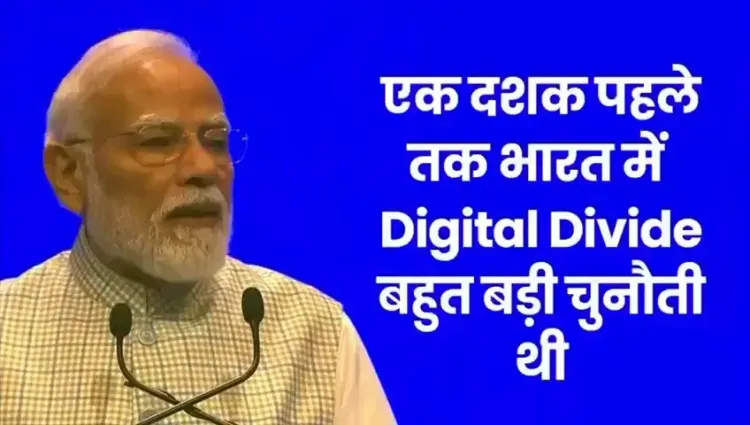
CM Gupta quoted the Prime Minister directly: 'एक दशक पहले तक भारत में digital divide बहुत बड़ी चुनौती थी' — 'Until a decade ago, the digital divide in India was a very large challenge.' Modi's framing was pointed: modern technology was becoming a privilege, accessible only to those with means. That, he said, was the trajectory India was locked into — until Digital India intervened.
The Prime Minister described placing the mobile phone at the centre of the democratisation effort as a deliberate, structural choice. It was not incidental. Telecom sector reforms were pushed through, and infrastructure was expanded — all engineered to make connectivity a right rather than a luxury.
Why the mobile phone was the pivot
Choosing the mobile phone as the vehicle for technology democratisation was a calculated bet. Landline infrastructure was sparse and expensive to build; mobile networks could leapfrog that gap. By driving down data costs, expanding tower networks, and pushing device affordability, the government's strategy reached rural households, small traders, and first-time internet users who would never have been served by traditional models.
Modi's phrase — 'technology ke democratization ka bahut bada prayas' (a very large effort at the democratisation of technology) — signals how the government frames Digital India: not as a tech upgrade, but as a social equity project delivered through telecom infrastructure.
India Mobile Congress as the annual scorecard
The India Mobile Congress, where these remarks were made, has become the flagship annual platform for India's telecom and digital ecosystem. It draws global industry players, policymakers, and startups — making it a high-visibility stage for the government to narrate the Digital India story and signal the next phase of ambition.
For CM Gupta, amplifying Modi's remarks on this platform is as much about Delhi's own digital governance push as it is about national policy — a city-state that has been ground zero for digital public services, from e-governance portals to last-mile connectivity drives.
If one decade turned a divide into a platform, the question India now faces is what it builds on top of it.
Point of View
Where Gupta's government faces pressure to deliver on urban digital governance, aligning with the national Digital India brand offers both policy cover and political capital. The mobile-first framing also pre-empts opposition critiques about elite-centric growth by centering the rural and the unbanked as the primary beneficiaries.
NationPress
8 Oct 2026
Frequently Asked Questions
What did PM Modi say at the India Mobile Congress 2026?
PM Modi stated that a decade ago India faced a severe digital divide where modern technology was becoming a privilege for the wealthy, and that the Digital India campaign deliberately placed the mobile phone at the centre of efforts to democratise technology through telecom reforms and infrastructure expansion.
What is the Digital India campaign?
Digital India is a flagship government initiative launched to transform India into a digitally empowered society and knowledge economy, with a focus on expanding internet access, digital infrastructure, and e-governance services across the country.
Why did Rekha Gupta share PM Modi's remarks on X?
Delhi CM Rekha Gupta shared PM Modi's remarks from the India Mobile Congress to amplify the Digital India narrative and associate Delhi's governance agenda with the national technology democratisation effort.
What is the India Mobile Congress?
The India Mobile Congress is India's largest annual telecom, media, and technology forum, serving as a key platform for government policy announcements, industry collaboration, and showcasing India's digital progress.
How did India address its digital divide?
India addressed its digital divide through the Digital India campaign by placing mobile phones at the centre of connectivity, carrying out telecom sector reforms, cutting data costs, and expanding network infrastructure to reach underserved populations.